
A deadly attack on San Diego’s largest mosque is being labeled a likely hate crime even as officials admit they still do not fully understand how two armed teenagers slipped through the cracks and murdered three men.
Story Snapshot
- Two teenage gunmen killed three men outside the Islamic Center of San Diego before dying of apparent self-inflicted gunshot wounds.
- Police and federal agents are investigating the shooting as a potential anti-Muslim hate crime while acknowledging the motive is not yet fully established.
- A security guard is being praised as a hero whose actions likely saved children and worshipers from additional harm.
- The attack is fueling broader anger that leaders talk tough after each tragedy but fail to confront rising polarization and targeted violence.
What Officials Say Happened At The Islamic Center
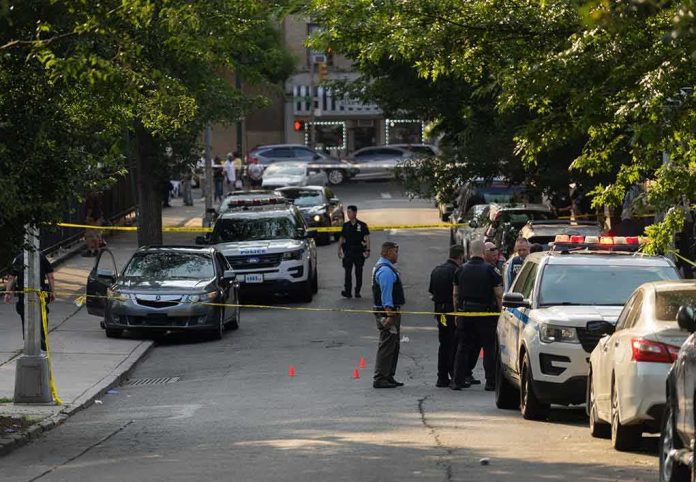
San Diego police say that late Monday morning two teenage males armed with firearms opened fire outside the Islamic Center of San Diego, the county’s largest mosque complex, killing a security guard and two other adult men before fleeing in a vehicle.[3] Officers responding within minutes to active shooter calls found three men dead near the center, while terrified parents and staff sheltered and evacuated children who attend a school on the grounds.[1][3] Authorities later located a vehicle nearby containing two deceased teenage suspects, ages seventeen and eighteen, who appeared to have died from self-inflicted gunshot wounds after firing again in a residential area.[1][3]
San Diego Police Chief Scott Wahl told reporters that based on early evidence, including where the shooting occurred and writings recovered by investigators, law enforcement and the Federal Bureau of Investigation (FBI) are treating the attack as a hate crime targeting Muslims, although the motive is still being pieced together.[1][3] Reporters citing law enforcement sources say anti-Islamic writings were found in the suspects’ vehicle, and officials confirm they are reviewing written materials and digital communications for signs of premeditated bias.[2][3] Prosecutors will ultimately have to decide whether the evidence meets the legal threshold for hate crime charges posthumously, which requires proof that hostility toward a protected group was a primary motive, not merely background rhetoric.[1][4]
Heroism, Rapid Response, And The Limits Of “We Neutralized The Threat”
Police officials and local media say the slain security guard confronted the shooters and likely diverted gunfire away from the school building and main prayer hall, allowing many people to escape.[2][3] The police chief stated that there is no ongoing threat to the public because both suspects are dead, and he emphasized that between fifty and one hundred officers surged to the scene within minutes, securing classrooms and escorting children to safety.[1][3] Parents who had to wait for word about their children’s status received assurances that every child at the mosque’s Bright Horizon Academy was accounted for, a small mercy on a day that otherwise reinforced how vulnerable houses of worship remain in a polarized country.[3]
Law enforcement leaders highlighted their rapid tactical response and interagency coordination, pointing out that there had been no specific, actionable threat warning about this mosque or other local religious centers before the shooting.[3] Officials described previous concerns about “generalized hate rhetoric” in the community and reports of a runaway teenager with access to multiple weapons and camouflage clothing, but they stressed that those signals did not rise to the level that would justify targeting a specific individual or location before any crime occurred.[3] That distinction matters legally, yet for many Americans watching repeated attacks on churches, synagogues, and mosques, assurances that authorities moved quickly after bullets started flying feel hollow compared with the failure to prevent another predictable act of violence.
Hate Crime Label, Political Rhetoric, And Public Distrust
Chief Wahl’s phrase that the shooting is being considered a hate crime “until it’s not” reflects how investigators now routinely talk after mass killings that appear tied to race or religion.[1][4] On one side, Muslim community leaders and civil rights advocates argue that rising “unprecedented” levels of anti-Islam hostility, both online and offline, create a climate where teenagers can marinate in hatred and then act on it, and they want government to confront that trend directly rather than dismissing it as random evil. On the other side, many conservatives worry that hate crime labels are sometimes used selectively or politically, while officials ignore violence and intimidation directed at other groups or viewpoints, reinforcing a sense of double standards and eroding trust.
Both reactions sit on top of a deeper, shared frustration: ordinary Americans sense that the system talks endlessly about unity and safety but rarely addresses root causes such as family breakdown, untreated mental illness, online radicalization, and the ease with which angry young men obtain powerful weapons. Each new press conference after tragedy features the same script—somber statements, promises of thorough investigations, vows that “hate has no home here”—while neighborhoods absorb the reality that a handful of disturbed people can still upend hundreds of lives in minutes.[2] In this San Diego case, officials again promise that they will support the Islamic Center community and harden security, but neither conservatives nor liberals see much evidence that Washington’s bureaucracy or local authorities are seriously reducing the likelihood of the next attack.
Why This Shooting Fits A Troubling National Pattern
Researchers who study mass shootings note that determining motive is often slow and murky, especially when suspects are dead and their writings are angry but incoherent, which makes early official statements about hate crimes provisional by necessity.[1][4] Yet the pattern is depressingly consistent: emotionally unstable young men, exposed to ideological extremism and convinced that some group is the enemy, decide to make themselves famous for a day by attacking a symbolic target such as a school, church, synagogue, or mosque.[1] Political leaders from both parties then point fingers—at guns, at rhetoric, at mental health, at social media—while neglecting long-term reforms that would demand real courage, such as confronting online platforms, rethinking juvenile intervention and supervision, or reining in a justice system that often seems reactive rather than preventative.
The San Diego mosque shooting underscores how fragile basic freedoms of worship and assembly have become in a culture defined by grievance and polarization. For Americans across the spectrum—Christians, Jews, Muslims, secular families—the message is chilling: you can follow the rules, raise your kids, attend services, and still be at the mercy of teenagers steeped in hatred that older generations allowed to fester. As investigators sift through evidence and politicians issue statements, the deeper question remains whether a distant political and bureaucratic class that many view as self-protective and insulated is capable of rebuilding enough trust, competence, and moral clarity to keep people safe while preserving the principles on which the country was built.
Sources:
[1] Web – San Diego shooting: 5 dead in mosque attack; anti-Islam … – LA Times
[2] Web – Suspects killed in Islamic Center of San Diego shooting | KTVU FOX 2
[3] Web – Mayor Bass Releases Statement on Deadly Attack at Islamic Center …
[4] YouTube – Mayor, Imam speak at press conference with Police, FBI