

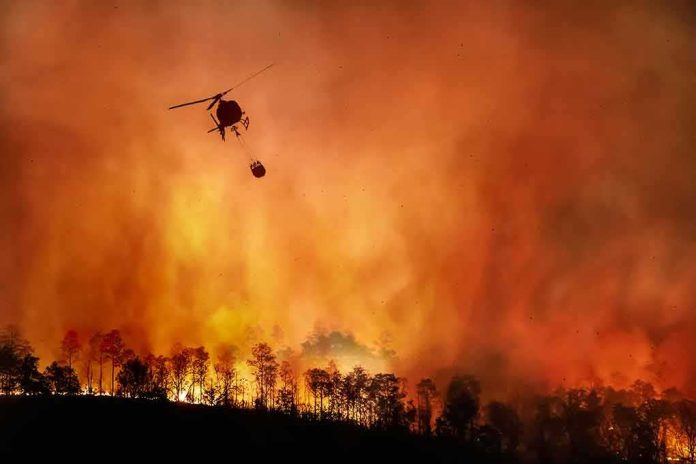
As the Old Trails Fire roared into Spokane neighborhoods, thousands watched power go out, homes burn, and even a veterans’ hospital empty—while wondering why “extreme fire weather” warnings did little to protect them.
Story Snapshot
- Level 3 “Go Now” evacuations swept across northwest Spokane as the Old Trails Fire jumped the Spokane River and pushed into residential areas.
- Officials say extreme winds and a rare “particularly dangerous situation” fire warning helped drive the blaze from a brush fire near Airway Heights to more than 3,500 acres in hours.
- Critical infrastructure, including a Department of Veterans Affairs hospital and city water facilities, was evacuated, highlighting how fragile local systems are in a major crisis.
- Early reports show hundreds of structures destroyed and tens of thousands without power, raising fresh questions about whether leaders are really prepared to protect ordinary families.
How A Brush Fire Became A Citywide Emergency
The Old Trails Fire started around midday near Airway Heights, west of Spokane, burning through brush and grass in open land. Strong winds and very low humidity quickly turned it from a local brush fire into a fast-moving wall of flames heading toward neighborhoods. Within hours, the fire grew from tens or hundreds of acres to roughly 2,500–3,500 acres, according to state officials and later tallies. That is about five square miles of land, much of it close to homes and city infrastructure.
As the afternoon went on, flames jumped the Spokane River and moved into northwest Spokane, pushing straight toward residential streets and parks. Video and photos showed thick smoke over the city and gridlocked traffic as people tried to escape. Washington State’s forester said the fire was threatening about 4,000 structures, meaning thousands of families suddenly faced the risk of losing everything they had built. With zero containment reported in the early hours, fire crews were racing simply to keep up with the spread.
Evacuation Orders And A City On The Move
Local emergency management issued Level 3 “Go Now” orders, the highest evacuation alert, for large parts of northwest Spokane and nearby areas. These zones ran between major roads like Rutter Parkway and Francis Avenue and covered neighborhoods from the river toward Division Street. Residents were told to leave immediately and not drive into the evacuation zone unless they were escaping, to keep roads clear for fire trucks and ambulances. Shelters opened at Spokane Falls Community College and other sites to handle the sudden wave of evacuees.
Cars lined highways and neighborhood streets as families grabbed what they could and fled. Some people watched live coverage of flames from evacuation centers, trying to guess whether their blocks would still be standing by morning. Social media showed scenes of panic, but also neighbors helping pack cars and load pets. Officials later said that about 200 homes had been ordered evacuated early in the event and expected that number to rise sharply as boundaries expanded. The fast changes in evacuation maps and messages made it hard for many people to know exactly when to leave and where to go.
Extreme Fire Weather And A System Under Strain
The National Weather Service had already warned that eastern Washington faced a Red Flag day with strong southwest winds between 20 and 30 miles per hour and gusts up to 50 miles per hour. Forecasters even issued a “particularly dangerous situation” Red Flag Warning, something they rarely use, to highlight how explosive any fire could become. Gusts of 35 to 45 miles per hour and very dry air gave the Old Trails Fire near-perfect conditions to race across land and jump natural barriers like rivers and roads. Those same winds pushed smoke into the city and made air dangerous to breathe for thousands.
More than a dozen wildfires are burning across Washington State, with the largest—the Old Trails Fire near Spokane—rapidly growing to about 2,500 acres due to strong winds and extreme heat.
Mandatory evacuations were ordered for parts of Spokane County, including a hospital,… https://t.co/qff2fZXa21 pic.twitter.com/Bd7vJm4eCo
— Adam Scott (@chefcascottccc) August 2, 2026
As flames neared key facilities, leaders ordered evacuations of major infrastructure, including water treatment and waste-energy plants and the Mann-Grandstaff Department of Veterans Affairs Medical Center. Patients and staff at the veterans’ hospital were moved to other locations as a precaution. Utility company Avista reported that about 60,000 people had lost power, many in Spokane, as high-voltage lines and substations were either damaged or shut off to prevent further fire risk. Later information showed roughly 40,000 people without power in the city, and hundreds of structures destroyed, mostly inside Spokane itself.
Shared Frustration: Are Leaders Really Prepared For Crisis?
Residents across the political spectrum see this fire as another sign that government talks more about risk than about real readiness. State and federal leaders knew extreme fire weather was coming, yet everyday families still ended up racing through gridlock while smoke and embers rained down on their streets. Many conservatives worry that money goes to distant “green” plans or global projects instead of hardening power lines, clearing fuels near cities, and backing local fire crews. Many liberals look at the same scenes and see a system that leaves working families and vulnerable patients exposed while large institutions and elites find ways to protect themselves first.
In Spokane, ordinary people saw a complex emergency unfold in real time—warnings that sounded technical, evacuation maps that shifted by the hour, and official numbers that changed as media outlets rushed to post updates. Some reports said 500 acres, others 2,000 or 2,500, then Wikipedia and social posts cited more than 3,500 acres and hundreds of destroyed buildings before full damage checks were complete. That confusion is common in fast disasters, but it also feeds the feeling that the system is not straight with citizens. When the fire is out and the smoke clears, many in Spokane and across the country will ask the same question: if leaders can see danger coming days in advance, why does it still look like every family is on its own when flames reach the edge of town?
Sources:
thegatewaypundit.com, khq.com, cnn.com, youtube.com, rollingout.com, krem.com, hindustantimes.com, allfirefighter.com, facebook.com, sfchronicle.com, nytimes.com, instagram.com, kesq.com, woodlandfirefighter.com