

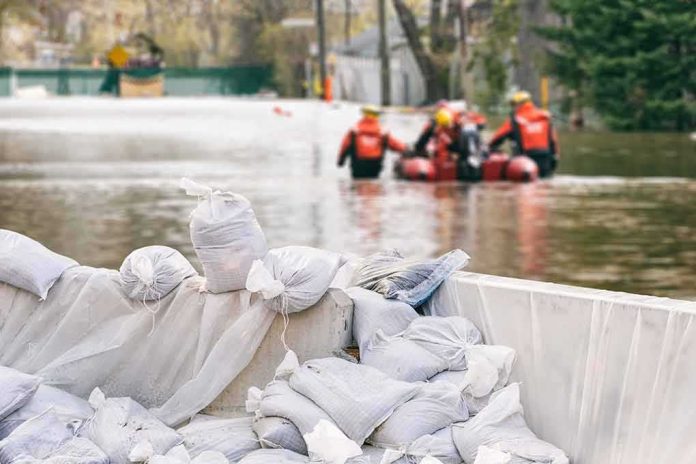
As rescuers dig through mud and rubble in remote eastern Afghanistan, officials admit they still do not know how many families have been swept away by the latest flash floods.
Story Snapshot
- At least 23 people are confirmed dead after flash floods hit Nuristan province.
- Afghan authorities say over 100 people are still missing, with the toll likely to rise.
- Parun, the provincial capital, was hit hard, with homes destroyed and its mayor among the missing.
- The disaster highlights chronic underreporting and weak state response to climate‑driven floods in Afghanistan.
Flash floods slam remote Nuristan, leaving dozens dead and missing
Afghanistan’s National Disaster Management Authority says sudden flash floods in the eastern province of Nuristan have killed at least 23 people and injured around 80 more after heavy rain on Monday. The water tore through Parun, the mountain capital of Nuristan, and nearby villages, collapsing homes and burying families in mud and debris. Officials report that more than 100 people are still missing, and they warn that the death toll will likely rise as search teams reach cut-off areas.
Local reports describe entire sections of Parun washed out overnight, with roads, small shops, and simple mud-brick houses destroyed in minutes. Survivors told reporters they had almost no warning before floodwaters roared down narrow valleys, a pattern seen often in Afghanistan’s steep terrain. Rescue crews and villagers are now digging by hand and using basic tools, because modern equipment is scarce and many roads are blocked, slowing the race to find trapped people.
Conflicting death counts and a pattern of missing data
Different outlets are already reporting different casualty figures from the same event, with some early reports citing 20 deaths and others 23, even as the number of missing people stays above 100. This confusion fits a wider pattern in Afghanistan, where official Taliban-run agencies often give lower death counts than United Nations bodies and aid groups for major floods. In a 2024 flood wave, the United Nations later confirmed more than 200 deaths across several provinces, far above the numbers first released by authorities in Kabul.
Humanitarian analyses note that Afghanistan’s flood data is often incomplete because many remote districts lack phones, internet, and reliable local government, so early numbers almost always miss people in isolated valleys. Aid agencies say this poor information flow makes it harder to plan rescue and relief, and it leaves families in damaged areas waiting longer for help. When the world only hears the lower official figures, the true scale of rural suffering can stay hidden, feeding the feeling that distant leaders and global institutions do not fully see or value these communities.
Why Afghanistan keeps getting hit by deadly floods
Scientists studying Afghanistan’s climate say eastern and northeastern regions, including Nuristan, face some of the highest flood risks because steep mountains and narrow river basins funnel heavy rain into fast, destructive runoff. Recent research links more intense downpours to climate change and El Niño, with unusual rain events triggering flash floods, mudslides, and landslides in most of the country’s provinces since 2024. With forests cut down by war and poverty, bare slopes cannot absorb water, so more of it crashes downhill into villages.
United Nations reports show that in just one 2024 flood episode, at least 225 people died and more than 119,000 were affected nationwide, as homes, roads, and fields were washed away. These disasters strike some of the poorest families in the world, many already struggling with hunger, job loss, and the collapse of basic services after decades of conflict. When flash floods crush simple houses and wipe out small farms, they erase years of hard work, pushing entire communities deeper into poverty and forcing more people to depend on international aid.
Weak state response, sanctions, and the sense of a distant global elite
Since the Taliban takeover, Afghanistan’s disaster agencies have operated with limited money, little modern gear, and few trained staff, even as flood risks climb. International sanctions and political isolation have slowed outside help and blocked many normal channels for funding and expertise, making it harder to build warning systems, strong bridges, and safe housing. For families watching loved ones die in yet another flood, it can look like both their own rulers and foreign powers are trapped in politics while ordinary people drown.
Flash floods have claimed lives and caused severe damage in eastern #Afghanistan, especially in Parun, Nuristan. Our thoughts are with bereaved families.@UNICEFAfg and partners are on the ground, setting up a field clinic to provide trauma care and emergency medical services. pic.twitter.com/558Ua2YS6z
— UNICEF Afghanistan (@UNICEFAfg) July 21, 2026
People across the political spectrum in the United States often feel that global institutions talk about climate and human rights but fail to protect the most vulnerable, whether in Afghanistan or at home. Stories like Nuristan’s disaster can deepen that mistrust, because the pattern is familiar: warnings ignored, weak infrastructure, slow rescue, and poor data that hides the full human cost. As more extreme weather hits fragile states, the gap between high-level promises and on-the-ground reality will likely keep fueling anger at distant elites and broken systems.
Sources:
youtube.com, reliefweb.int, en.wikipedia.org, bbc.com, jpost.com, facebook.com, reuters.com, egusphere.copernicus.org, lossanddamagecollaboration.org, afghanistan.iom.int, unocha.org