

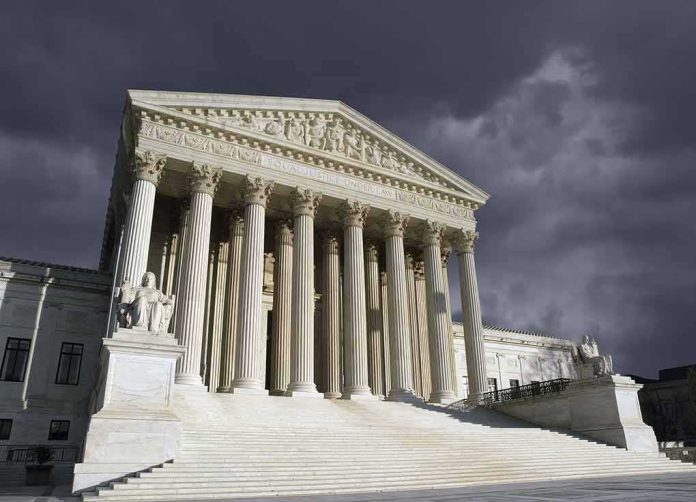
The Supreme Court ruled that New Hampshire voters cannot use student IDs to get a ballot on November 3, because federal courts should not rewrite election rules this close to Election Day.
Story Snapshot
- On Thursday, October 22, the Supreme Court paused a lower court’s order, letting New Hampshire fully enforce its student-ID voting rules for the midterm election.
- State lawmakers passed House Bill 323 in April, and it took effect in June. It removed student IDs from the list of IDs that count for getting a ballot.
- The justices leaned on the “Purcell principle,” which says federal courts should not change election rules right before an election.
- Justice Ketanji Brown Jackson was the lone dissenter. The order does not decide whether the law is constitutional, so the court fight goes on.
- The Republican National Committee backed the state’s emergency appeal, while the Coalition for Open Democracy says the rule unfairly hurts young voters.
- Justice Jackson wrote that the judge’s order was “reasonably designed to address alleged misinformation, not to change the law,” a charge aimed at the state’s own election guidance.
Supreme Court Steps In Before Midterms
The Supreme Court issued a one-paragraph, unsigned order in Scanlan v. Coalition for Open Democracy. It put on hold a ruling by U.S. District Judge Joseph Laplante, a federal judge in New Hampshire. That ruling had blocked part of the state’s student-ID rules. The hold lasts while the state’s appeal moves through the courts, so the full rules apply on Election Day, less than two weeks away.
The Court pointed to the Purcell principle. It comes from a 2006 case and tells federal judges not to change how elections are run right before voters head to the polls, because late changes can confuse voters and poll workers. The order quoted an earlier decision saying lower federal courts “should ordinarily not alter the election rules on the eve of an election.” It said the lower court “did not point to anything that would justify deviating” from that rule.
New Hampshire Lawmakers Tightened ID Rules This Year
Republican Gov. Kelly Ayotte signed House Bill 323 after lawmakers passed it in April. The law took high school and college IDs off the list of IDs that count for getting a ballot. Republican lawmakers argued that school IDs are less secure than a driver’s license or other ID issued by the government. Voters can still use a driver’s license from any state, a passport or a military ID.
The court fight was over a “safety valve.” That is a backup process that lets election officials weigh other proof of who a voter is when he has no accepted photo ID. Judge Laplante ruled on October 2 that officials could still weigh a student ID that way, along with other documents. Secretary of State David Scanlan, the state’s top election official, had told officials in April not to. The Supreme Court’s order puts Scanlan’s guidance back in force for this election.
Legal Fight Far From Over
New Hampshire Attorney General John Formella, the state’s top lawyer, called the order “an important victory.” He said the state “has a responsibility to protect the integrity of its elections” and must make sure “election laws are applied as written.” The order keeps the rules in place while the case goes on. It does not settle whether the law is constitutional. That fight continues in the federal appeals court.
Justice Jackson was the only justice to publicly dissent. She wrote that the judge “issued a targeted order” that was “reasonably designed to address alleged misinformation, not to change the law.” In her view, the lower court left the state’s election rules untouched and only corrected a misstatement of what the law requires.
Democrats and Activists Cry Foul
The Coalition for Open Democracy, a New Hampshire voting rights group, brought the lawsuit. It argues the law unfairly burdens younger voters, who are less likely to carry other forms of ID. Opponents also said there is no evidence that school IDs are more likely to be used for fraud. Bryan Sells, a lawyer for the coalition, said the order is “authorizing an unconstitutional policy that will deprive young voters of their right to vote.” He said blocking an order that had been in place for almost three weeks added confusion, the very thing Purcell is meant to prevent.
The state saw it the other way. Scanlan told the Court his office had spent months on voting guides, posters, radio ads and public talks, and that undoing that work weeks before the vote risked confusion. A stated security reason for using government ID is a policy choice made by elected lawmakers and signed by a governor. That is how election laws are supposed to change, not through a last-minute court order.
On Friday, October 23, local election officials said it is rare for a student to show up to register or ask for a ballot with only a student ID, so the change may touch few voters. Groups like VoteRiders, which helps people get the ID they need to vote, are helping students gather the papers to apply for a state ID before Election Day.
Sources:
cbsnews.com, scotusblog.com, nhpr.org, courthousenews.com, indepthnh.org, nhpr.org, npr.org, law.cornell.edu