
German prosecutors say a trained Ukrainian diver was arrested in Croatia on a European warrant for planting Nord Stream explosives, reviving a case that strikes at Europe’s energy security and public trust.
Story Snapshot
- German prosecutors announced the arrest of “Vladimir Z.” in Pula, Croatia, on a European warrant.
- Authorities allege he helped plant explosives on Nord Stream pipelines near Bornholm in 2022.
- The charges include causing explosions and anti-constitutional sabotage under German law.
- Public evidence behind the warrant remains sealed; the suspect denies involvement in media reports.
Arrest In Croatia On A European Warrant
German federal prosecutors stated that Croatian police detained a Ukrainian national, identified as “Vladimir Z.,” in Pula. They said the arrest executed a European arrest warrant issued by the Federal Court of Justice on June 3, 2024. Reuters and other outlets also reported the detention and said Germany seeks extradition. The move marks a second arrest linked to the 2022 pipeline blasts and advances a cross-border case that mixes criminal law and high politics.
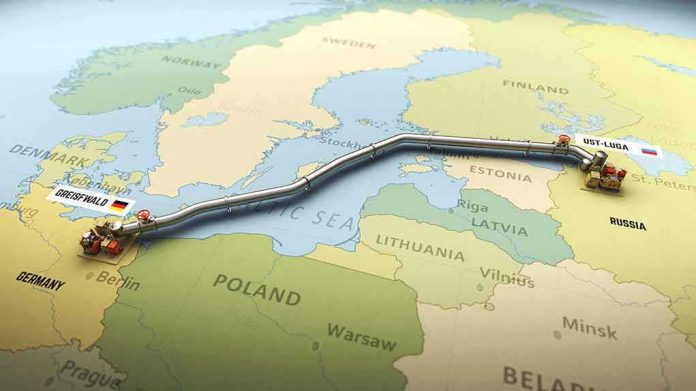
Prosecutors allege the suspect is a trained scuba diver who took part in placing charges on Nord Stream 1 and Nord Stream 2 near Denmark’s Bornholm island in September 2022. The official statement frames the legal basis as multiple serious offenses, including jointly causing explosions, anti-constitutional sabotage, and destruction of infrastructure. These are allegations at the charging stage. The office has not released the underlying exhibits or forensic proof that would tie the suspect to the scene.
Another Ukrainian man suspected of bombing the Nord Stream gas pipelines has been arrested in Pula, Croatia, Reuters reports. The man was detained by local police on the basis of a European arrest warrant. The federal prosecutor refers to the detained Ukrainian man as Vladimir Z. pic.twitter.com/aLjtoizoZU
— Kenraalikunta (@Kenraalikunta) August 19, 2026
What Is Known And What Remains Sealed
The public record shows a clear timeline of warrants and arrests, but not the evidence behind them. The German prosecutor’s press material identifies the suspect, the alleged role, and the charges. It does not publish the case file, witness statements, or forensic lab results. Media summaries track the prosecutor’s account and note a rented yacht and skilled divers, but say there is no public proof linking any government to the blasts at this stage. That information gap drives debate across Europe.
Earlier reporting showed procedural snags before this arrest. In 2024, Polish prosecutors said the suspect had left Poland after Germany issued a warrant, raising questions about coordination. German and international outlets have since noted repeated denials by the suspect and a woman contacted in the case. In a later interview, the suspect was quoted saying he did not blow up Nord Stream and committed no crime in Germany. These denials exist, but they have not been tested in a courtroom yet.
Why This Case Resonates Beyond The Baltic Sea
The Nord Stream strikes cut key gas lines that once fed Europe. That shock hit energy prices, supply plans, and political narratives about who benefits and who pays. For many readers, this case blends national security with daily costs, like heating and power. It also feeds a wider concern: big cases often move on opaque files, while the public is asked to trust institutions that have stumbled before. That tension is on display here, again.
Cross-border arrests inside the European Union follow the European arrest warrant system. That process rests on mutual trust between courts and is designed to move faster than classic extradition. It helps pursue suspects who cross borders, but it also shifts much of the record behind closed legal channels until trial. In such cases, prosecutors lead with summaries. Courts weigh evidence later. The arrest in Croatia is a procedural step, not a verdict on who planted the bombs.
How To Read The Claims And The Denials
German prosecutors have put forward a direct operational claim: a trained diver helped place explosives on the pipelines. That is stronger than a loose association. It also carries serious criminal counts under German law. At the same time, the suspect has denied involvement in comments reported by major outlets, and Ukraine’s government has denied any role in the blasts. Both strands can be true at once at this stage: a firm accusation and a firm denial, with proof still sealed.
For citizens on the left and the right, the shared worry is familiar. Major cases that shape energy costs, foreign policy, and public safety unfold in the dark. Officials urge patience. Media repeat official lines. Years pass before a court settles facts. This arrest matters because it could finally pull evidence into the open. Watch the extradition filings in Croatia and Germany. They may be the first place where the strongest proof appears in black and white.
Sources:
insiderpaper.com, bbc.com, bloomberg.com, unn.ua, semissourian.com, dw.com, lemonde.fr, reuters.com, politico.eu, noticias.foxnews.com