
A naked man’s 278-foot leap from the Brooklyn Bridge into the East River has Americans asking how someone can survive a fall that should have killed him — and what it says about a system that reacts to crisis but rarely prevents it.
Story Snapshot
- A 44-year-old man, identified as Galymzhan Abaildayev, stripped naked, jumped from the Brooklyn Bridge’s north tower, and survived.
- New York police say he attached flags to the bridge, jumped into the East River, and was rescued by the Harbor Unit, then taken to Bellevue Hospital in stable condition.
- He now faces charges including reckless endangerment, making graffiti, public lewdness, criminal trespass, and disorderly conduct.
- The dramatic incident highlights growing concern that America responds to visible emergencies but ignores deeper mental-health and social stress building under the surface.
A shocking leap from an iconic American bridge
On a Sunday afternoon in New York City, police say 44-year-old Galymzhan Abaildayev climbed the north tower of the Brooklyn Bridge on the Manhattan side around 2:30 p.m. Authorities and news outlets report that after reaching the top, he removed his clothes, attached several flags, and then jumped from the tower into the East River below. Witness video shows him holding an item over his head, described as a “makeshift parachute,” as he falls toward the water. The scene unfolded in broad daylight, in front of stunned onlookers on one of America’s most famous landmarks.
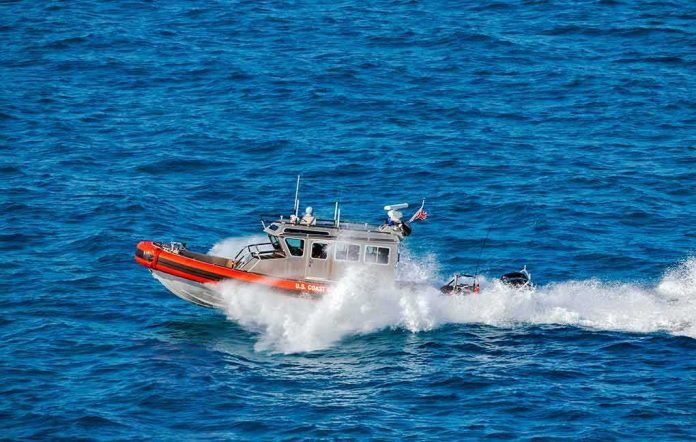
Police sources and multiple reports say officers from the New York Police Department’s Emergency Service Unit tried to talk Abaildayev down before he jumped. After his leap, members of the Harbor Unit quickly moved in, pulled him from the East River, and brought him to shore. He was transported to NYC Health + Hospitals Bellevue, where medical staff listed his condition as stable. Despite the fall being described as roughly 278 feet—an “overwhelmingly fatal” height according to one trauma expert—Abaildayev avoided immediate death and major visible injury, a result doctors say depended on his body position, impact angle, and rapid medical care.
From miracle survival to a list of criminal charges
The survival itself grabbed the headlines, but what happened next followed a familiar pattern: a dramatic emergency quickly turned into a criminal case. According to New York police, Abaildayev now faces charges of reckless endangerment, making graffiti, public lewdness, criminal trespass, and disorderly conduct. These charges reflect several concerns at once—risk to his own life, danger to people and boats below, defacing public property with flags or markings, and disruption on vital city infrastructure. He was arrested after the incident, and as of the latest reports, there is no clear public information on his legal defense or whether he has an attorney.
Media coverage points to him as an activist critical of the government of Kazakhstan, with one outlet reporting that a roommate claimed he planned the leap for his birthday. Still, authorities have not released an official motive. The flags attached to the bridge were reported as linked to Kazakhstan, but police have not publicly explained any messages written on them. That leaves the deeper “why” of the incident unsettled. For many Americans watching, it adds to a broader feeling that institutions focus quickly on punishment while offering little clarity—or help—around the desperation or protest that might lead someone to risk death in such a public way.
What this says about risk, mental health, and a strained system
Experts quoted in coverage stress how close this event came to being another fatal story. Falls from heights like Brooklyn Bridge towers are usually deadly, and even survivors can face severe brain, spine, or internal injuries. Here, a mix of factors—the way Abaildayev entered the water, the speed of rescue by the Harbor Unit, and rapid transport to trauma care—turned what should have been a tragedy into a “miracle” survival. Yet the same reports hint he was sent for psychiatric evaluation, underscoring a painful reality: many people reach crisis points before the system engages, and that engagement often comes only after a highly public, dangerous act.
The surprising reason why Brooklyn Bridge jumper may have survived 'overwhelmingly fatal' plunge https://t.co/Ijov8SnQbd
— Churlish Insubordinate (@sparklecopy) August 4, 2026
For conservatives and liberals alike, this incident lands in a wider story they already recognize. The bridge is old, the city is crowded, and police units now spend hours talking people down from ledges or pulling them from rivers, while underlying mental-health care, community support, and economic stress go largely unaddressed. People on the right see another example of chaos in a city they feel has been mismanaged for years. People on the left see a troubled activist whose extreme act points to deep frustration and inequality. Both sides see a government that reacts to emergencies but struggles to prevent them, even as money flows to bureaucracy and political fights instead of basic services.
Why this one jump feels bigger than one man
Brooklyn Bridge has long been a symbol of American ambition, linking Manhattan and Brooklyn and appearing in movies, books, and postcards. It is also, as police have noted over the years, a place where a small but steady number of people try to end their lives or make dramatic public statements. Abaildayev’s naked leap, flags and all, plugs straight into that history—but in today’s climate, it also reflects growing tension between citizens and a government many now see as distant, elite, and slow to care until something becomes a spectacle. Video of the jump ricocheted across social media in minutes, while detailed official records have yet to be widely shared.
That gap matters. When the public mostly sees viral clips and tabloid labels like “naked nutjob,” it becomes easier to dismiss the person and harder to ask hard questions about stress, alienation, or protest. At the same time, people rightly worry about public safety and the strain on police who must handle crisis after crisis from bridges to subways. This one man’s survival from a near-certain death fall is a story about physics and luck, but it is also a warning light on a national dashboard already flashing: systems that only respond at the edge are not working as they should. Americans across the spectrum feel that truth, even when they disagree on everything else.
Sources:
ndtv.com, nbcnews.com, yahoo.com, tmz.com, instagram.com, nypost.com, x.com, facebook.com