

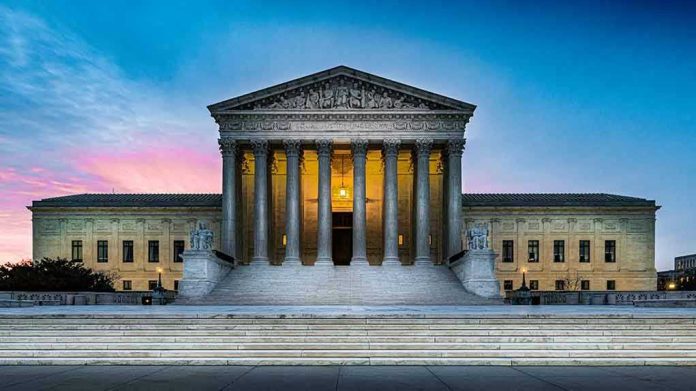
With the Supreme Court now blessing state bans on trans athletes in girls’ sports, the remaining states that still allow them are under growing political and cultural pressure to fall in line.
Story Snapshot
- The Supreme Court said states may legally bar transgender girls and women from female school sports teams.
- The ruling affects at least 25–27 states with bans and leaves the rest to decide their own policies.
- States that still allow trans athletes now face intense pressure from both activists and politicians to change course.
- The decision highlights deep gaps in data and science, even as it escalates America’s wider culture war over gender.
What The Supreme Court Actually Decided
On June 30, 2026, the United States Supreme Court upheld laws in West Virginia and Idaho that bar transgender girls and women from playing on female school and college sports teams. Justice Brett Kavanaugh wrote that states may separate teams by biological sex at birth to protect fair competition and safety for female athletes under the Equal Protection Clause and Title IX, the main federal law on sex discrimination in education. The Court said these bans are allowed but did not order every state to adopt them.
This ruling immediately strengthened existing bans in other states with similar laws. Media reports and legal maps show that 27 states now restrict transgender students from playing on teams that match their gender identity, with about half of transgender teens living under such bans. At the same time, 21 states plus several territories still allow or protect participation based on gender identity. Those more permissive states now sit in the national spotlight, knowing the Court has given lawmakers legal cover if they choose to tighten the rules.
Pressure Mounts On States That Still Allow Trans Athletes
States that continue to allow transgender girls to compete with other girls are now under heavy pressure from both sides of the political aisle, though for different reasons. Republican leaders, including House Speaker Mike Johnson and state officials in West Virginia, quickly praised the ruling as “common sense” and a “big win for female athletes,” and some are already calling for a national law that would lock in sex-at-birth rules across the country. That public push sends a clear message to governors and legislatures in more liberal or divided states: the legal green light is on if they want to move toward bans.
At the same time, civil rights groups and transgender advocates see the ruling as a major setback and are rallying to defend the remaining inclusive policies. Organizations such as the American Civil Liberties Union describe the decision as “devastating for transgender youth” and warn that more bans will deepen mental health struggles and isolation. Some Democratic officials argue that, even if bans are lawful, they still conflict with the spirit of equal protection and the original promise of Title IX to open doors in education for all. This creates a tense environment for officials in states that still allow trans athletes, who now face intense lobbying from national groups on both the left and the right.
Fairness, Safety, And The Missing Evidence
The Court’s majority leaned heavily on the idea that there are “inherent physical differences between the sexes” that justify separating sports by biological sex to protect fairness and reduce injury risk. Many Americans across the political spectrum share worries about stronger, faster male bodies competing in girls’ sports, especially in contact events. Yet the opinion did not cite specific studies or detailed data on how often transgender athletes compete, how they perform, or whether they increase injury rates. The two lawsuits involved only a high school runner in West Virginia and a college athlete in Idaho, not a broad national sample.
Scientific research so far offers a more mixed picture than the political talking points suggest. A review from the Williams Institute notes that existing data do not show a clear, categorical athletic advantage for transgender women compared with cisgender women once hormone treatment is in place, though the evidence is limited. Another medical review found that many sports policies that exclude transgender athletes are not based on strong, direct evidence and urged caution until better data exist. Justice Sonia Sotomayor’s dissent stressed that the Court went “farther than needed” without fully examining how hormone therapy affects strength and speed in real-world competition. For states that still allow trans athletes, these gaps in knowledge may be a key reason to hold the line or demand better research before changing course.
Culture War Politics And A Deepening Distrust Of Government
The fight over transgender participation in girls’ sports has become a symbol of larger culture battles that many Americans feel are tearing the country apart. Since 2020, mostly Republican-led states have rapidly passed bans that define sex strictly by reproductive biology and genetics at birth for sports purposes. Supporters say they are protecting decades of progress for female athletes under Title IX. Opponents say politicians are using a tiny number of youth athletes as a wedge issue to score points and distract from bigger failures on jobs, health care, and the cost of living.
Today, the Supreme Court upheld West Virginia and Idaho state laws that bar transgender athletes from playing on girls’ and women’s sports teams, a decision with nationwide implications.
27 states have enacted restrictions on trans athletes competing within their borders. States…
— (((Orchid)))🌻 (@OrchidNYC) June 30, 2026
For older conservatives, this ruling fits into a pattern: push back against “woke” gender policies, global elites, and rules they believe ignore basic biology. For older liberals, it looks like another step in an “America First” agenda that cuts support for vulnerable groups and widens the gap between the powerful and everyone else. Both groups increasingly share one core frustration: they do not trust that Washington or state capitals are focused on solving real problems rather than fueling headline battles. When the Supreme Court hands so much power to states while leaving major factual questions unresolved, it can feel like yet another sign that ordinary families and kids are caught in the crossfire of a political game they did not choose to play.
Sources:
washingtontimes.com, npr.org, nbcnews.com, bbc.com, espn.com, youtube.com, foxnews.com, bestcolleges.com, nytimes.com