

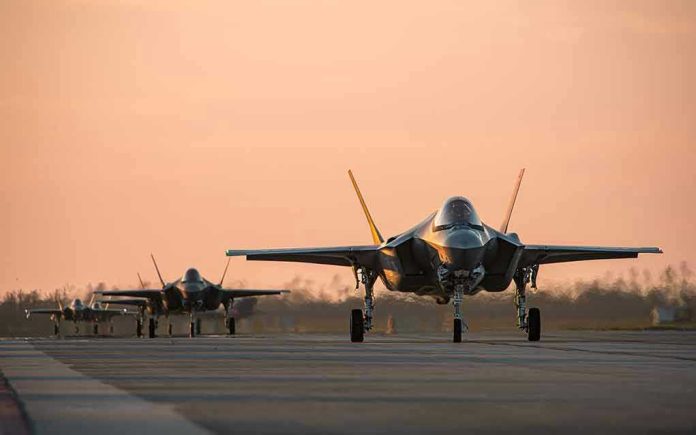
China is building J-20 stealth fighters faster than it can field seasoned pilots to fly them, and both trends are speeding up at once.
Story Snapshot
- Pilot training in China was four years and is now moving to three, with full modernization aimed by 2030.
- Reports say J-20 output surged, pressing China to accelerate training for fifth-generation missions.
- Analysts say China’s academies were consolidated and new transition units stand up inside schools.
- Public data on qualified J-20 pilots versus jets remains scarce, leaving readiness unclear.
What Changed Inside China’s Pilot Pipeline
Air University’s China Aerospace Studies Institute reported that the People’s Liberation Army Air Force cut a year from fighter pilot training by replacing an older program and shifting more steps into flight academies. The study says China’s system historically ran about four years, roughly double the United States Air Force’s two-year path. The modernization push aims to finish around 2030, with new training units at Xi’an and Harbin flight academies easing the load on combat brigades.
Sourcing from the same research shows China consolidated six pilot academies to three over the last decade, using the Hongdu JL-10 trainer to speed up early phases. That move cuts time and standardizes skills before pilots reach operational units. The net effect is a shorter funnel and a more central plan. But a faster pipeline does not instantly create veteran aviators with complex combat experience, which takes years of flying and constant practice.
The J-20 Production Surge and Mission Creep
Military Watch Magazine, citing the book “J-20 Mighty Dragon,” describes a major ramp in J-20 output and broader missions beyond air-to-air roles. The outlet frames this surge as pushing the People’s Liberation Army Air Force to train more pilots, faster, to keep pace with the fleet. It also claims Chinese fighter pilots are logging high training hours, at times more than American peers, partly due to United States aircraft availability problems, a point that remains debated among experts.
The United States Naval Institute reported in early 2026 that China revealed a J-20 variant aimed at striking maritime targets. That suggests planners expect these jets to perform complex missions in crowded zones like the Western Pacific. Multi-role tasks raise the bar for pilot skill, coordination, and decision speed. More jets and more mission types mean the training enterprise must scale in both quantity and quality at the same time, a hard mix for any air force.
The Knowns, Unknowns, and Why They Matter
Open sources agree on key facts: the training timeline is shrinking, the academies are centralized, and transition training is moving from frontline units back to schools. Those steps free up combat brigades and help standardize skills. But no public, primary numbers show how many pilots are fully qualified to fly the J-20 today, or how many jets sit ahead of the pilot pipeline. Without that data, assessments of readiness carry uncertainty on both sides of the debate.
For Americans watching Congress and the Pentagon, this matters beyond hardware bragging rights. If China can flood the zone with stealth jets and build competent pilots fast, regional air balance shifts. If pilot seasoning lags, China’s edge is thinner than fleet counts suggest. Either way, taxpayers deserve straight answers grounded in verifiable numbers, not talking points that serve contractors, party leaders, or entrenched bureaucrats on either side of the Pacific.
What to Watch Next
Watch for official or leaked figures tying J-20 brigades to fully mission-capable pilot counts. Look for more satellite analysis that links aircraft rollouts to training range use and sortie rates. Track whether China stands up more transition brigades inside academies ahead of 2030. Monitor United States aircraft availability and pilot flight hours, since China’s claimed hour advantage partly depends on those American trends. Clear data will cut through spin and show who is closing the gap fastest.
Sources:
19fortyfive.com, militarywatchmagazine.com, scmp.com, ort.org, airuniversity.af.edu