

Your BMI can look “fine” while your real risk quietly rises—or look “bad” while you’re perfectly healthy.
Quick Take
- A large UF Health analysis following U.S. adults for 15 years found BMI didn’t predict all-cause or heart-disease mortality, while measured body fat did.
- Bioelectrical impedance analysis (BIA) can estimate body fat in a clinic setting and may flag risk that BMI misses.
- Newer obesity frameworks add waist-based measures to capture dangerous abdominal fat and “hidden” risk at normal BMI.
- Expanded definitions could label roughly 70% of U.S. adults as obese, raising hard questions about treatment, cost, and overmedicalization.
Why BMI Became a “Vital Sign” Without Earning the Job
BMI looks scientific because the math is tidy: weight divided by height squared. The problem starts with why it was invented. Adolphe Quetelet built it in the 1830s to describe an “average man” for population statistics, not to forecast individual health. Insurers later adopted it because it was cheap and scalable. Clinics followed suit, and eventually BMI got treated like blood pressure: a number that supposedly tells the truth fast.
That convenience comes with a blind spot your doctor can’t exam-room their way around. BMI cannot separate muscle from fat, cannot see where fat sits, and does not adjust for sex. That’s how a muscular 55-year-old who lifts can get labeled “obese,” while a sedentary 62-year-old with a soft belly and normal BMI can get waved through. One number became a shortcut for a body that never agreed to be summarized.
The 15-Year Wake-Up Call: BMI Didn’t Predict Death, Body Fat Did
The most disruptive recent evidence came from University of Florida Health researchers who tracked 4,252 U.S. adults over 15 years using national survey data linked to the National Death Index. Their headline finding hit like a cold splash: BMI showed no statistically significant association with mortality risk, including death from heart disease. Body fat measured by bioelectrical impedance did correlate strongly with mortality, including markedly higher heart-disease deaths for people with high body fat.
That doesn’t mean weight never matters or that “obesity is fake.” It means BMI, as a single screening tool, can fail at the exact moment you want it to work: predicting who is in trouble. Common sense—and conservative values around competent measurement—say a tool should be judged by outcomes, not tradition. When a metric doesn’t predict what it claims to predict, the honest move is to demote it from decision-maker to rough context.
BIA and the Question Patients Actually Care About: “Am I Over-Fat?”
Bioelectrical impedance analysis (BIA) sounds fancy but works like a practical compromise. It sends a small electrical current through the body and estimates fat mass based on resistance. Compared with gold-standard scans like DEXA, BIA is more accessible in regular offices. That matters because most people don’t need a perfect measurement; they need a better one than BMI. The UF team argued that BIA can deliver that better signal without turning every checkup into a medical production.
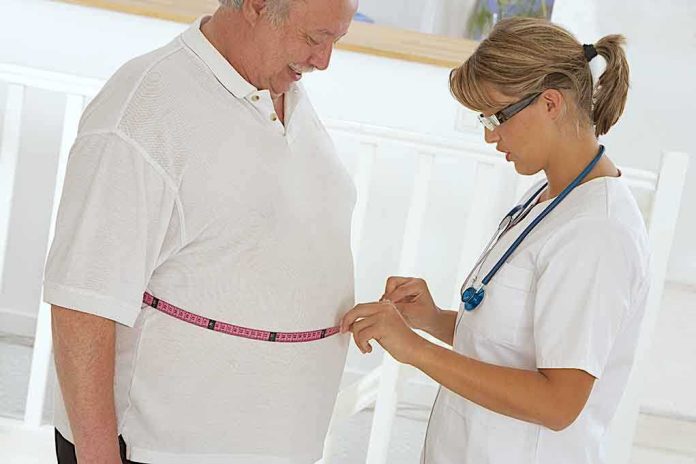
For adults over 40, the real trap is composition drift: muscle slips away while fat rises, even if weight stays steady. BMI often misses that swap. BIA can catch it, and so can a tape measure in the right place. If a tool helps you see the trade—less strength, more fat—then it supports the goals that matter: independence, mobility, and fewer prescriptions. That is prevention, not vanity.
The Waistline Coup: New Definitions Could Reclassify Most of America
While UF researchers questioned BMI’s predictive power, other teams attacked its blind spot: fat distribution. A Lancet commission and follow-up analyses pushed obesity definitions that incorporate waist circumference, waist-to-height ratio, and waist-to-hip ratio alongside BMI. When researchers applied these criteria to large U.S. cohorts, the “obese” share jumped sharply—often toward roughly 70%—and the shift hit older adults especially hard. Waist measures can expose risk that BMI hides.
This is where the story gets politically and financially real. A broader label can mean more counseling, more lab work, more drugs, and more insurance claims. Sometimes that’s appropriate—abdominal fat correlates with diabetes and cardiovascular risk. Sometimes it becomes a numbers game that treats people as patients first and citizens second. The standard should be targeted care: identify the people at genuine risk and avoid turning healthy adults into lifelong subscribers to the medical system.
So How Worried Should You Be: A Common-Sense Triage for Adults 40+
Use BMI the way you use a weather forecast: it sets context, but it doesn’t decide your day. If BMI is high, the next question should be “high what?”—fat, muscle, or both. Ask for body composition if it’s available, including BIA. If it isn’t, ask for waist measures and track them over time. A steady upward waistline with stable weight often signals worsening composition. Pair that with basics that beat hype: strength training, protein, sleep, walking, and cutting ultra-processed calories.
Worry becomes useful only when it produces action that matches reality. If you’re strong, metabolically healthy, and your waist is stable, panic over BMI is wasted energy. If your BMI is normal but your waist is climbing, complacency is the mistake. The future of screening should reward accuracy and personal responsibility: measure what matters, then choose interventions that restore function, reduce visceral fat, and keep people off the conveyor belt of chronic disease.
The next time a chart tells you who you are, treat it like a starting point, not a verdict. BMI still works for large populations, but individual health needs individual measurement. The emerging consensus isn’t “ignore obesity.” It’s “stop pretending one crude ratio can see your organs, your muscle, and your future.”
Sources:
UF Health study shows BMI’s weakness as a predictor of future health
Nearly half of American adults will be obese by 2035, study warns
New U.S. obesity estimate: Up to 70% of adults have obesity under expanded criteria
New obesity criteria reclassify more U.S. adults as having obesity
Under new criteria, 3 in 4 U.S. adults considered obese
Obesity rise could affect 126 million American adults