

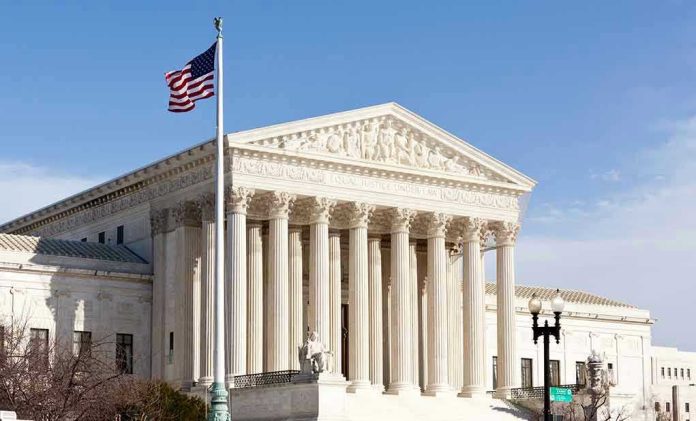
When the Supreme Court says many “unlawful drug users” may keep their guns, it is not just ruling on marijuana—it is exposing how far Washington tried to stretch its power over ordinary people’s rights.
Story Snapshot
- The Court sided with a Texas man and limited a federal ban on gun ownership by drug users.
- Justices said the government cannot disarm sober people for past or general marijuana use alone.
- The ruling narrows how “unlawful drug user” can be used to strip Second Amendment rights.
- The case highlights growing anger that federal elites twist vague laws to control everyday Americans.
What the Supreme Court Actually Decided
The Supreme Court ruled that the federal government cannot use a broad, vague label like “unlawful user of a controlled substance” to permanently strip a sober person of the right to keep a gun at home for self‑defense, at least in cases like Ali Danial Hemani’s.[1] Hemani was charged because he regularly used marijuana while owning a lawfully purchased handgun that he kept secured at home, and there was no evidence he was high when he possessed the gun.[1] The district court threw out the charge, the Fifth Circuit Court of Appeals agreed, and now the Supreme Court has largely upheld that result, rejecting the government’s push for a sweeping ban that would cover tens of millions of Americans who use marijuana but have never misused a firearm.[2]
The justices focused on history and the Second Amendment test they announced in the 2022 New York State Rifle and Pistol Association v. Bruen decision, which says modern gun rules must match the nation’s historical tradition of gun regulation.[3] The government argued that Congress can disarm anyone who is an “unlawful user” of drugs, even when they are stone sober, because illegal drug use itself shows poor judgment and risk.[7] But Hemani’s lawyers, backed by civil‑liberties and gun‑rights groups, argued there is no founding‑era tradition of disarming people simply for being drug users; instead, historical laws targeted people who were actively drunk, violent, or found dangerous by a court.[4]
How the Justices Cut Back a Vague, Open‑Ended Ban
During oral argument, justices from both wings pressed the government on what counts as a “habitual” or “regular” drug user and how an ordinary person is supposed to know when their private marijuana use turns them into a federal felon.[5] The term “unlawful user” is not clearly defined in the law, and the Bureau of Alcohol, Tobacco, Firearms, and Explosives had long used an expansive rule that could flag someone over any repeated illegal drug use.[7] Critics said that gave federal agents a “blank check” to deny or revoke gun rights from millions of otherwise law‑abiding citizens without any specific finding that they were dangerous.[1] The Court’s ruling rejects that open‑ended reading, signaling that, at most, lawmakers may bar people who are actively intoxicated while armed, not everyone who admits to using marijuana on weekends.[4]
The decision builds on a 2025 Fifth Circuit case that said history supports at most a ban on carrying guns while “presently under the influence,” not a lifetime or status‑based ban for people who use banned substances at other times.[4] In Hemani’s case, the government never claimed he was high when he possessed the gun, only that he used marijuana (and allegedly cocaine) while owning it.[7] That was not enough. The Court agreed with lower courts that a modern law which sweeps in sober citizens with no record of gun misuse does not match older rules that targeted specific acts of dangerous behavior.[2] The justices appear to have issued a relatively narrow ruling tied to Hemani’s facts, but one that clearly warns Congress and agencies that vague labels cannot be used to erase core constitutional rights.
Why This Case Taps Deep Frustration With the “Deep State”
This fight did not break along simple party lines, either in the courtroom or in the country. Many conservatives saw the case as another example of Washington using drug laws and background checks to chip away at the Second Amendment for ordinary gun owners, especially in states that now treat marijuana more like alcohol.[2] Many liberals, even those wary of guns, worried about a system where federal agents and prosecutors can brand someone an “unlawful user” and strip rights without any finding that the person is violent, unstable, or even intoxicated with a firearm in hand.[1] Both sides recognized a familiar pattern: a vague law, written decades ago, stretched by agencies and prosecutors in ways Congress never clearly debated, with real lives in the balance.
The case also exposed internal conflict inside the federal government itself. While the Justice Department told the Court that the law only targets “habitual” users and is “temporary” because people regain rights if they quit drugs, the firearms background‑check system has used a much broader rule, and the Bureau of Alcohol, Tobacco, Firearms, and Explosives only recently proposed narrowing its own definition under pressure from the courts.[7] That gap fed the sense that unelected officials write their own rules on top of vague statutes, then apply them in secret databases, leaving citizens to guess when they cross an invisible line. For many Americans, this looks less like public safety and more like a bureaucracy that answers to itself.
What Comes Next for Gun Owners and Marijuana Users
The ruling stops short of wiping out the entire drug‑user gun ban, but it will likely force lower courts to throw out cases where the government cannot show that a person was armed while actually under the influence or clearly dangerous.[3] Legal analysts expect hundreds of pending prosecutions and background‑check denials to be challenged, especially in states where marijuana is legal under state law but still banned federally.[3] The Eleventh Circuit has already signaled similar doubts in a case involving medical marijuana patients, showing that judges across the country are rethinking how far the government can go.[10] Congress could try to rewrite the law to be clearer and narrower, but that would mean openly debating how much trust to place in citizens instead of hiding behind vague language and agency rules.
JUST IN🚨: The Supreme Court just sided with a Second Amendment challenge to the federal law that bars drug users from owning guns. The case involved Texas man Ali Danial Hemani, who was charged after FBI agents searched his home in 2022 and found a legally purchased pistol along… pic.twitter.com/k6Zs8dg4jU
— Melissa Hallman (@dotconnectinga) June 18, 2026
For many readers, this case confirms a broader fear: when Washington gains a tool to control people, it rarely gives it up, even as society changes. A law passed in 1968, in the middle of the War on Drugs, was quietly used for decades to strip rights from people who might be guilty of nothing more than admitting they use marijuana, with no evidence of violence. Hemani’s win does not fix the deeper problem of vague, open‑ended laws and unaccountable enforcement. But it shows that, at least this time, the Supreme Court was willing to push back and remind the federal government that rights belong to the people, not to the agencies that claim to manage them.
Sources:
[1] Web – Supreme Court sides with man who challenged law barring drug users …
[2] Web – US v. Hemani | American Civil Liberties Union
[3] Web – Guns, Cannabis, and the Constitution: SCOTUS to Hear United …
[4] Web – Should Hemani be Decided as a Statutory Case?
[5] Web – United States v. Hemani – Liberty Justice Center
[7] YouTube – SCOTUS Shorts: United States v. Hemani
[10] Web – United States v. Ali Danial Hemani | Supreme Court Bulletin | US Law