

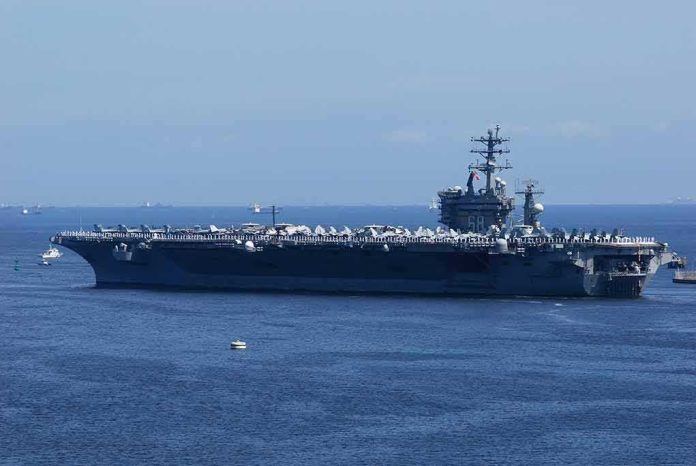
Sailors aboard one of the Navy’s biggest aircraft carriers have tried to jump into the ocean during a deployment that has kept them at sea for nearly 250 days straight.
Story Snapshot
- Multiple sailors on the USS Abraham Lincoln reportedly tried to go overboard during an extended deployment tied to the conflict with Iran.
- Families say repeated extensions, food shortages, and broken bathrooms pushed some sailors to a breaking point.
- The Navy has a history of using limited status reports after man-overboard incidents without fully explaining what happened.
- Lawmakers are now demanding the Navy answer questions about living conditions and mental health support on the ship.
Nine Months at Sea With No End in Sight
The USS Abraham Lincoln has spent about 250 straight days at sea, a record-breaking stretch tied to the ongoing war with Iran. That means the roughly 5,000 sailors and Marines on board have gone nine months without setting foot on land. Congress members and military families say the strain has grown into what they call an intensifying mental health crisis aboard the carrier.
Two well-known military newspapers, Military Times and Navy Times, first reported the overboard attempts. Their stories, along with follow-up coverage from The Guardian, point to a pattern of distress building across the deployment rather than a single isolated event.
Families Describe Repeated Extensions and Breaking Points
Annabelle Loma, who lives in San Diego, said her husband had been repeatedly overextended before he tried to jump from the carrier. She has only spoken with him a few times since the attempt. Maria Rodriguez described a separate case where her husband stepped in as a shipmate prepared to go overboard, stopping him before he could jump.
Both accounts point to the same root cause: a deployment that keeps getting pushed back with no clear end date. Families say sailors were told they would return home, only to learn their time at sea had been extended again. That repeated pattern, they say, wore down morale long before anyone tried to jump.
Food Shortages and Broken Facilities Add to Strain
Beyond the length of the deployment, sailors have complained about food shortages, broken toilets, and moldy showers aboard the ship. Reports tied the difficult living conditions directly to the mounting pressure crew members described feeling as the deployment dragged on for nearly 210 days at one point. Cramped, unsanitary conditions on a warship built for shorter missions can quickly compound existing stress.
These complaints matter because they are not abstract morale issues. Broken plumbing and food shortages affect basic daily life for thousands of people confined to a floating steel city. When paired with no fixed return date, small physical discomforts can become part of a much bigger strain on mental health.
Navy’s Track Record on Overboard Incidents
The Navy has faced man-overboard situations on this same ship before. In past incidents, officials listed missing sailors under a status called Duty Status Whereabouts Unknown while search and rescue teams worked, without immediately explaining what led to the disappearance. That pattern of limited disclosure now shapes how families and lawmakers are reacting to the latest reports.
Lawmakers Step In as Questions Mount
Congress members are now pressing the Navy for answers about conditions aboard the Abraham Lincoln, including how long sailors have been kept at sea and what mental health resources are available to them. The demand for answers reflects a broader worry shared by many Americans, regardless of politics, that those serving overseas are being stretched past reasonable limits while the institutions responsible for their care stay quiet.
260+ days at sea. No return date. Multiple sailors reportedly trying to jump overboard.
The USS Abraham Lincoln crew is being ground down — moldy showers, broken toilets, rationed food, 12-16 hr shifts with no relief — for a war with Iran that never should’ve happened.
The…
— Webba (@WebbaBroadside) August 13, 2026
Some reports circulating online, including claims of a deadly clash aboard the ship, remain unconfirmed by the Navy and come from sources with limited independent verification. Those claims should be treated separately from the documented overboard attempts and family accounts, which multiple outlets have reported consistently. The Navy has not yet issued a detailed public response addressing the specific claims about deployment length, food shortages, or crew mental health.
Sources:
realcleardefense.com, theguardian.com, militarytimes.com, moneycontrol.com