

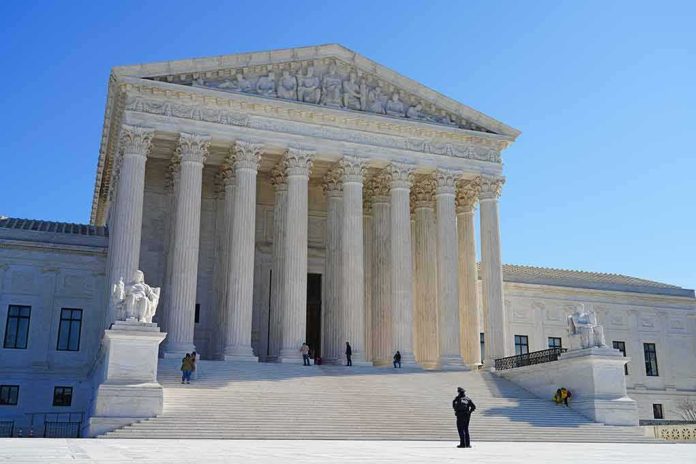
The Supreme Court has refused to let the Trump administration stop hormone treatment and other gender care for transgender inmates in federal prisons while a lawsuit over the policy goes on.
Story Highlights
- The justices turned down the administration’s emergency request in an apparent 7-2 vote, with Justices Clarence Thomas and Samuel Alito dissenting.
- The Court gave no reasons for its order.
- The order that stays in place came from Judge Royce Lamberth, who was appointed by President Ronald Reagan, so the Bureau of Prisons must keep providing the care to the almost 1,000 inmates the policy would affect.
- This is not a final ruling. The lawsuit continues in the lower courts.
What The Court Did On Wednesday
On Wednesday, October 21, the Supreme Court denied the government’s emergency application. That is a fast-track request asking the justices to step in before a case is finished. The administration wanted to put its prison policy into effect right away. The Court said no, and it did not explain why. Justices Thomas and Alito dissented, meaning they disagreed with the decision. The Court did not announce a vote count, but the vote appears to have been 7-2.
The ruling leaves in place an order from U.S. District Judge Royce Lamberth, a federal judge in Washington, D.C., appointed by President Ronald Reagan. In June, he blocked the Bureau of Prisons from enforcing a policy it adopted in February. His order is a preliminary injunction, a court order that freezes a policy while the lawsuit is decided.
Supreme Court rebuffs Trump administration restrictions on medical care for transgender inmateshttps://t.co/xbzwAygjtB
— Roberta Gonzales (@RoGonzalesTV) October 21, 2026
What The Prison Policy Would Have Done
The care at issue is often called gender-affirming care. It means hormone drugs, surgery and daily items such as wigs, makeup or chest binders that help an inmate live as the gender they identify with. The inmates in the case have been diagnosed with gender dysphoria, a medical term for deep distress over a gap between a person’s body and the gender they identify with.
The February policy would have barred surgery, limited hormone treatment and ended those daily items. It would have focused care on mental health treatment instead. It followed President Trump’s January 2025 executive order, which aimed to restore “biological truth to the federal government.”
Judge Lamberth found the policy was “reverse-engineered to implement the executive order.” He said prison officials had not given a serious reason for treating this care differently from other medical care, and had not weighed the agency’s own past experience providing it.
What Each Side Argues
The administration asked the Supreme Court for help on Sept. 28. It argued that hormone treatment and the daily accommodations are “not medically necessary” to treat gender dysphoria, and that inmates would not be harmed if they were withdrawn. Solicitor General D. John Sauer, the government’s top lawyer before the Supreme Court, wrote that the policy “falls well within the bounds of reasoned decision-making.” The government also said the Bureau of Prisons acted on its own “independent judgment” and that the courts “should have deferred to its experience and expertise.”
Lawyers for the inmates said the bureau “overrode its own medical providers’ clinical judgment” to cut off care. The ACLU, which represents the inmates, told the justices the government’s request “would overturn a three-decades-long status quo.” In September, a federal appeals court in Washington had also refused to let the policy take effect while the government’s appeal is heard.
For taxpayers, the order means the Bureau of Prisons keeps paying for this care for the length of the case. The fight goes on in the lower courts, where the appeal will be decided.
Sources:
courthousenews.com, apnews.com, reuters.com, prisonlegalnews.org, bop.gov