

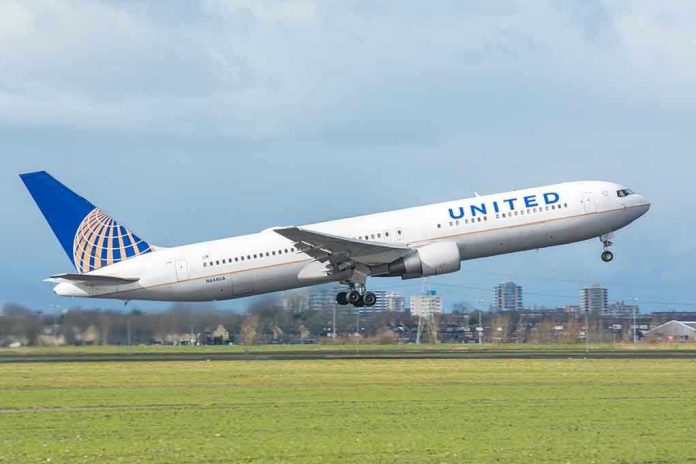
A commercial airliner pilot’s chilling radio transmission reveals a collision with what he describes as a small, red, shiny object at 3,000 feet—seven times higher than federal law permits recreational drones to fly.
Story Snapshot
- United Airlines Flight 1980 reportedly struck an unidentified object at approximately 3,000 feet during descent into San Diego on April 29, 2026
- Pilot described the object as small, red, and shiny, suspecting it was a drone despite the altitude being well above the 400-foot legal limit for consumer drones
- ATC audio captured the pilot’s post-landing report, circulating on social media before any official confirmation from the FAA, United Airlines, or air traffic control
- The flight landed safely with no reported injuries or visible aircraft damage, though official investigations remain pending
When the Impossible Becomes Reality
United Airlines Flight 1980 was executing a routine approach into San Diego International Airport when something went terribly wrong. The Boeing 737, carrying passengers from San Francisco, encountered an object the pilot could only describe in stark, unsettling terms during his radio transmission to ground control. His words, now viral on social media platforms and aviation tracking apps, paint a picture of an incident that should not have happened at that altitude. Federal Aviation Administration regulations explicitly prohibit recreational drone operations above 400 feet, yet this collision allegedly occurred at 3,000 feet—an altitude reserved exclusively for controlled air traffic.
The Audio That Launched a Thousand Questions
The pilot’s transmission crackles with professional restraint masking obvious concern. Ground control received the report after the aircraft had already touched down safely at Lindbergh Field. The description—small, red, shiny—offers tantalizing details yet raises more questions than answers. Was this truly a drone, as the pilot suspected? If so, what type of drone possesses the capability to reach such heights? Consumer models lack both the battery capacity and legal authorization to operate at commercial aircraft altitudes. The incident exposes a glaring vulnerability in America’s airspace security, one that has been growing since drone technology became affordable and accessible to the masses.
United Airlines flight reportedly hits drone at 3,000 feet over San Diegohttps://t.co/6UHJ8JSaU3
— Bodoxstocks (@bodoxstocks) April 29, 2026
A Pattern of Escalating Threats
This San Diego incident fits within a disturbing trend. Since 2021, drone incursions near airports have multiplied globally, with tracking systems documenting hundreds of unauthorized operations, near-misses, and close calls. The D-Fend Solutions global tracker chronicles this escalating threat, showing that what once seemed like isolated incidents now represents a systemic challenge to aviation safety. Previous airport shutdowns, including Newark’s disruption in 2019, demonstrated the chaos a single drone can unleash. Yet those incidents typically involved drones at lower altitudes near runway approaches. A strike at 3,000 feet represents a new and more dangerous evolution.
The Regulatory Response Vacuum
What makes this incident particularly frustrating is the regulatory gridlock surrounding drone enforcement. The FAA maintains strict no-fly zones around airports and imposes clear altitude restrictions, yet enforcement remains spotty at best. Identifying operators who violate these rules proves extraordinarily difficult, especially when incidents occur over densely populated areas like San Diego. The agency’s reliance on voluntary compliance and after-the-fact investigations leaves gaping holes in prevention. United Airlines has remained silent, likely awaiting official FAA findings before issuing statements that could expose the company to liability or public relations fallout.
What Comes Next for Aviation Safety
The implications ripple outward in concentric circles of concern. Short-term, expect heightened scrutiny of San Diego’s airspace and potentially temporary flight restrictions while investigators determine what actually struck Flight 1980. Long-term consequences could prove more significant. This incident provides ammunition for regulators and legislators pushing for mandatory drone detection systems at major airports and substantially stiffer penalties for high-altitude violations. The aviation industry has been remarkably fortunate that drone strikes have not yet resulted in catastrophic loss of life. That luck cannot hold indefinitely. Advanced detection technologies exist—systems capable of identifying, tracking, and even neutralizing unauthorized drones before they pose threats to aircraft. The question is whether regulators will mandate their deployment before tragedy forces their hand. The passengers aboard Flight 1980 landed safely, but their close encounter at 3,000 feet should serve as an unmistakable warning that America’s skies are not as secure as travelers assume when they board commercial flights.
Sources:
United Airlines flight 1980 reportedly hit by drone above San Diego; scary ATC audio surfaces
Drone Incident Tracker – D-Fend Solutions