
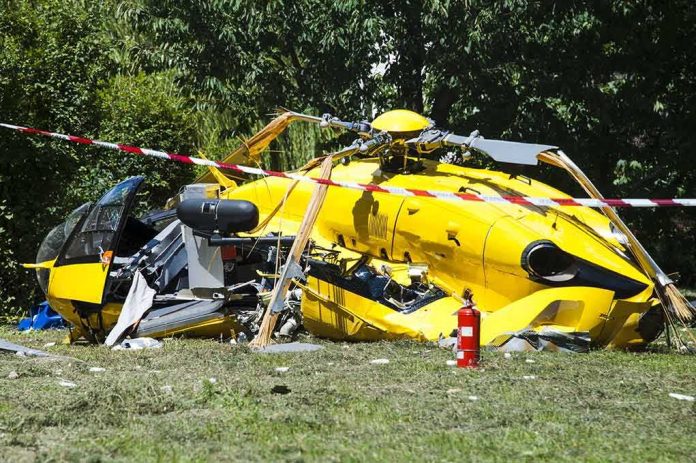
A medevac flight lost GPS guidance in a military jamming zone, then hit a mountain and killed all four people aboard.
Quick Take
- The National Transportation Safety Board’s preliminary report says the aircraft entered an area where military GPS jamming was active.
- The crew reportedly lost GPS soon after takeoff, and air traffic control had to give alternate headings.
- Three other aircraft reported GPS trouble during the same period, pointing to a wider interference problem.
- The report is still preliminary, so investigators have not assigned final cause or blamed one factor alone.
What the Preliminary Report Shows
The clearest fact in the case is timing. The Beechcraft King Air medevac flight left Roswell, New Mexico, and later flew into a mountain near Ruidoso after the crew said they had lost GPS capability. Contemporaneous summaries of the National Transportation Safety Board report say the plane was inside an area where the United States military was conducting GPS jamming, and that three other aircraft also reported GPS problems during the same period.
That matters because GPS loss is not just a minor inconvenience in mountain flying. In this case, controllers had to issue alternate headings after the navigation problem began, which shows an immediate operational impact. Coverage of the preliminary report also says the aircraft was operating in nighttime, mountainous conditions, and that the crash point was about 230 feet below the summit, which fits a controlled-flight-into-terrain pattern rather than a simple engine failure or breakup.
Why the Jamming Details Matter
The reported sequence is the part that has drawn the most attention. According to the coverage, air traffic control asked White Sands Missile Range to pause the jamming, the military briefly stopped, and the jamming later resumed once controllers believed the aircraft had moved to a visual approach. That sequence does not prove the jamming alone caused the crash, but it does show the flight was moving through a known interference environment while navigation support was already degraded.
The Federal Aviation Administration had also warned of planned GPS disruption in the area before departure. That makes the case harder to dismiss as a random equipment failure or a surprise loss of signal. The public record instead points to a known hazard near a civil flight path, which is exactly the kind of gap that frustrates people who already believe federal agencies are too slow to protect ordinary Americans from their own systems and testing programs.
What Still Is Not Known
The most important limit is simple: this is still a preliminary report. The National Transportation Safety Board has not issued a final probable-cause finding, and the material now available does not include the full recorder data, the complete docket, or a final factual analysis. That means investigators have not ruled out other contributors such as crew decisions, approach judgment, weather, terrain clearance, or how the aircraft’s backup systems performed after GPS loss.
Pete Hegseth's Pentagon switched its GPS jammers back on five minutes before a medevac plane hit a mountain. All four people aboard died.
Their names were Keelan Clark and Ali Kawsara, the pilots, and Sarah Clark and Jamie Novick, the flight nurses. They lifted off from Roswell,… pic.twitter.com/8udSyq3OMW
— Viral Reel Addict (@ViralReelAddict) August 5, 2026
That uncertainty should keep the discussion disciplined. Some early coverage uses stronger language than the evidence supports, while other accounts stress that the crew reported the airport in sight and then flew a visual approach. Both facts can be true at once: the jamming was real, and the final crash chain is still under review. The broader lesson is not partisan. It is about whether military testing near civil airspace is being managed with enough care to protect the public.
What This Means for Public Trust
This crash lands in a wider national argument about whether federal agencies and defense programs are transparent enough when military needs collide with civilian safety. For aviation users, the concern is practical: if a flight loses satellite navigation in mountain weather, every second matters. For taxpayers, the concern is bigger: government systems that are meant to protect the public should not leave families wondering whether routine training, weak coordination, or slow oversight put them in danger.
The case also shows how fast a technical safety issue can turn into a trust crisis. If the final report confirms that military jamming contributed to the accident, critics will see another example of official systems ignoring risks outside the range fence. If investigators find a broader mix of causes, the aviation record will still show how fragile flight safety can be when navigation tools fail in the dark, near terrain, and inside a managed interference zone.
Sources:
tomshardware.com, sofx.com, spectrum.ieee.org, facebook.com