

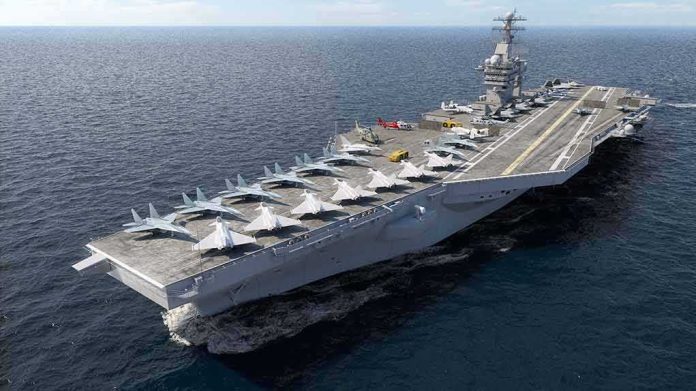
As Washington quietly sends thousands more troops and warships toward Iran, Americans are once again watching their leaders inch toward a major Middle East war without a clear public plan.
Story Snapshot
- The U.S. is surging thousands of Marines, sailors, and soldiers into the Middle East as fighting with Iran widens.
- Multiple aircraft carrier strike groups, more than 20 warships, and over 120 advanced warplanes are being positioned near Iran.
- About 50,000 U.S. service members are now in the region, the largest buildup since the Iraq invasion.
- Officials say deployments “provide options,” but offer few answers on goals, risks, or an endgame for American troops.
Massive New Buildup Near Iran
Beginning in late January 2026, the United States launched its largest military buildup in the Middle East since the 2003 Iraq invasion, focused mainly around Iran. This surge includes major air, naval, and missile defense assets moved under United States Central Command, which oversees operations in the region. A Reuters report in March said the Pentagon is sending “thousands more Marines and sailors” to reinforce existing forces, citing three U.S. officials speaking on background. These new units are described as giving Washington options if the war with Iran escalates further.
Defense officials say the fresh deployment will sit on top of about 50,000 American personnel already spread across bases and ships in the region. That troop level is roughly 10,000 higher than what has been typical in recent years. The additional forces include two full Marine expeditionary units and thousands of soldiers from the Army’s 82nd Airborne Division, sent from Fort Bragg in North Carolina. These units are trained for rapid air assault missions and could be used for evacuations, base defense, or ground operations inside Iran if ordered.
Carriers, Warships, and Advanced Airpower
Naval power is also surging toward the Gulf. Reporting on the 2026 buildup notes that the U.S. Navy has assembled multiple aircraft carrier strike groups near Iran, including USS Abraham Lincoln and USS Gerald R. Ford, the largest warship in the world. The Wall Street Journal and other outlets detailed Pentagon orders for another carrier group to prepare for deployment, expanding the armada positioned within striking range of Iranian territory. One Associated Press account added that USS George H.W. Bush sailed with three destroyers and about 6,000 sailors toward the region.
Beyond carriers, the United States has deployed over 20 Navy warships across Middle East waters as relations with Tehran have sharply worsened. Satellite and port tracking show destroyers capable of long‑range missile strikes, littoral combat ships for coastal operations, and logistics vessels massed at key hubs like Bahrain. In the air, open‑source flight data and Al Jazeera reporting describe more than 120 U.S. aircraft shifted into the theater, from F‑35 stealth fighters and F‑22 jets to airborne warning planes and refueling tankers. Analysts say this is the biggest jump in American airpower near Iran since the early Iraq war days.
Official Rationale: “Options” Amid Escalating War
Public statements from the Trump administration walk a careful line. Officials say the deployments are meant to “enhance capabilities” and provide “options” as combat with Iran expands, but they stop short of announcing a full ground invasion. General Dan Caine, chairman of the Joint Chiefs of Staff, confirmed the U.S. is sending more troops and fighter jets as the Iran conflict intensifies, framing the moves as necessary to protect American forces and regional allies. At the same time, Trump and his team insist negotiations with Tehran are ongoing, even as bombs and missiles continue to fly.
Reports from major outlets show how unclear the endgame remains. The Washington Post, citing U.S. officials, says the Pentagon is preparing for “weeks of ground operations in Iran” and warns that thousands more Marines could mark a “perilous new chapter” of the war. National Public Radio notes that the vital Strait of Hormuz—through which a huge share of the world’s oil flows—has at times been inaccessible due to fighting, raising the stakes for global energy prices. For many Americans, this looks like another slow drift into a large war, with big risks for troops and the economy but few straight answers from Washington.
What This Means Back Home
For older conservatives, this buildup feels like proof that decades of globalist foreign policy never really ended. They see thousands of Americans once again sent into harm’s way across the world, while the southern border remains porous and domestic problems like debt, inflation, and energy costs grind on at home. The presence of 50,000 U.S. troops and multiple carrier groups near Iran suggests a level of commitment and spending that dwarfs many domestic priorities, reinforcing fears that the “America First” promises were hollow.
3 AM Top-of-the-Hour News
The U.S. military says it's completed an eighth day of new airstrikes against Iran to “swiftly punish” the country’s Revolutionary Guard for an attack in Jordan that killed two American service members, left one more missing and four requiring… pic.twitter.com/D2xVw8dkfS
— Worldwide News Network (@WorldwideNNX) July 19, 2026
Older liberals see something different but equally troubling. To them, this looks like another chapter where powerful elites and defense contractors profit, while working‑class soldiers carry the physical and mental burden of war. Most deployments have been announced without a clear vote of Congress on a new war authorization, raising questions about democratic oversight. Both sides can agree on one thing: the federal government is again moving toward a massive conflict with limited public debate, and ordinary Americans—whether overseas in uniform or at home paying the bills—will bear the cost.
Sources:
realcleardefense.com, iz.ru, english.news.cn, biz.chosun.com, middleeasteye.net, oann.com, stripes.com, reuters.com, fox5dc.com, theguardian.com, cnn.com, turkiyetoday.com, nytimes.com, reddit.com