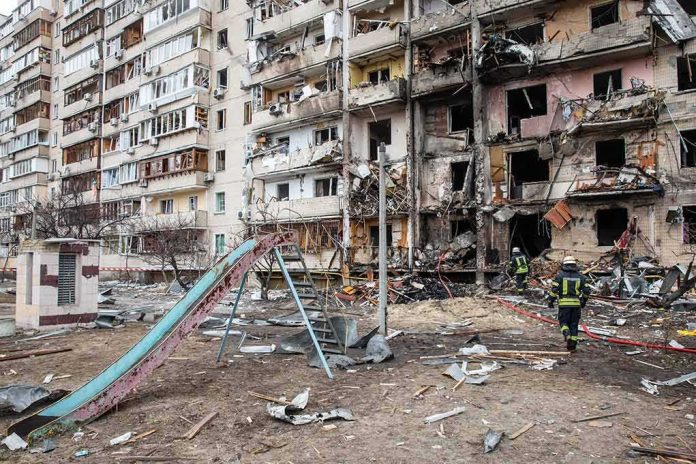
As another Russian missile and drone barrage tears through Kyiv’s apartment blocks, many Americans are asking why our leaders keep writing blank checks while civilians — including children — keep paying in blood.
Story Snapshot
- At least 27 people were killed and more than 100 injured in Kyiv after a massive Russian missile and drone strike that hit mainly residential areas.
- Competing claims say Russia targeted energy or military sites, but on-the-ground damage shows collapsed homes and apartment blocks across many districts.
- The attack fits a growing pattern of long-range strikes on cities far from the front lines, which United Nations monitors say are driving a sharp rise in civilian deaths.
- The fog of war, media bias, and lack of independent investigations feed public distrust and deepen the sense that global elites are playing games with ordinary people’s lives.
Deadly Night in Kyiv: What Actually Happened
Ukrainian officials say Russia launched one of its largest recent air assaults on Kyiv, using missiles and drones in several waves through the night. Local authorities reported at least 27 people killed and over 100 injured in the capital, with the toll rising as rescue teams pulled bodies from rubble. A nine-floor apartment block partly collapsed, trapping families inside. Firefighters and medics worked for hours as sirens continued and more alerts forced people back into shelters.
City officials and Ukraine’s president say more than 20 to 30 locations across Kyiv were damaged, most of them ordinary homes. Photos and video from the scene show entire sections of residential buildings smashed open, with bedrooms and kitchens exposed to the street. Kyiv’s military administration chief said dozens of residential structures, schools, and medical sites were hit or damaged in the wider region. That picture directly undercuts the idea that this was a clean strike on purely military targets.
Civilian Targets or Energy Sites? The Battle Over the Story
Russia’s defense ministry claims its forces aimed at energy facilities and military-industrial sites, not civilians. Ukrainian leaders insist the opposite, arguing Moscow “deliberately targets residential areas” to break public morale. Independent confirmation of intent is hard in real time. Still, the visible pattern of shattered apartment towers, damaged schools, and hit clinics in Kyiv and other cities suggests that civilians are not just unlucky bystanders to a precise, limited campaign.
That pattern is not new. Conflict researchers have tracked thousands of Russian attacks since 2022 that damaged homes, schools, and hospitals. United Nations human rights monitors say long-range missiles and drones in urban areas now account for a large share of civilian casualties across Ukraine, far from active front lines. These findings do not prove every strike is planned as a war crime. They do show that the chosen tactics make heavy civilian loss of life entirely predictable — and yet the attacks continue.
Rising Civilian Toll and Why People No Longer Trust the Numbers
Across Ukraine, United Nations investigators report that civilian casualties have surged again, with some recent months seeing the highest death toll in years. One United Nations update said more than 2,000 civilians were killed or injured in a single month, most from Russian missiles and drones hitting cities. Total verified civilian casualties since the invasion began are in the tens of thousands, and even these counts likely underestimate the real numbers.
Yet even in this Kyiv attack, reported death tolls jumped from 10 to 15 to more than 25 as hours passed. That kind of shift is normal in a disaster zone. But it fuels a wider frustration many Americans now feel about all “official” data. Governments and big media often lock onto one narrative early. Later corrections rarely get the same attention. In a world shaped by propaganda from Moscow, Kyiv, Washington, Brussels, and Silicon Valley, citizens on both the right and the left are left wondering whose numbers can be trusted.
Media, Big Tech, and the Sense of a Managed Narrative
Major Western outlets mainly rely on Ukrainian officials for casualty counts and strike details and present Russian statements as disputed or unverified. That may reflect real concerns about Russian disinformation. But for viewers already skeptical of corporate media, it can also look like one more controlled storyline. Many know these same outlets have close ties to governments and defense contractors, which profit when wars drag on. That does not mean every report is false. It does explain why so many people doubt they are getting the whole truth.
Searching a Kyiv apartment after a missile/drone strike, July 5th 2026
📷 Main Directorate of the State Emergency Service of Ukraine in Cherkasy Oblast pic.twitter.com/8lVkjwYNSv
— Titch Ashen (@titchashen) July 6, 2026
Social media does not fully solve the problem. Platforms like YouTube and Facebook openly suppress content they label as war “misinformation,” often removing Russian state media and some independent voices along with it. At the same time, Russia jails its own citizens for posting information that challenges Kremlin narratives. Ordinary people — in Ukraine, Russia, and the United States — get squeezed between state censors and tech algorithms. The result is a bitter feeling that powerful interests, not facts, decide which stories we are allowed to hear.
Why This Matters for Americans Tired of Endless Crises
For many Americans, this strike on Kyiv is not just a faraway tragedy. It raises hard questions about our own leaders. Washington sends tens of billions abroad while families at home struggle with high prices, weak wages, and broken infrastructure. Both conservatives and liberals see a pattern: elites in every capital talk about “rules-based order” or “national greatness,” yet the people who truly pay for these grand plans are the workers, parents, and retirees caught in the crossfire.
Russian missiles smashing into Kyiv’s apartments are a brutal reminder of what happens when unaccountable power, secret deals, and military buildup go unchecked. United Nations reports and independent researchers show civilians are paying a rising price. But there is still no strong global system to quickly investigate attacks, verify claims from both sides, and hold any government — not just Russia — to the same standard. Until that changes, more innocent people will die abroad, and more citizens at home will lose faith that their leaders are telling the truth or working for them.
Sources:
youtube.com, abcnews.com, nbcnews.com, en.wikipedia.org, ukraine.bellingcat.com, ukraine.ohchr.org, acleddata.com, statista.com