

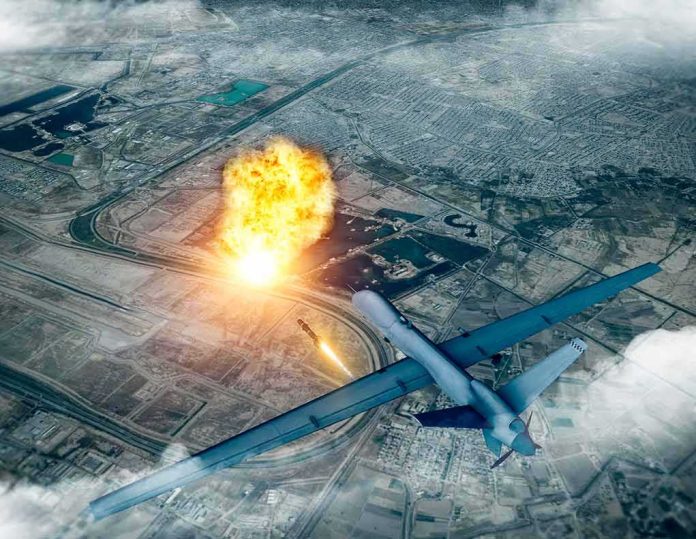
Kuwait says its air defenses battled incoming Iranian missiles and drones while Iran claimed it was striking U.S. military sites on Kuwaiti soil, pulling a small nation into a big-power crossfire.
Story Snapshot
- Kuwait reported intercepting “hostile” missiles and drones over its territory.
- Iran’s Revolutionary Guard said it targeted U.S.-used facilities in Kuwait as retaliation.
- Kuwait condemned the attacks as a violation of its sovereignty and international law.
- Independent confirmation of damage to U.S. assets in Kuwait remains unclear in available reports.
What Kuwait Reported During The Attack
Kuwait’s army said air defenses were intercepting hostile missile and drone threats over the country. Officials explained that blasts people heard were the result of intercepts, not confirmed strikes on the ground. Government statements framed the events as attacks on Kuwaiti territory and airspace, stressing the danger to civilians and vital sites. These statements match a pattern seen across the Gulf during regional flare-ups, where small states become the arena for larger rivalries.
Kuwait’s Foreign Ministry and Cabinet condemned the attacks as a flagrant violation of sovereignty, international law, and the United Nations Charter. Leaders affirmed Kuwait’s “full and inherent right” to self-defense under Article 51. Officials also said repeated attacks since late winter threatened national security and stability. This legal framing underscores that, regardless of the attacker’s stated target, the intrusion into Kuwaiti airspace is treated as an attack on the state.
What Iran Claimed It Hit And Why It Says It Struck
Iran’s Islamic Revolutionary Guard Corps said it carried out retaliatory strikes on U.S. infrastructure in Kuwait, citing U.S. military actions as the trigger. Reporting described alleged targets such as aircraft shelters, satellite systems, and equipment storage at bases used by U.S. forces. Outlets summarized Iranian claims that specific Kuwaiti bases tied to U.S. operations were in the crosshairs, presented as a response to earlier U.S. strikes in the region.
These Iranian statements aim to cast the operation as payback against the United States rather than an assault on Kuwait. That message matters for regional politics, where Tehran often signals it will hit American-linked sites hosted by partners. However, current public reporting does not provide independent battle damage assessments of U.S. assets inside Kuwait. The gap leaves a key question open: what, if anything, beyond the defended airspace was actually hit?
Where The Facts Are Firm And Where They Are Not
Two points are clear. First, missiles and drones entered Kuwaiti airspace and Kuwait engaged them. Second, Iran publicly said it aimed at U.S.-linked facilities on Kuwaiti soil. What is less clear is whether any U.S. equipment or infrastructure in Kuwait suffered confirmed damage. No detailed U.S. or Kuwaiti damage report appears in the available sources. That uncertainty is common in the first days of fast-moving conflicts and often takes time to resolve.
PLASTICGIRL REPORTING | Sept 3
The board is HOT.1. IRAN JUST SPIKED Trump: we hit them “very hard.” Ready again “anytime we want.” Iran says a U.S. strike hit a WEDDING. 4 dead, including kids. Tehran fired on Kuwait and the UAE this morning. Brent $97+. Six months in. Not… pic.twitter.com/J0SUrkP3lf
— PlasticGirlReporting™️©️ (@PlasticGirl1776) September 3, 2026
This clash fits a familiar pattern in the Gulf. Iran and the United States trade moves, and partner countries end up exposed. Kuwait must defend its skies even if it is not the main actor in the feud. Americans across the political spectrum see another example of great-power fights spilling costs onto ordinary people. Many will ask why clear answers on targets and damage are slow, and whether officials on all sides are managing truth, not only risk.
Why This Matters For Americans Watching Energy, Security, And Trust
Attacks near key Gulf infrastructure can lift oil prices and raise shipping risk, which can show up later in fuel and goods costs at home. U.S. troops and contractors in host nations face higher danger when Iran frames strikes as retaliation for U.S. actions. Citizens on the left and right also see a government messaging fog that leaves basic facts in dispute. That fog feeds the sense that the system keeps people in the dark while the stakes keep rising.
What To Watch Next
Watch for official damage assessments from the United States Central Command or Kuwait’s defense ministry. Look for satellite imagery of named bases before and after the strike window. Monitor whether Kuwait coordinates new air-defense measures with neighbors, and whether Iran issues further target details. Clear answers on what was hit, if anything, will shape the next steps—diplomatic protests, military moves, or both—and help cut through claims designed to score points in a dangerous cycle.
Sources:
kuna.net.kw, iranintl.com, aa.com.tr, bbc.com, malaymail.com, reuters.com, tabnak.ir