

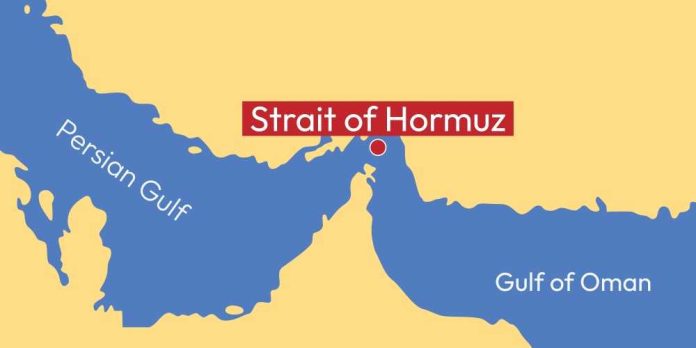
A war-zone data blackout in the Strait of Hormuz now lets Iran choke a vital oil artery while Western trackers tell the world “zero ships” are moving.
Story Snapshot
- Windward and live dashboards show **near-zero AIS ship transits** in the Strait of Hormuz, signaling a historic collapse in visible traffic.
- At the same time, Windward admits **ships are still slipping through in the dark**, using Iranian-controlled corridors and AIS shutoffs.
- Experts say AIS tracking now **misses up to half of real traffic**, as Iran runs a permission-based “tollbooth” model for who gets to sail.[3]
- The data fog hides how much oil is really moving and leaves American families paying the price in energy costs and supply shocks.[7]
How “Zero AIS Transits” Created a Strait of Hormuz Panic
When Iran announced it was closing the Strait of Hormuz, many tracking tools suddenly showed zero or near-zero ship crossings, and headlines followed fast.[1] Maritime firm Windward reported days with only a handful of visible transits, far below the normal 100-plus ships per day that usually pass through the chokepoint.[9] A dedicated Hormuz dashboard even declared outbound traffic at a “complete standstill,” with no commercial ships observed finishing a transit for days and all major vessel types showing zero outbound movement.[2]
For a world that relies on this narrow waterway for about a fifth of global energy trade, those “zero” numbers sounded like a total shutdown. Conservative readers know what that means at home: higher gasoline prices, more strain on supply chains, and yet another reminder that American energy security hangs on unstable foreign regimes. Iran framed the closure as leverage in talks over its nuclear program, using the strait as a pressure point while U.S. negotiators and allies watched markets react.[1]
Dark Ships, Hidden Corridors, and Iran’s New “Tollbooth”
Under the surface, though, the picture is very different from a simple on–off switch. Windward itself admitted in a LinkedIn update that “AIS has gone dark near the Strait of Hormuz” even as satellite images showed ships still moving through the area.[2] Other Windward analysis on social media reported AIS transits dropping to almost zero while so-called “dark” traffic surged by 600 percent, with large tankers and container ships using a northern corridor without broadcasting their positions at all.[5] That means the sea lane is not empty; it is simply going invisible to public tools.
Investigators at Citrini Research, backed by several maritime intelligence firms, now estimate that Automatic Identification System data around Hormuz may be missing roughly half of the ships that are actually transiting.[3] Their work describes a permission-based or “tollbooth” model run by Iran’s Islamic Revolutionary Guard Corps, where ships must secure approval, share detailed cargo and ownership data, and in some cases make payments or political deals before they can pass.[3] Windward’s own multi-source intelligence echoes this, describing the strait as “controlled,” with bulk carriers routing through Iranian waters and hundreds of vessels stuck at anchor on both sides waiting for clearance.[6]
Why AIS “Ground Truth” Fails in a Shooting War
The deeper problem is that the main tool the public sees—AIS ship dots on a screen—was never designed to be wartime intelligence. A detailed analysis in Fortune, drawing heavily on Windward’s risk report, explains that traffic through Hormuz collapsed by 97 percent in one week after U.S. and Israeli strikes, leaving about 800 ships idling west of the chokepoint and most loaded barrels unable to exit.[7] At the same time, ships began “vanishing into digital black holes” and reappearing on the other side, showing that many transits now happen under radio silence.[7]
Windward’s own data in that report show only about 25 percent of ships near Bandar Abbas broadcasting AIS on a key April date, with almost a million global positioning system jamming incidents hitting more than 1,100 vessels across the region over the quarter.[7] Their conclusion is blunt: AIS is underreporting Hormuz traffic by about half, and analysts must stop treating a 1990s collision-avoidance tool as “ground truth” for a modern conflict zone.[7] For patriots trying to understand energy security, that means dashboards can exaggerate or misread a crisis, even as real, dangerous disruption is happening off-screen.
Energy Markets, American Families, and Biden-Era Globalism’s Hangover
Even if some ships are still sneaking through in the dark, the visible damage to global trade is huge. Windward and other trackers show daily transits collapsing from over 120 ships to only a few per day, a shock they describe as one of the most severe hits to oil markets in half a century.[9] Crude shipments bound west through Hormuz have plunged, while dry bulk and container traffic has also dropped sharply as carriers pause bookings, leave ships waiting, or divert routes entirely.[9][24]
Current traffic volumes show a nuanced picture in the Strait of Hormuz.
Despite the lack of an immediate public stampede following the recent U.S.-Iran agreement, regional transit pacing is already accelerating behind the scenes. Windward tracked 151 Hormuz transits from June 1…
— Windward (@WindwardAI) June 16, 2026
For Americans, these numbers are not academic. Years of globalist energy policy and attacks on domestic oil and gas left the United States more exposed to foreign chokepoints. Now, with Iran using the Strait like a toll gate and ships going dark to dodge risk, disruptions in the Gulf ripple straight into fuel prices, shipping costs, and even the availability of medical supplies. Conservative voters who warned about energy dependence and weak deterrence can see those warnings playing out in real time at the pump and in the grocery aisle.
What Patriots Should Watch Next in a “Regulated Suspension” Strait
One maritime summary based on Windward reporting now describes Hormuz as in a “regulated suspension,” with traffic sparse, tightly controlled, and still dependent on coordination with Iranian forces for passage.[4] Windward’s social posts talk about very few outbound ships, including only a small number of bulk carriers and product tankers moving through Iranian-managed channels.[4] In plain terms, Iran has not fully shut the door, but it decides who walks through and when, while much of the world sees only “zero AIS” and assumes total closure.
For readers focused on American sovereignty and security, the lesson is clear. First, you cannot trust surface-level dashboards to tell you whether a vital sea lane is open or closed; hostile powers can hide traffic and weaponize our dependence on easy data. Second, relying on energy from a region where a rogue regime can flip markets with a press release or a few mines is a long-term threat to U.S. families, jobs, and even the strength of the dollar. Finally, any serious America First strategy must pair strong defense of navigation with a push for real energy independence at home, so foreign tollbooths and dark fleets cannot hold our economy hostage again.
Sources:
[1] Web – Windward Says “Zero AIS Transits” On Hormuz Chokepoint
[2] X – The Strait of Hormuz, June 8–9: 8 transits tracked (2 inbound, 6 …
[3] Web – Strait of Hormuz Traffic | Live Vessel Tracking Dashboard
[4] Web – Live Ship Data – Strait of Hormuz
[5] Web – Iran Exerts Control Over Strait of Hormuz with New Corridor – LinkedIn
[6] Web – Will __ ships transit the Strait of Hormuz on any day by June 30?
[7] Web – Windward: Hormuz traffic remains critically constrained – safety4sea
[9] Web – Tracking data shows vessel traffic through the Strait of Hormuz …
[24] Web – Strait of Hormuz: Which container vessels are trapped? – Kpler