

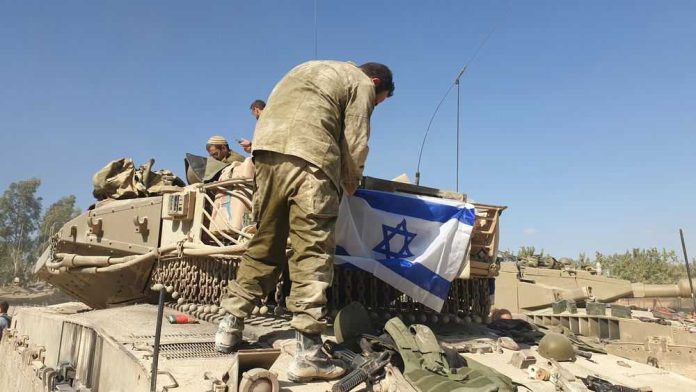
As Israel digs in up to Lebanon’s Litani River and talks about a “new reality,” many warn the south is being turned into a second Gaza-style buffer zone right on Israel’s northern doorstep.
Story Snapshot
- Israel has seized Beaufort Castle and pushed a deep buffer zone in Lebanon, saying it must shield northern Israeli towns from Hezbollah rockets and anti-tank missiles.[18]
- More than a million Lebanese have been driven from their homes by bombing and evacuation orders, fueling claims this is slow-motion ethnic cleansing, not a short-term raid.[11]
- Top Israeli officials now talk about long-term control up to the Litani River and barring hundreds of thousands of residents from returning, echoing Gaza-style tactics.[1]
- Rights groups and legal experts say mass displacement and village demolitions may break the laws of war, putting U.S. support and Western credibility on the line.[12]
Why Israel’s New “Security Zone” Matters to American Conservatives
Israeli forces have crossed deep into southern Lebanon, taken the high ridge of Beaufort Castle, and expanded a ground offensive all the way to the Litani River, about twenty miles from Israel’s border.[18] Israeli leaders say this is about stopping Hezbollah rockets and anti-tank missiles before they can hit farms, towns, and military posts in northern Israel.[18] For many American conservatives, that core goal—secure borders and safety for civilians—sounds both reasonable and familiar.
At the same time, this new push looks less like a quick strike and more like a long-term “security zone” deep inside another country. Defense Minister Israel Katz has said Israel will occupy southern Lebanon as far as the Litani River and keep troops there as part of an expanding buffer, not just a temporary raid.[1] That language matters, because whenever a democracy starts talking about open-ended control of foreign land, the rest of the world hears “occupation” and “mission creep.”
On the ground in Lebanon, the IDF is pressing to seize the strategic Ali al-Taher Ridge and the subterranean network beneath it. The IDF assesses the complex to be the “nerve center” of Hezbollah’s Badr Division – the formation regarded as the organization’s primary force on the…
— Drake Mariani (@DrakeMariani) June 21, 2026
Beaufort Castle, High Ground, and the Logic of a Buffer Zone
Beaufort Castle sits on a ridge that overlooks big parts of southern Lebanon and northern Israel, including key roads and the Litani valley.[2] Israeli commanders argue that whoever holds this hilltop can see and block Hezbollah movements, rocket teams, and supply routes before they get close to the border.[2] From a straight military view, it is classic high ground—exactly the kind of place any army would want to hold when facing a dug-in terror group firing across the line.[18]
Israeli officials say their goal is to dismantle Hezbollah sites, destroy tunnels, and push launch teams beyond easy firing range of Israeli towns.[3] Supporters compare it to the way the United States hunted Islamic State cells outside its own borders rather than waiting for the next attack at home. For many on the right, stopping Iran-backed Hezbollah from turning northern Israel into another rocket range fits a basic belief: you do not wait for terrorists to come to you; you take the fight to them.[6]
“Lebanon, the New Gaza”? Displacement, Demolished Villages, and Legal Fights
Critics say the way this buffer is being built looks less like precise self-defense and more like turning southern Lebanon into a no-man’s land. Reporting from Lebanon describes waves of strikes, bulldozed villages, and large zones marked as combat areas, with residents ordered to flee or face “extreme force.”[21] One major outlet estimated that more than one million people have been displaced across Lebanon by Israel’s campaign, a huge share of the country’s population.[11]
Legal groups are warning that broad evacuation orders and widespread destruction could cross the line from wartime necessity into unlawful mass displacement. The International Commission of Jurists said Israeli directives in Lebanon sparked “panic, upheaval, and homelessness,” and reminded all sides that forced transfer without clear and urgent military need can qualify as a war crime.[12] Human Rights Watch likewise called Israel’s displacement of Lebanese civilians a possible war crime and urged an end to blanket clear-out orders.[14] These are not fringe voices; they shape how U.S. allies, churches, and media see the fight.
Israeli Leaders Talk About a “New Reality” South of the Litani
What makes many observers nervous is not only what is happening on the ground, but what is being said out loud in Jerusalem. Israel Katz has described plans for long-term control of land up to the Litani, destruction of homes in border villages, and keeping around six hundred thousand Lebanese from going back until Israel decides its north is safe.[2] A French-language outlet summed this up as a “new territorial regime” for southern Lebanon, warning of de facto annexation if it continues.[2]
Strategists with the Council on Foreign Relations note that Prime Minister Benjamin Netanyahu has ordered an expanded security zone in Lebanon while talking about creating a “new reality” on the ground.[5] For Israelis burned by October 7 and years of Hezbollah rockets, that message plays as “never again” and “we will handle our own security.” For critics, it sounds like the start of another long occupation that will be hard to leave and easy for Iran and global activists to exploit in the propaganda war.
What This Means for U.S. Policy, Borders, and Conservative Concerns
For Trump supporters watching from home, the Lebanon front raises hard questions that echo our own debates. Israel says it must push danger away from its border, even if that means holding a chunk of hostile territory and clashing with a terror army that hides among civilians.[18] Many conservatives will see a clear parallel to our southern border, where cartels and smugglers use chaos and weak states to move drugs and people into the United States.
But America also knows the cost of long, open-ended missions overseas that blur into nation-building and hand our enemies talking points about “occupation” and “war crimes.” Groups like Amnesty International say Israel’s past operations in southern Lebanon showed “extensive destruction” of civilian property that could not all be justified as “imperative military necessity.”[17] If Lebanon becomes a second Gaza in the public mind—a place of ruins, refugees, and endless war—Washington will face louder calls to cut aid, sanction Israel, or force terms that may not match Israel’s real security needs.
Sources:
[1] Web – Lebanon, the New Gaza
[2] Web – Why Israel’s Beaufort Castle seizure is historically and strategically …
[3] Web – Israel captures Beaufort Castle in Lebanon – The Times of India
[5] YouTube – Why Israel’s Capture Of Beaufort Castle Matters | Dawn News English
[6] YouTube – Why Israel’s capture of Lebanon’s Beaufort Castle matters
[11] Web – What is Beaufort Castle, why does it matter strategically – Instagram
[12] Web – One Million People Displaced in Lebanon as Israel Launches … – TIME
[14] Web – Operation Litani | IDF
[17] Web – 1978 South Lebanon conflict – Wikipedia
[18] Web – Fears of an all-out Israeli invasion mount in Lebanon – NBC News
[21] Web – Forcibly displaced Lebanese families began returning to towns in …