

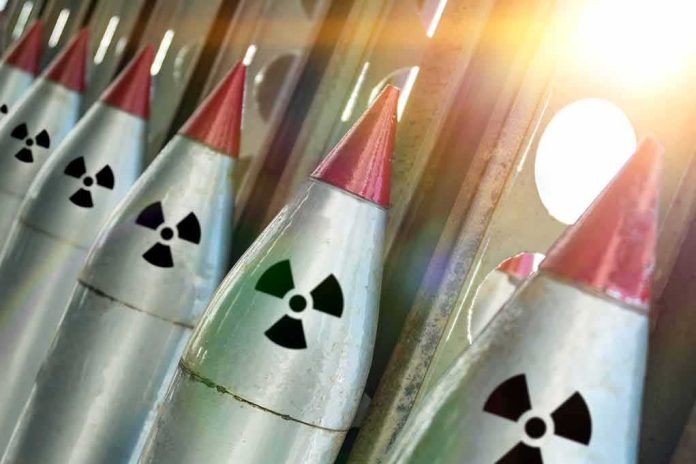
Three nuclear powers met in China to talk cutting nukes and ending wars, marking a first-ever summit with high stakes but no signed deal.
Story Highlights
- President Trump met China’s Xi and Russia’s Putin in Shenzhen for a first-of-its-kind summit.
- Trump said the three nations are “uniquely positioned” to reduce nuclear weapons.
- The leaders listed the war in Ukraine among agenda items, with Putin signaling interest in conflict talks.
- Reports said the talks ended without a major agreement or firm timeline.
Historic Three-Way Meeting Focused on Nuclear Risks
On November 19, 2026, President Trump sat down with China’s Xi Jinping and Russia’s Vladimir Putin in Shenzhen for a first-of-its-kind trilateral meeting. Reports documented opening remarks focused on lowering nuclear risks before private talks began, and coverage confirmed the meeting concluded the same day. Trump framed the goal clearly. He said the United States, Russia, and China are “uniquely positioned” to reduce the world’s nuclear weapons stockpile, spotlighting a shared responsibility among the three biggest nuclear powers.
Politico described the event as an unprecedented summit, while other outlets echoed the “first-ever” character of the format. The gathering took place in Shenzhen, with CNBC identifying Kylin Villa as the venue and setting the timeline on November 19. Coverage stressed that the meeting was real and not just a plan. Leaders delivered public remarks, then moved into a closed-door session reported to last about an hour-plus before wrapping up.
Ukraine War and Regional Conflicts Entered the Room
The leaders placed the Russia-Ukraine war on the agenda alongside nuclear risk reduction. Politico reported that the conflict would be discussed during the session, and Russian statements pointed to “common interests” in resolving regional conflicts, including Ukraine. ABC News noted that President Trump said the United States would not make decisions about the war without Ukraine at the table, signaling that any settlement would require Ukrainian participation at a later stage.
This focus aligns with wider security concerns. The United States and Russia hold the vast majority of global nuclear arms, while China’s arsenal is expanding from a smaller base. Analysts describe this as a “three-body” nuclear environment, where actions by one power affect the others in complex ways. That structure makes even small steps meaningful, since dialogue can reduce miscalculation and help avoid a new arms race that drains economies and threatens families.
No Major Deal Yet, but a New Channel Opened
Outlets reported no signed disarmament agreement or firm numerical targets after the talks. Multiple sources said the summit was not expected to produce a major deal and, after the meeting, none was announced. The evidence supports that nuclear risks and Ukraine were discussed, not that a binding agreement, verification regime, or timeline emerged. One caveat from reporting is that follow-on talks remain possible, which is often how past arms control efforts have moved from big summits to real terms over time.
🇨🇳 Chinese President Xi Jinping urged the total abolition of nuclear weapons during his historic trilateral meeting with Donald Trump and Vladimir Putin
“Nuclear weapons must be completely prohibited and eliminated to create a world free of nuclear arms,” Xi said, emphasizing… pic.twitter.com/O5ekP7wRXV
— Sophia Bennett 🇺🇸 (@sophiabennett07) November 19, 2026
For conservative readers, two points stand out. First, President Trump put American security first by pressing the two other major nuclear states to talk about cuts and restraint. That approach seeks to lower the chance of miscalculation without giving away U.S. strength. Second, raising Ukraine while keeping the principle of “nothing about Ukraine without Ukraine” respects national sovereignty and avoids backroom deals that would undercut allies or the rule of law.
Why This Matters for American Strength and Stability
This summit creates a top-level channel in a tense era. With the New START framework gone and great-power rivalry growing, Washington, Moscow, and Beijing need clear lines to prevent crises from spiraling. Even without a deal, the three-way format marks a shift from old, two-party arms talks to a modern reality where China must be in the room. That recognition protects American families by reducing the chance that a regional shock becomes a global disaster.
Moving forward, watch for official readouts and any follow-on working groups. Concrete progress would include measurable caps, verification steps, and timelines that hold Russia and China to their word while keeping America strong. Until then, this first step shows President Trump is pressing the world’s other nuclear powers to face risk head-on, seek responsible reductions, and keep wars from widening—all while defending U.S. interests and allied security.
Sources:
townhall.com, politico.com, cnbc.com, dw.com, us.cnn.com, abc11.com, abc7chicago.com