

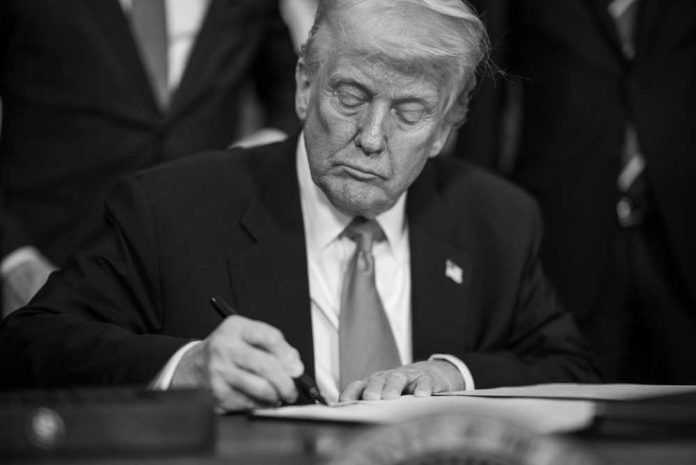
President Trump has put his signature on the nation’s most familiar bill, and the move lands as both a symbolic first and a political flashpoint.
Quick Take
- Trump shared the first image of the redesigned $100 bill on Truth Social.
- The Treasury Department said his signature will appear on future U.S. paper currency.
- Reuters reported the new bills are set to be printed in June 2026.
- The change ends a 165-year tradition tied to the Treasurer’s signature.
What Trump showed
Trump posted what he said was the new $100 bill design, drawing immediate attention because it showed his signature on U.S. currency for the first time. People reported that the image was first shared on Truth Social, and that CNN described him as the first sitting president to put his own signature on a bill. The image is the main public visual tied to the announcement.
The Treasury Department backed up the broader policy change in March, saying Trump’s signature would appear on future paper currency with the Secretary of the Treasury. Reuters reported that the new notes would be printed in June 2026 and that the change would end a 165-year run in which the Treasurer’s signature appeared on the bills instead. Treasury said the redesign is meant to honor the 250th anniversary of U.S. independence.
NEW: President Trump unveiled the new $100 bill design, featuring his signature above Treasury Secretary Scott Bessent's. The change follows a Treasury policy update, while lawmakers continue pushing for a separate $250 bill with Trump's portrait. pic.twitter.com/oF6VVE58IX
— Ernie Anastos (@ErnieAnastos7) July 5, 2026
Why this matters
The design is more than a novelty. It places a sitting president’s name and signature on money, which has long been treated as a shared national symbol rather than a personal one. Reuters said this would be the first time in history that a sitting president’s autograph appears on American money. That makes the move stand out even in a period when Trump’s team has leaned hard into branding across public life.
For supporters, the bill fits the idea of celebrating the country’s 250th anniversary with bold symbolism. For critics, it raises the same concern that comes up in many Trump-linked projects: where does public commemoration end and personal image-building begin? The research package also notes that some outlets and fact-checkers have questioned the image’s authenticity, while the Treasury has not released a full official specimen for outside verification.
What is still unclear
Two important gaps remain. First, the Treasury statement says the signature will appear, but it does not say whether that signature is a printed facsimile or some other production method. Second, the public record in the research does not give a clear rollout date for circulation beyond the June printing timeline reported by Reuters. That leaves the exact path from announcement to wallet still partly open.
The broader context also adds fuel to the story. House Democrats have separately accused Trump-backed Freedom 250 efforts of misleading donors and lacking transparency, while ethics critics have raised pay-to-play concerns around related commemorative projects. Those fights are not proof about the bill itself, but they help explain why this currency move has triggered suspicion far beyond the usual debate over design.
Sources:
facebook.com, people.com, reuters.com, youtube.com