
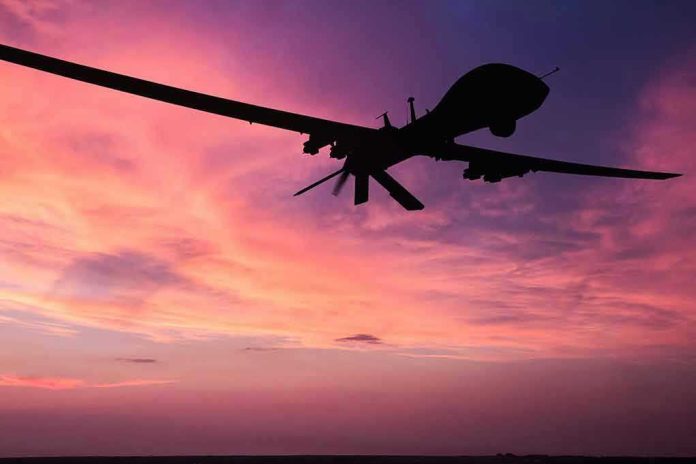
A JetBlue pilot says his airliner was hit by a drone near New York’s busiest airport, but officials claim they cannot find a scratch.
Story Snapshot
- A JetBlue pilot reported colliding with a drone at 3,000 feet while approaching JFK, triggering a federal investigation.[2]
- Post-flight inspection found no damage or physical evidence on the Airbus A321, raising doubts about what really happened.[1]
- The case highlights how often officials ask the public to “trust the system” even when key facts do not line up.
- Both supporters and critics of strict drone rules see reasons to question whether regulators and industry are being fully transparent.[8]
What The Pilot Reported In The Sky Over JFK
On Monday morning, JetBlue Flight 948 from Las Vegas was on final approach to John F. Kennedy International Airport when the pilot radioed that the jet had collided with a drone.[2] Federal Aviation Administration (FAA) officials said the report came at about 7:15 a.m. at roughly 3,000 feet, a critical phase of flight near a major city airport.[1][2] Air traffic control audio captures the pilot saying, “we collided with a drone back there in the turn,” and confirming it “hit us right above the cockpit.”[1]
According to news reports, the jet, an Airbus A321, continued to land safely, and passengers deplaned normally without knowing much about the scare.[2][3] Flight tracking data show the plane followed its planned route from Las Vegas to New York and arrived on schedule.[7] JetBlue later said the pilot had reported a “possible drone encounter,” a softer phrase than the firm words heard on the radio, which already hinted at uncertainty that would grow on the ground.[2]
This morning, JetBlue Airbus A321-231 (N979JT) operating flight B6948 from Las Vegas to New York JFK reported a drone strike while on approach to JFK.
According to the crew, the drone struck the aircraft just above the cockpit at approximately 3,000 feet around 7:15 a.m. The… pic.twitter.com/VJNVOoBrW5
— Turbine Traveller (@Turbinetraveler) June 29, 2026
What Investigators Found – And Did Not Find – On The Ground
After landing, JetBlue pulled the aircraft from service and mechanics carried out a detailed post-flight inspection.[1][2] Both the FAA and JetBlue say they found no damage and no signs of any impact anywhere on the jet.[1][2][4] That means no dents, cracked windows, chipped paint, or drone debris, even though the pilot believed the object hit just above the cockpit, an area where even small marks are usually obvious on modern aircraft.[1]
The lack of physical evidence puts this case in a gray zone that aviation officials know well. Pilot reports of drones have surged in recent years, especially near airports, yet very few turn into confirmed damaging strikes.[12][17] A study using bird-strike data found that most collisions in the sky, even with hard objects, do not cause damage, and serious damage is rarer still.[8][10] That history gives regulators room to downplay single incidents, but it also feeds public doubt when stories change and details stay vague.
Why This Strange Case Fuels Public Distrust
For many Americans on both the right and the left, this incident touches a deeper worry: powerful institutions seem more focused on managing public reaction than telling the full story. The FAA quickly confirmed the report but has not named any drone operator or shown radar or tracking data that could back up the pilot’s account.[2][15] Officials say they are investigating, yet there is no information about suspects, confiscated equipment, or clear next steps, which leaves a hole that people fill with their own doubts.
Aviation experts and industry groups are also not neutral players. Drone advocates often stress that the odds of a damaging collision are extremely low and warn against “overreacting” with harsh regulations that hurt business and hobby flyers.[8] Airport and airline leaders, on the other hand, have strong incentives to secure more funding and authority by pointing to drone threats.[12][13] When money and power are at stake on all sides, many citizens see yet another example of a system that works for the connected few, while ordinary travelers are kept in the dark.
What This Says About Safety, Technology, And Accountability
This case also shows how modern technology can both help and fail us. Drones are banned near airports, and unauthorized flights can bring heavy fines and even criminal charges, yet enforcement still depends on finding a small device and its operator in a huge city.[1][11][15] Officials say they receive around one hundred drone sighting reports each month near airports, but there is no clear, public record that tells citizens which ones were confirmed, which were false alarms, and what penalties were actually imposed.[1][12][17]
As the skies grow more crowded with small aircraft, the gap between what insiders know and what the public is told becomes more important. When a pilot says, “we collided with a drone,” but the official story becomes “no damage, nothing to see here,” people on both sides of the political spectrum reasonably ask who is being protected.[1][2] Without full data, photos, and follow-up, every unexplained incident like JetBlue Flight 948 makes it harder to believe that the government and big companies are putting safety and honesty ahead of public relations and profit.
Sources:
[1] Web – ‘We Hit a Drone’ — JetBlue Pilot’s Chilling Report Over JFK
[2] X – JetBlue Pilot reports striking a drone at 3000ft …
[3] Web – FAA Investigates JetBlue Drone Strike – AVweb
[4] YouTube – JetBlue pilot reports striking drone as flight approached JFK Airport
[7] Web – JetBlue pilot reports hitting drone while landing at JFK … – CNN
[8] Web – B6948 (JBU948) JetBlue Flight Tracking and History – FlightAware
[10] Web – JetBlue pilot reports hitting drone while landing at New York’s JFK
[11] Web – Strategic Market Analysis for Global Travel Trade Pioneers
[13] Web – Do Consumer Drones Endanger the National Airspace? Evidence …
[15] Web – A review on collisions between drones and aerostructures
[17] Web – Aviation Watchdog Report – March 2025