

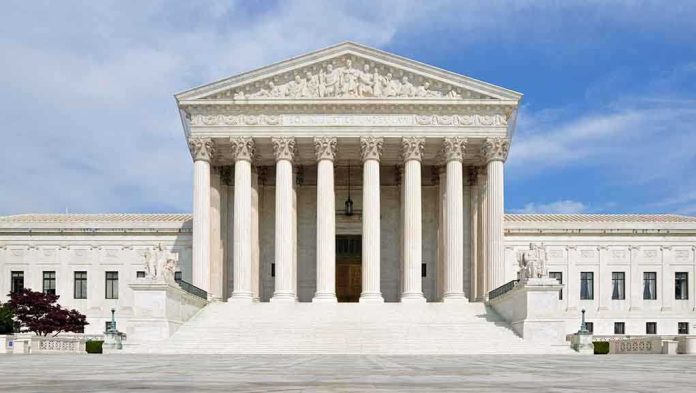
The Supreme Court has cleared the way for states to count some mail ballots that arrive after Election Day, preserving a rule that now affects millions of voters and reignites the fight over how much control states have over elections.
Quick Take
- The Supreme Court ruled 5-4 that Mississippi may count mail ballots postmarked by Election Day and received within five days.[5]
- The decision protects similar grace-period laws used in many states and territories.[2][11]
- Supporters say the rules keep voters from being punished for mail delays outside their control.[2][12]
- Critics say ballots should be received by Election Day to protect confidence in election rules.[1][5]
The ruling settles a major legal fight
Justice Amy Coney Barrett wrote for the majority that federal election-day laws do not stop Mississippi from counting timely mailed ballots that arrive later.[5] Mississippi law allows absentee ballots postmarked by Election Day to be counted if they reach officials within five business days. The court said the voting choice must be made by Election Day, but the counting can happen later under state law.[5]
The decision follows years of litigation over the meaning of Election Day. The Republican National Committee argued that federal law means ballots must be received by Election Day, not just mailed by then.[11] The Fifth Circuit accepted that view before the Supreme Court reversed it.[1][4] The ruling now leaves Mississippi’s system in place and protects similar rules in other states that use grace periods.
Why the case mattered beyond Mississippi
The case matters because it reaches far past one state. The Brennan Center for Justice says about 30 states, the District of Columbia, and three territories have some form of grace period for late-arriving mail ballots.[2] The National Conference of State Legislatures has said sixteen states count a mail ballot if it is postmarked by Election Day and received later.[1] That means the ruling helps keep a large share of current mail voting rules intact.
Supporters of grace periods say they protect voters from postal delays and other problems outside their control.[2][12] They also point to history, saying similar rules have existed in past decades, including the 1920s, 1930s, and the years before the Covid-19 pandemic.[2] In 2024, the Brennan Center said at least 750,000 ballots were postmarked by Election Day and arrived during grace periods, showing the practical reach of the policy.[2]
The political fight is far from over
The justices did not erase the political tensions around mail voting. Justice Samuel Alito’s dissent said the majority’s ruling raises troubling election-law questions and could harm confidence in election integrity.[1] That message will likely shape future attacks on grace periods, especially from Republicans who have framed mail-ballot rules as vulnerable to abuse. At the same time, the majority opinion gives states a stronger legal shield when they choose to count ballots that were mailed on time.
Today's decision by the Supreme court 5-4 to allow mail in ballots to be counted after election day is the more reason we need to pass the Save america act now.
This is why Trump issued an executive order for USPS to not send any mail in ballots to states that didn't clean…
— Matthew Zimmerman 🇺🇸 (@MattZimmerman26) June 29, 2026
The bigger story is not just one ballot deadline. It is the growing clash between state flexibility and national efforts to tighten election rules. For many voters, especially those who rely on the mail, the ruling avoids a hard cutoff that could discard valid votes over delivery delays. For critics, it keeps alive the same distrust that has turned election administration into another front in America’s political warfare.
Sources:
[1] Web – Supreme Court says states can count mail ballots that arrive after …
[2] Web – The Supreme Court upholds grace periods for mail-in ballots, siding …
[4] Web – What could the Supreme Court’s decision in Watson v. RNC mean …
[5] YouTube – Stakes of Supreme Court case on grace period for mail-in ballots
[11] Web – The Supreme Court rules that states can count mail-in ballots that …
[12] Web – Watson v. Republican National Committee – Ballotpedia