

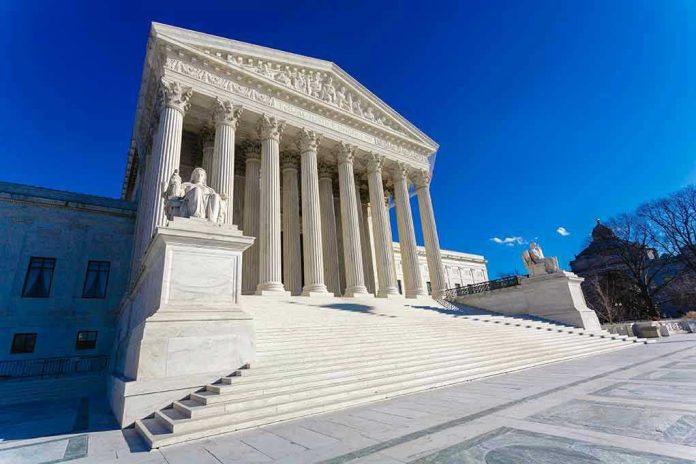
When a sitting senator says adding justices and capping their time on the bench are “on the table,” it signals both parties now see the Supreme Court itself as a political battlefield, not a neutral backstop.
Story Snapshot
- Sen. Raphael Warnock says Supreme Court term limits and adding seats should stay “on the table” if Democrats regain power.
- He ties these ideas to anger over recent voting rights rulings that weaken protections against racial gerrymandering.[4]
- Supporters frame this as saving democracy; critics see it as partisan court-packing that threatens judicial independence.[3][6]
- Both left and right worry that powerful elites are reshaping the courts to lock in their own power, not to serve the people.
What Warnock Actually Said About Court Expansion and Term Limits
Senator Raphael Warnock of Georgia has made clear he does not want to rule out changing the Supreme Court itself. In a June 2026 interview on YouTube, he said that reforms including “term limits” and “expansion of the court” are among “a number of reforms on the table.” He added, “given the crisis we’re in… all of those things have to be on the table” and stressed that “everything should be on the table.”[4] That goes beyond a one-off remark and sounds like an open invitation to structural change.
Warnock links his call for possible expansion and term limits directly to recent Supreme Court decisions on voting rights. He describes a new ruling that narrowed Section 2 of the Voting Rights Act as “devastating” and “a massive blow” to voting rights, and he says it poured fuel on a “redistricting arms race.”[4] In his view, the Court has not just decided a legal question. It has tilted the playing field in favor of those already in power, especially in how districts are drawn in the South.
Why He Frames It as “Saving Democracy,” Not Just Grabbing Power
Warnock does not talk about court expansion and term limits as stand-alone moves. Instead, he wraps them into a larger “democracy” agenda aimed at voting rules, dark money, and ethics. In that same interview, he calls for the John Lewis Voting Rights Advancement Act, which would ban racial and partisan gerrymandering, and he argues for enforceable ethics rules for Supreme Court justices as a “good first step.”[4] Only then does he list term limits and expansion as other options to consider.
He also leans on his background as a pastor and civil rights voice. In campaign-style messaging and speeches, Warnock has said “democracy is the house we live in” and accused “MAGA politicians, some of them on the Supreme Court,” of “burning and looting” that house.[5] That kind of language tells his base this is a moral fight as much as a legal one. He is asking voters to see the Court not as distant judges in black robes, but as another arena where powerful interests can either protect or crush ordinary people’s votes.
How Critics See Court Expansion: A Dangerous “Packing” Move
Conservatives and many institutionalists hear something very different when a senator says “everything should be on the table” after a ruling he does not like. For years, Republicans have warned that expanding the Court is classic “court-packing,” a tactic used to intimidate or overrule judges who make unpopular decisions.[3] Party research memos blast Democrats for “leaving the door open” to adding justices and note that lawmakers have floated ideas like adding seats or rotating lower-court judges through the Supreme Court.[3]
Legal critics also argue that term limits clash with the Constitution’s guarantee that federal judges “hold their Offices during good Behaviour,” which has long been read as life tenure unless a judge is impeached. A House Judiciary Committee witness recently stressed that this traditional view has been shared by justices from both parties.[6] From this side, Warnock’s reforms do not look like a fix for democracy. They look like a direct shot at judicial independence that would let whichever party controls Congress and the White House try to remake the Court whenever it is unhappy.
Why This Fight Resonates With Americans Who Distrust the “Deep State”
Many Americans across the spectrum already feel like the system is rigged, and the Supreme Court fight taps into that anger. Warnock points to “dark money” and the Citizens United ruling as proof that billionaires and corporations have too much influence over who becomes a judge and what cases win.[4] Grassroots conservatives see the same Court as the last shield against what they call runaway bureaucracy, woke culture rules, and election games in blue cities. Each side thinks the other team captured the system long ago.
What both sides often share, even if they do not admit it, is a belief that regular voters have almost no voice in how the rules are set. Whether it is a Democratic senator talking about adding justices, or a Republican leader warning about court-packing, the debate rarely includes detailed plans for how these changes would protect ordinary citizens from abuse by the powerful. That gap feeds the sense that, once again, Washington’s fights are about who gets to control the machine, not about restoring equal justice under law.
Sources:
[3] YouTube – ‘Democracy Is on Fire’: Warnock’s Warning About the Supreme Court
[4] Web – Senator Reverend Warnock Testifies Before Senate Finance …
[5] Web – Senator Raphael Warnock sits down with the hosts of Politically …
[6] Web – Sen. Raphael Warnock – AFL-CIO