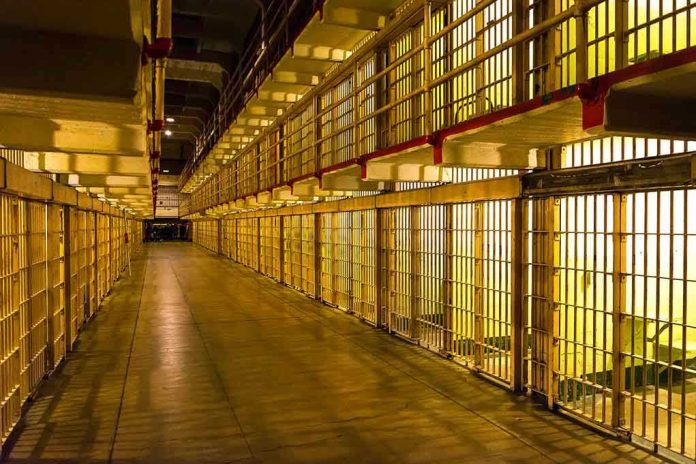
Alcatraz is back in Washington’s budget books—and that single line item could turn America’s most famous prison museum into a working cage again.
At a Glance
- The White House placed a $152 million request in the FY2027 budget draft to start rebuilding Alcatraz as a modern high-security prison.
- The proposal follows President Trump’s earlier social media directive to reopen and expand Alcatraz for “ruthless and violent offenders.”
- Alcatraz has operated as a National Park Service tourist site for decades; changing that would trigger a control fight and local backlash.
- Early estimates referenced in coverage peg a full rebuild around $2 billion, reviving the same cost problem that helped shut it down.
The Budget Request That Reopens an Old Argument About Crime
The White House’s fiscal year 2027 budget proposal asks for $152 million to begin rebuilding Alcatraz into a “state-of-the-art secure prison” under the Federal Bureau of Prisons. Congress still has to review it, and budget proposals can die quietly, but the symbolism is loud: a return to physical separation of the worst offenders from everyone else. That message lands with voters who want consequences to look like consequences again.
https://www.youtube.com/post/UgkxQk-kOl-W4YNDSfQ8b2l3SoJmhnY82Ua7
The politics are predictable, but the mechanics matter more than the slogans. A functioning federal prison requires staffing pipelines, transport procedures, court access, medical care, and hard infrastructure that meets modern standards. A tourist destination needs ferries, visitor safety protocols, and park rangers. The proposal implies a shift in mission from National Park Service stewardship to Bureau of Prisons control, which is never just a paperwork swap.
Alcatraz Was “Escape-Proof,” but It Was Also Cost-Proof
Alcatraz gained its legend between 1934 and 1963 as a federal penitentiary designed for maximum control, with San Francisco Bay’s cold water and currents serving as natural barriers. The facility later closed and, by 1969, the federal government had walked away from the prison mission altogether. The driving reason was not romance or reform; it was expense. Reports of operating costs far above other prisons still loom over every reopening fantasy.
Today’s question is whether modern construction and logistics can make the island cheaper to run than it was decades ago. The common-sense conservative answer: “Maybe,” but only if planners admit what the original Alcatraz actually was—an extreme solution with extreme overhead. Ferries, fuel, staffing premiums, emergency response, and maintenance in salty air do not get cheaper because the building is iconic. The budget request is only year one; the hard bills come later.
Two Agencies, Two Missions, One Rock in the Middle
Alcatraz now functions as a major tourist attraction under the National Park Service, which means its incentives center on access, preservation, and visitor experience. The Bureau of Prisons, by contrast, optimizes for security, controlled movement, and reduced outside contact. Those missions collide. A prison cannot share space with sightseeing lines, and a tourist economy does not applaud losing a marquee destination. Any transition would require decisions about land control, staffing authority, and what happens to existing visitor infrastructure.
The White House request effectively invites Congress to pick a side, because appropriations decide reality. If lawmakers fund the initial rebuild, they also inherit the downstream obligations: long-term operating costs, security upgrades, and interagency disputes that become headlines when something goes wrong. Opponents already frame it as wasteful; supporters frame it as overdue seriousness. Nancy Pelosi’s reported dismissal—calling it the “stupidest initiative yet”—signals the partisan temperature and the certainty of a noisy fight.
Why the “Tourist-to-Prison” Flip Appeals to Tough-on-Crime Voters
Alcatraz is a brand. Americans who grew up hearing about the “escape-proof” Rock understand, in one word, what “high-security” means. That is why the proposal resonates beyond policy circles. It offers a simple public promise: the most violent offenders go somewhere the public can picture, far from neighborhoods and far from soft treatment. That clarity aligns with conservative instincts about order, deterrence, and the moral requirement to protect law-abiding people first.
Symbolism, however, does not house inmates by itself. Federal prison policy has to answer practical questions: who qualifies as “most violent,” how transfers occur, what legal and medical access looks like, and whether creating one headline-grabbing facility distracts from broader capacity and safety problems elsewhere in the system. A super-secure island prison might strengthen deterrence messaging, but deterrence also depends on arrest certainty, prosecution follow-through, and sentences that mean what they say.
The Real Test: Can Congress Fund a Legend Without Buying a Money Pit?
The proposal sits at an early stage: a non-binding budget request awaiting congressional review, with no construction started. Coverage has pointed to a potential total cost around $2 billion, which would make the $152 million request feel like a down payment on a much larger commitment. Fiscal conservatives should treat that gap as the center of the debate. If the goal is public safety, Washington must explain why this project beats alternatives in cost per secure bed.
Alcatraz’s return, if it happens, will not be decided by nostalgia or movie posters. It will be decided by line-item scrutiny: security design, transport realities, staffing plans, operating costs, and whether the federal government can manage an interagency handoff without turning a national landmark into a political bonfire. The idea sells because it feels like accountability. The execution only works if it looks like stewardship—of money, of safety, and of priorities.
Sources:
https://logos-pres.md/en/news/trump-requested-152-million-to-rebuild-alcatraz-prison-closed-in-1969/
https://whbl.com/2026/04/03/trump-seeks-152-million-to-reopen-alcatraz-as-active-prison/