

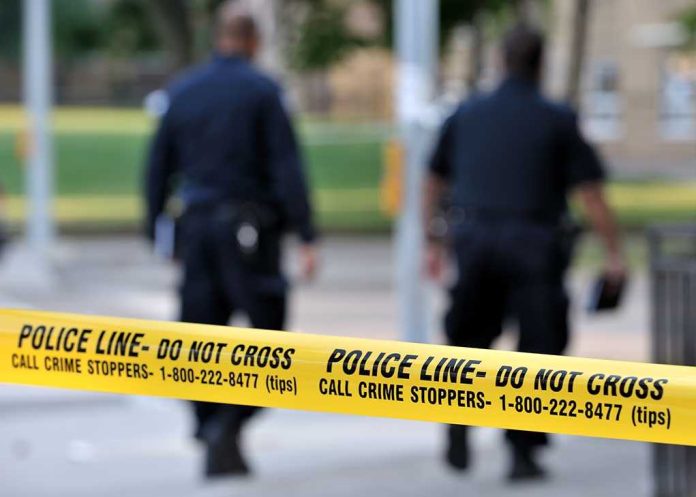
Neighbors on Seattle’s Aurora Avenue counted shell casings by the handful, then dragged planters into the street because they decided waiting for help felt more dangerous than blocking a road.
Story Snapshot
- Residents reported four shootings in 72 hours on the same block, with bullets hitting homes and cars [3].
- Police collected roughly 40 shell casings at scenes, confirming heavy gunfire near Aurora Avenue [3].
- Neighbors erected barriers and planters to slow alleged prostitution- and drug-linked traffic after appeals to officials fell flat [3].
- City leaders cite more patrols and citywide crime declines, setting up a collision of corridor chaos and macro metrics [4][5].
When neighbors start stacking planters, the system has already lost the argument
Residents near 97th Street and Aurora Avenue described a blitz of gunfire compressed into days, including claims of four shootings within 72 hours and around 20 shots in one incident, with damage to homes and vehicles [3]. A father said a round hit the wall above his six-week-old baby; another neighbor woke to find his fourth-floor apartment struck [3]. Police documented the scale on the ground, recovering roughly 40 shell casings at nearby scenes, a detail that anchors fear in physical evidence [3].
Neighbors said they pleaded with the mayor’s office, city council, and police for action and got little they could touch, measure, or sleep through without flinching [3]. They responded by turning side streets into speed bumps with planter boxes and barriers to disrupt the late-night economy they blame for the gunfire [3]. That approach tracks with community policing doctrine, which says residents become active partners when formal enforcement alone does not stem threats to safety and quality of life [3].
Police say crime is falling; the corridor says “come stand on my porch at 2 a.m.”
Seattle’s police chief highlighted citywide progress: fewer shootings and shots-fired calls, homicides trending down sharply, and officer hiring moving toward records [4]. The city maintains an official crime dashboard that lets anyone track those indicators across time and geography [5]. Those claims do not erase the experience on Aurora, but they complicate blanket assertions of inaction. Conservative common sense separates two truths: a city can be improving on paper while a specific block is getting hammered and needs targeted help now.
Residents draw a stark line between talk and outcomes. The mayor’s office pointed to increased emphasis patrols and gun-violence-unit deployments along Aurora during late-night, early-morning windows, yet neighbors judged the impact insufficient when bullets still reached living rooms [3]. That disagreement is not about whether patrol cars exist; it is about whether they interrupt the nexus of drive-up solicitation, drug dealing, and retaliatory violence that residents say travels the corridor under cover of darkness.
Blocking streets is a signal flare—and a legal minefield
Community self-help arrives quickly because it works fast: barriers change traffic patterns in hours, not quarters. But planter walls are a legal soft target. City transportation officials can remove unauthorized obstructions, which means residents risk seeing their sweat-equity defenses hauled away by morning crews without a replacement plan that calms the street after sundown. A policy vacuum encourages improvisation; a clear enforcement model—officer presence, predictable interdiction, and swift consequences—makes improvisation unnecessary.
Terrified Seattle neighborhood builds massive barricade across streets amid horrific crime wave https://t.co/FhOKxk9bZ0
— Sanford Tillman (@sgtilltwtr) May 26, 2026
Measured next steps align with both prudence and data. The Seattle Police crime dashboard can spotlight micro-hotspots and hours that align with resident reports, guiding beat-level deployments that disrupt the corridor’s illicit marketplace rather than chasing its aftermath [5]. Community policing principles support structured resident partnerships—lighting, cameras pointed at public rights-of-way, and coordinated reporting—without inviting vigilante risk [3]. Public safety gets durable when the city pairs visible order maintenance with targeted enforcement that deters, not just responds.
Sources:
[3] Web – [PDF] Understanding Community Policing – Office of Justice Programs
[4] YouTube – Seattle police chief sees progress in hiring, response to violent …
[5] Web – Crime Dashboard – Police | seattle.gov