

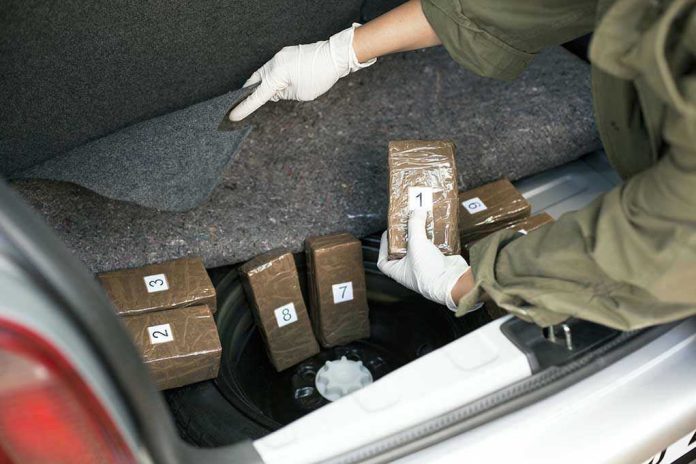
Traffic stopped for a simple violation on a Kentucky interstate ended with 55 pounds of methamphetamine unwrapped from Christmas paper, exposing how deeply cartel-level drug trafficking now hides in America’s holiday traffic.
Story Snapshot
- Troopers on I-75 in eastern Kentucky seized over 55 pounds of meth disguised as wrapped Christmas presents.
- The load’s street value topped $1 million, enough to fuel months of addiction and crime in rural counties.
- The bust exposes how cartels exploit holiday travel, family imagery, and America’s busiest corridors.
- The case highlights a deeper battle: law enforcement versus a meth pipeline running straight through Appalachia.
How A Routine Stop Turned Into A Million-Dollar Christmas Bust
Kentucky State Police troopers from Post 11 pulled over a northbound vehicle on I-75 in Laurel County two days before Christmas, allegedly for a basic traffic violation near mile marker 38. The driver, a 32-year-old man from neighboring Knox County, probably expected the stop to end with a warning or a ticket. Instead, a trained K-9 named Maso walked the perimeter, alerted to the scent of narcotics, and quietly shifted the entire tone of the encounter.
Troopers opened the vehicle and found what looked like someone’s holiday generosity: multiple neatly wrapped Christmas presents, the sort of packages you might toss into a trunk on the way to grandma’s house. Once unwrapped, those “gifts” revealed roughly 55 pounds (about 25 kilograms) of crystal methamphetamine, packaged for transport and worth more than $1 million on the street. The seizure became one of eastern Kentucky’s largest meth busts of 2024 and a stark reminder that drug traffickers study America’s habits as closely as any marketer.
Why Cartels Love America’s Holidays And Highways
Drug traffickers did not pick Christmas wrapping paper because they love tinsel. They picked it because they understand how people think, and they bet heavily on our desire to see what we expect instead of what is there. Highways like I-75 form a known pipeline from southern hubs up through Appalachia to the Midwest, and December travel adds cover: packed trunks, out-of-state plates, families on the move, and sympathetic assumptions from other drivers and, they hope, from police.
Cartel suppliers shifted long ago from local “shake-and-bake” meth labs to high-purity product shipped in bulk along interstates that cut through states like Kentucky. Wrapping loads as Christmas gifts works on two psychological levels. First, it blends visually with the season. Second, it subtly pressures officers to question whether they want to be the grinch who rips open someone’s presents. The only reason this scheme failed is because troopers trusted training and a dog’s nose more than holiday optics.
The High Cost Hidden Inside 55 Pounds Of Meth
Fifty-five pounds of meth is not just a number in a press release; it is thousands of individual doses that ripple through rural communities already stretched by addiction, broken families, and overrun court dockets. Street pricing estimates suggest a load like this could fuel months of local distribution across Laurel, Knox, and neighboring counties, where high poverty rates and limited treatment access create ideal conditions for meth to take root.
Each pound taken off the road removes countless opportunities for burglaries, assaults, and fatal overdoses that often follow meth use. Conservative common sense says policing has to treat interdiction like a form of prevention, because the public ultimately pays either on the front end through serious enforcement or on the back end through welfare costs, foster care, and funerals. A single seizure like this can save taxpayers hundreds of thousands of dollars in downstream damage, even before you count the lives spared.
What This Bust Reveals About Traffickers, Police, And Policy
The unnamed 32-year-old driver probably did not design the operation. Most mules sit near the bottom of a hierarchy that stretches into cartel territory, swapping personal risk for a payoff that rarely matches the danger. Law enforcement understands this dynamic, which is why large seizures with no immediate public arrest often signal a deeper investigation aimed at identifying suppliers and networks instead of just the courier unlucky enough to meet a K-9 on the interstate.
For Kentucky State Police and partnering federal agencies, the bust supports a strategy built around saturating key corridors like I-75, using K-9 teams, data-driven patrol patterns, and grant-backed operations to keep pressure on traffickers. Critics sometimes claim traffic stops become pretexts for broader searches. The counterpoint, aligned with traditional American law-and-order values, is straightforward: if a lawful stop and a trained dog uncover 55 pounds of poison disguised as presents, the greater injustice would be looking the other way in the name of theoretical concerns while real families bury loved ones.
Sources:
Lexington Herald-Leader (herald-leader.com)
Kentucky State Police – Official Press Release (ksp.ky.gov)
DEA National Drug Threat Assessment (dea.gov)