

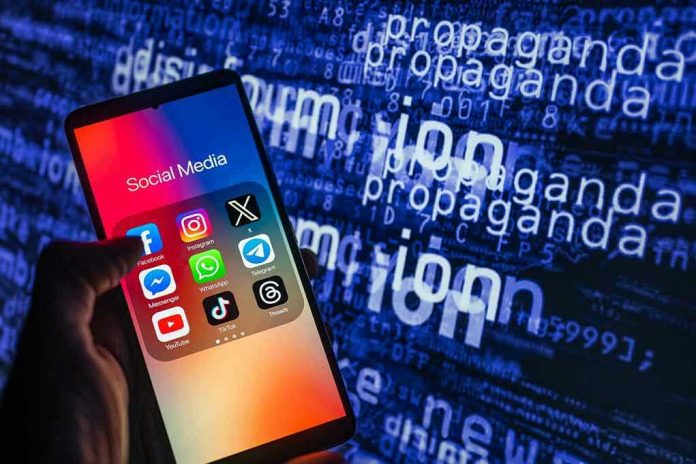
Russia’s sweeping internet crackdown has silenced the last remaining Western communication platforms for over 100 million citizens, forcing them onto a state surveillance “super-app” just as election season begins—a chilling blueprint for digital totalitarianism that should alarm every American who values free speech and privacy.
Story Snapshot
- Russia fully blocked WhatsApp and YouTube on February 11, 2026, via DNS manipulation after months of phased restrictions targeting 93-100 million users
- Telegram was throttled starting February 9-10, degrading media and voice messaging to coerce migration to Max, a Kremlin-backed surveillance app
- Roskomnadzor justified the crackdown under fraud and data protection laws, while Kremlin spokesman Dmitry Peskov promoted Max as a “convenient alternative”
- Experts warn the graduated ban model offers a replicable template for authoritarian regimes worldwide, accelerating the splintering of the global internet along geopolitical lines
Digital Iron Curtain Descends on Russian Communications
Russia executed a coordinated digital blackout on February 11, 2026, removing WhatsApp and YouTube domains from the national DNS system, effectively erasing access for millions of citizens who relied on these platforms for family communication and business operations. This represents the culmination of restrictions that began in August 2025 with blocked voice and video calls, escalating through October 2025 when new user registrations were prohibited and traffic throttling commenced. By December 2025, connection failures exceeded ninety percent, extending even to Apple FaceTime and Snapchat. The systematic approach contrasts sharply with Russia’s failed 2018 Telegram ban, which collapsed after two years due to technical limitations and public resistance.
State-Backed Max App Fails to Gain Traction Without Coercion
The Kremlin’s push for Max, a VK-integrated “super-app” designed to replace Western services, has faltered without forced migration through communication platform shutdowns. Roskomnadzor began throttling Telegram on February 9-10, 2026, citing non-compliance with anti-fraud and data protection laws, though Telegram founder Pavel Durov condemned the action as surveillance-driven censorship on February 10. Kremlin spokesman Peskov defended the WhatsApp block on February 12, explicitly promoting Max as the state’s preferred alternative. The timing coincides with 2026 State Duma elections, revealing the government’s priority to control information flows during a politically sensitive period. Analysts note that even pro-government Telegram channels face disruption, demonstrating the indiscriminate nature of these restrictions that punish ordinary Russians alongside dissidents.
Phased Censorship Model Threatens Global Internet Freedom
Russia’s graduated restriction strategy—employing DNS tampering, traffic throttling, and selective feature blocking rather than immediate total shutdowns—marks a qualitative shift from previous censorship attempts and offers authoritarian regimes a more sustainable playbook. The approach builds on 2019 legislation authorizing ISP hardware installations for surveillance and throttling, which enabled regional Telegram tests in 2024-2025 across the Far East, Dagestan, and Volgograd. Signal and Discord were already blocked in 2024, followed by Instagram and Facebook after the 2022 Ukraine invasion, leaving WhatsApp and Telegram as the last major Western encrypted platforms. Experts warn this creates a template for internet splintering along geopolitical lines, fundamentally threatening the open internet that conservatives recognize as essential for free commerce and speech. Activist Sarkis Darbinyan predicts intensified VPN countermeasures, while analyst Epifanova notes the DNS tampering escalates Russia’s digital wall to unprecedented scale.
Surveillance State Expansion Mirrors Leftist Tech Control Dreams
The compulsory migration to Max represents precisely the kind of government-mandated technology adoption that erodes individual liberty and privacy—core conservative principles that distinguish free societies from authoritarian regimes. VK and Max developers, operating under Kremlin backing, benefit directly from eliminating competition through state force rather than market innovation. The public and education sectors face compulsion to adopt Max, with businesses bearing migration costs while losing secure communication channels. The 93-100 million affected users, representing over sixty percent of Russia’s population, include non-political citizens whose family and business communications are now monitored. This government overreach should resonate deeply with Americans who have witnessed Big Tech’s collaboration with leftist censorship efforts. Russia’s model demonstrates the endgame of state-controlled digital infrastructure: total surveillance justified under fraud prevention and data protection—the same pretexts often invoked by regulatory overreach advocates domestically.
Economic and Social Disruption Hits Ordinary Citizens Hardest
The immediate impact extends far beyond political activists, disrupting daily life for millions of ordinary Russians who depend on WhatsApp for family connections and business operations. Short-term consequences include a sharp surge in VPN adoption, though the state actively counters these workarounds with additional restrictions. Businesses face costly platform migrations while losing reliable international communication tools, hampering commerce and professional relationships. Social friction intensifies as families struggle with disrupted communications, and even pro-government Telegram channels experience strain from throttling measures. Long-term projections indicate near-zero availability of unmonitored Western platforms, accelerating Russia’s digital isolation that began with Facebook and Instagram blocks in 2022 and Signal’s blocking in 2024. The civil society and independent media sectors face particularly severe constraints, limiting information flow during election periods when government accountability matters most.
Sources:
Russia’s WhatsApp Ban: Digital Sovereignty and the Splintering of the Global Internet
The Insider: Russia’s Phased Restrictions on Messaging Platforms
Max Cometh: What The Blocking Of WhatsApp, Telegram Means for Russia
As Kremlin Throttles Telegram, Russians Stand to Lose More Than Just Messaging
Russia is Cracking Down on WhatsApp and Telegram: Here’s What We Know