

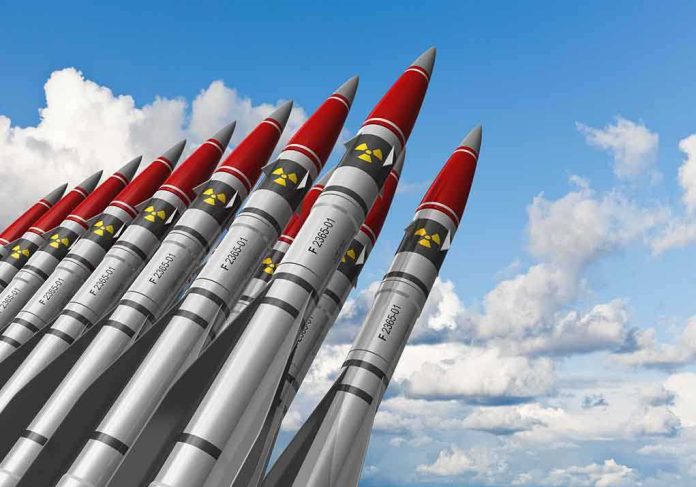
Russia’s nuclear posturing near European borders is a calculated move to send chilling signals rather than actual threats of destruction.
Story Snapshot
- Russia’s Oreshnik missile illustrates nuclear capability without actual warhead deployment.
- Strategic missile positioning close to EU borders amplifies psychological impact.
- Russia’s hybrid warfare strategy includes disinformation and infrastructure sabotage.
- Arms control collapse fuels nuclear rhetoric and strategic unpredictability.
Russia’s Calculated Nuclear Signals
Russia’s deployment of the Oreshnik intermediate-range ballistic missile near Ukraine’s Lviv region sends a powerful message to Europe. The missile’s ability to reach Mach 10 speeds and a range of up to 5,000 kilometers positions it as a potent symbol of Russia’s military prowess. Although the missile reportedly carried no warhead, its proximity to European Union borders served as a stark reminder of the potential reach of Russian military might.
This strategic deployment is not an isolated event. It forms part of a broader hybrid warfare campaign by Russia, designed to exert psychological pressure on NATO capitals. The positioning of nuclear-capable systems near Western borders acts as a nuclear warning shot, signaling Russia’s willingness to escalate tensions if Western support for Ukraine continues. This deliberate show of force is as much about influencing European decision-makers as it is about showcasing military capability.
Historical Context and Arms Control Collapse
Europe’s reliance on nuclear deterrence has roots in the Cold War era, with arms control agreements like the INF Treaty and New START playing pivotal roles. However, the demise of these treaties, particularly the expiration of the INF Treaty, has removed critical constraints on Russia’s weapons development. As the New START approaches expiration without extension, the lack of binding limits fuels uncertainty and strategic unpredictability, enhancing the potency of Russia’s nuclear rhetoric.
The escalation of nuclear threats by Russia aligns with its broader geopolitical objectives. By creating an atmosphere of uncertainty, Russia seeks to deter Western intervention in Ukraine while maintaining its sphere of influence. The strategic relocation of nuclear-capable assets, coupled with overt nuclear rhetoric, serves to fracture Western unity and complicate NATO’s efforts to maintain credible deterrence.
Hybrid Warfare and European Response
Russia’s hybrid warfare campaign extends beyond nuclear posturing. With a three-pronged strategy targeting European defense infrastructure, information warfare, and military coercion, Russia is executing a comprehensive plan to destabilize the continent. Sabotage incidents, such as attacks on defense production infrastructure and Ukraine-bound supply chains, disrupt military support and drain resources.
Information warfare during key elections amplifies pro-Russian populist messaging, potentially shifting European governments toward restraint in their support for Ukraine. Meanwhile, increased airspace and naval violations, coupled with nuclear rhetoric, create ongoing psychological pressure on European nations. These tactics expose vulnerabilities in Europe’s deterrence architecture, highlighting the need for strategic autonomy and independent deterrence capabilities.
Strategic Implications and Future Risks
The erosion of arms control agreements and the rise of hypersonic weapons blur the lines between conventional and nuclear domains. This technological disruption demands updated strategic planning and complicates traditional deterrence calculations. The psychological pressure exerted by Russia’s nuclear signaling challenges NATO’s resolve, potentially weakening support for Ukraine and fracturing the alliance.
Long-term implications include increased nuclear proliferation risks and the potential for uncontrolled escalation. Europe’s political fragmentation and economic constraints further limit its ability to formulate decisive responses. As pro-Russian populist parties gain traction, the risk of NATO cohesion fracture becomes increasingly pronounced. These dynamics underscore the urgent need for Europe to develop robust deterrence mechanisms and adapt to the evolving security landscape.
Sources:
CEPA (Center for European Policy Analysis)