

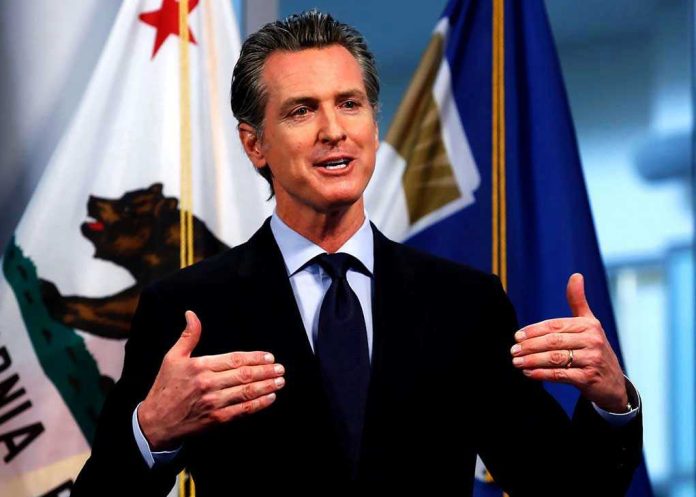
California’s high-speed rail just surged past a $135 billion price tag, and Gavin Newsom is still celebrating it as a “success story” while taxpayers are left holding the bag.
Story Snapshot
- Newsom used his 2025 State of the State to praise California’s troubled high-speed rail despite exploding costs and years of missed promises.
- The project’s full build is now projected around $130–135 billion, up from early estimates of roughly $30–40 billion.
- Supporters tout climate benefits and construction jobs, while critics see a symbol of government waste and mismanagement.
- As Trump’s second-term reforms emphasize accountability and spending discipline, this California mega‑project stands as a cautionary tale.
Newsom Celebrates a Project Taxpayers Still Can’t Ride
Gov. Gavin Newsom used his 2025 State of the State address to defend and celebrate California’s high‑speed rail as a legacy climate and jobs investment, even though trains are still years away from carrying passengers. He framed the system as a model for green mobility and economic growth, leaning heavily on talking points about union jobs and long‑term environmental gains. For many taxpayers, the spectacle of a victory lap without a finished product reinforces anger at political class priorities.
Newsom’s cheerleading comes as the project’s estimated full‑build cost for the San Francisco–Los Angeles/Anaheim system has surged into the $130–135 billion range, more than triple the early promises made to voters in 2008. That original pitch sold high‑speed rail as a roughly $30–40 billion, self‑financing modern miracle that would pay for itself through ridership and private investment. Instead, Californians have watched deadlines slip, budgets balloon, and scope change while political leaders insist everything is “on track.”
From $9.95 Billion in Bonds to a $135 Billion Behemoth
The modern saga began in 2008, when Californians narrowly approved Proposition 1A, authorizing $9.95 billion in state bonds for a high‑speed line linking San Francisco and Los Angeles with trains reaching 220 miles per hour. Early boosters pointed to global examples in Europe and Asia as proof the concept could be built quickly and efficiently. Over time, lawsuits, route fights, environmental reviews, and changing political demands helped transform that sleek vision into a sprawling, ever‑more expensive megaproject.
By the mid‑2010s, heavy construction focused on a 119‑mile initial segment in the Central Valley, far from the dense coastal cities voters first imagined riding between. Even that shorter stretch has been slow and costly, with complex bridges, viaducts, and grade separations dominating the landscape while no revenue service exists. Each new business plan and project update has brought revised timelines, higher cost ranges, and more “phased” promises, breeding skepticism among residents who remember all the confident assurances made when the bonds were approved.
Central Valley Construction, Climate Rhetoric, and Jobs Claims
State officials now highlight visible progress in the Central Valley to argue the project is finally turning a corner. They point to about 171 miles under design and construction between Merced and Bakersfield, nearly 70 miles of completed guideway, and dozens of major structures finished or underway. Supporters stress that more than 15,800 construction jobs have been created, with up to 1,700 workers on site daily, and nearly $22 billion in total economic output they attribute to high‑speed rail‑related spending.
The current plan targets completing the Merced–Bakersfield high‑speed segment around 2032, with hopes of connecting San Francisco to Los Angeles or Anaheim closer to 2038–2039, if funding cooperates. Backers package the line as the only true high‑speed rail system under construction in North America and a cornerstone of climate‑era transportation. For many conservatives, this framing sidesteps a basic question: is an over‑budget, decade‑late project that still lacks an operating train a responsible use of taxpayer dollars in a state already struggling with crime, homelessness, and out‑migration?
Funding Guarantees, Government Priorities, and a Stark Contrast with Trump’s Agenda
To keep the rail authority afloat, California lawmakers locked in a long‑term “Cap‑and‑Invest” funding stream expected to deliver roughly $1 billion a year through 2045. Combined with prior bonds and federal grants, the authority reports about $14.7 billion already invested, with state taxpayers shouldering more than four‑fifths of that sum. Recent board actions approved another $507 million for materials and advanced a $3.5 billion track-and-systems contract, further committing future budgets to a project decades from full completion.
For readers watching President Trump’s second‑term push to rein in wasteful spending, secure the border, and roll back bloated bureaucracies, California’s rail experiment illustrates the opposite model of governance. Where Trump emphasizes accountability, results, and skepticism of grand globalist schemes, Sacramento continues to double down on a megaproject that has repeatedly missed its own benchmarks. The contrast raises hard questions about priorities: infrastructure that works for families now, or political monuments paid for by generations to come.
Sources:
California High-Speed Rail Accelerates Timeline for 2026 Rail Installation
California High-Speed Rail: 2026 Contracts and Milestones
California High-Speed Rail Authority CEO Aims to Accelerate Construction
BuildHSR – California High-Speed Rail Construction
California High-Speed Rail Authority – Official Site