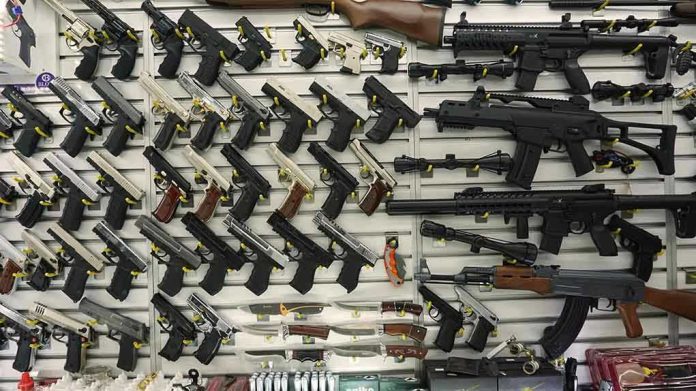
Canada’s gun buyback program calls itself voluntary, yet failing to surrender newly prohibited firearms after the October 2026 amnesty deadline can result in up to 10 years in federal prison.
Story Snapshot
- Over 2,500 firearm models banned since May 2020 with mandatory buyback framed as voluntary participation
- Final amnesty deadline of October 31, 2026 protects owners temporarily, but post-deadline possession becomes criminal offense
- Pilot program on Cape Breton yielded only 25 firearms from 16 owners versus 200 expected guns
- Costs ballooned from initial $400-600 million estimate to potentially $2 billion with only $41.9 million spent by 2023
- Most provinces refuse cooperation, with only Quebec providing police resources for collections
The Voluntary Mandate Contradiction
Prime Minister Justin Trudeau’s Liberal government enacted the assault-style firearms ban through executive Order-in-Council on May 1, 2020, initially targeting roughly 1,500 firearm models including AR-15 and Ruger Mini-14 rifles. The designation expanded to over 2,500 models by 2022. Owners face what officials call a “buyback,” implying choice, but the underlying prohibition makes continued possession illegal once amnesty periods expire. Licensed gun owners must surrender weapons for compensation, permanently deactivate them, or face Criminal Code charges for possessing prohibited firearms.
The government provides temporary amnesty periods to prevent immediate criminalization, with the current deadline set for October 31, 2026. A declaration portal launched January 17, 2026 allows owners to register eligible firearms before receiving surrender instructions. This framework creates an unusual legal paradox—participation appears voluntary during amnesty, but becomes compulsory under threat of imprisonment. The prohibition reclassifies previously legal property as contraband, transforming law-abiding hunters and sport shooters into potential criminals for simply keeping what they legally purchased.
Four Years of Delays and Dysfunction
Since the 2020 announcement, the program has lurched through false starts and bureaucratic paralysis. Phase 1 targeted business inventories through a Canadian Sporting Arms and Ammunition Association contract, identifying approximately 11,000 firearms from retailers. Phase 2 for individual owners remains stalled with no firm timeline despite repeated government assurances. Public Safety Canada spent $41.9 million by late 2023, hiring 60 staff members while the actual collection infrastructure languishes incomplete. The autumn 2025 pilot on Cape Breton Island became a cautionary tale—authorities expected 200 firearms but collected merely 25 from 16 owners.
Provincial resistance compounds federal frustrations. By January 2026, only Quebec agreed to provide provincial police for collections, while Saskatchewan and Alberta actively banned their law enforcement from participating. This jurisdictional standoff leaves gun owners in most provinces uncertain how they will physically surrender firearms even if willing. The Canadian Sporting Arms and Ammunition Association, despite opposing the ban philosophically, expressed puzzlement at the government announcing milestones without operational budgets or coherent processes. Former Public Safety Minister Marco Mendicino called Phase 1 a success in 2023, yet no clear path emerged for the vastly larger Phase 2 affecting hundreds of thousands of privately owned firearms.
The Prison Time Reality Behind Voluntary Language
Canada’s Criminal Code carries severe penalties for unauthorized possession of prohibited weapons—fines and imprisonment up to 10 years depending on circumstances. Once the October 2026 amnesty expires, owners who retain banned firearms without authorization face these consequences regardless of their lack of criminal intent or history. The government emphasizes the voluntary nature of choosing compensation versus deactivation, but ignores the involuntary nature of the prohibition itself. Owners cannot legally keep firearms in original condition, making “voluntary” a linguistic sleight-of-hand masking compulsory surrender.
This affects an estimated 150,000 to 500,000 firearms currently in legal private ownership, primarily owned by licensed hunters and sport shooters who underwent background checks and safety training. Automatic firearms were already banned in Canada, making the targeted semi-automatic rifles functionally similar to many unrestricted hunting rifles. Critics note criminals rarely use these specific models in crimes, questioning whether the program addresses actual gun violence or simply disarms compliant citizens. The low pilot turnout suggests many owners view the ban as government overreach and may risk noncompliance rather than surrender property they believe was unjustly prohibited.
Financial Disaster and Political Polarization
Initial cost estimates ranged from $400 million to $600 million, but current projections approach $2 billion as the program drags on without meaningful progress. Over $700 million has been budgeted for business collections alone, yet individual owner compensation remains undefined. This fiscal disaster unfolds while the RCMP and Public Safety Canada continue expanding administrative staff and infrastructure for a collection system most provinces refuse to support. Parliamentary critics including Conservative senators highlight these overruns while questioning the program’s effectiveness at reducing crime versus punishing legal gun owners.
Canadian Gun Buyback Program Is Voluntary, but Noncompliance Can Land You in Jail https://t.co/1yvxCijdye #gatewaypundit via @gatewaypundit
— Tim M (@Tmcfarlane9M) February 6, 2026
The controversy deepens Canada’s rural-urban political divide. Urban voters in Toronto, Montreal, and Vancouver generally support gun restrictions and view the ban as reasonable public safety policy. Rural communities and Indigenous groups who rely on firearms for hunting see the prohibition as disconnected Ottawa bureaucrats criminalizing their lifestyle. This mirrors debates over property rights, federal overreach, and whether executive orders should bypass parliamentary debate on major policy changes. The program sets precedent for future prohibitions and compensation schemes, making it a flashpoint for broader sovereignty and governance questions that will outlast this specific buyback.
Sources:
May 1, 2024: Canada’s Gun Confiscation Hits Four-Year Milestone
Canada Firearms Buyback CSAAA Agreement
Public Safety Canada Briefing Materials
Details of Federal Firearm Buyback Program to be Announced