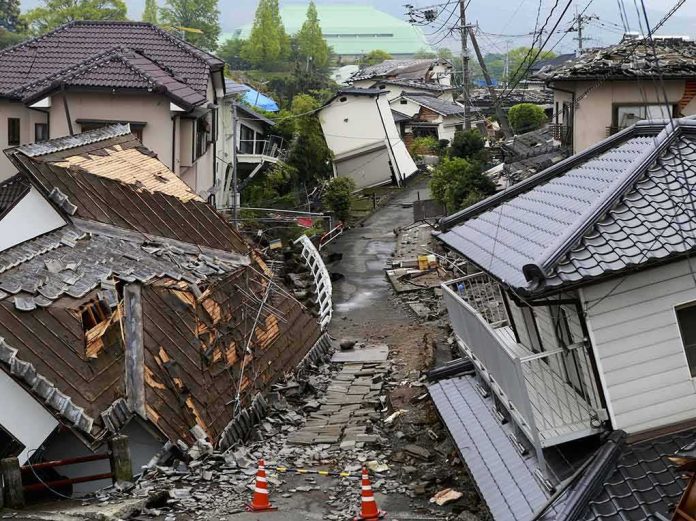
When a single Russian ballistic missile erased an entire Ukrainian family of ten in seconds, it exposed just how fragile ordinary life has become far beyond the front lines.
Story Snapshot
- A Russian ballistic missile hit the Voronov family home near Kryvyi Rih, killing ten relatives, including seven children and a grandchild.
- Local officials say the house in Radushne was struck by an Iskander-type missile launched from Russia, while President Volodymyr Zelensky now cites preliminary evidence of a North Korean weapon.
- Rescuers found six bodies and believe four more family members died, highlighting how casualty counts and identities lag behind the violence.
- The strike comes amid a wider Russian barrage with dozens of missiles and drones, underscoring how modern wars reach deep into civilian neighborhoods.
A Family Home Turned Into a Crater
On a recent Thursday, a Russian ballistic missile slammed into the Voronov family’s house in Radushne, a village near President Zelensky’s hometown of Kryvyi Rih. Officials say the blast reduced the home to rubble and left a deep crater where the yard once was. Inside were parents Artem and Olena, seven of their children, and an eighteen‑month‑old grandson, all believed to have died in the strike. Rescuers pulled six bodies from the ruins, while four more relatives remained missing but presumed dead.
Ukraine’s State Emergency Service press officer Sergiy Kovtoniuk said that, based on early information, all ten people in the house had died. President Zelensky shared a family photo and named the victims, calling the attack “a horrific crime” against an ordinary family in an ordinary home. Local reports described the children by age and even future plans, such as seventeen‑year‑old Mark training to be a railway worker in Kryvyi Rih. Those details drive home that these were not statistics, but people whose daily lives ended in an instant.
Missile Type Dispute Shows the “Fog of War”
Local Ukrainian officials first told reporters that an Iskander ballistic missile launched from Russia’s Voronezh region hit the Voronov home. That fits a broader Russian pattern of using Iskander missiles against Ukrainian cities. Hours later, Zelensky said preliminary information pointed instead to a North Korean ballistic missile used by Russia, adding that expert examinations were still underway. This shift does not change the core fact that Russia fired the weapon, but it shows how early wartime reports can change as investigators learn more.
‼️BREAKING || NINE KILLED AND 23 INJURED AS 26 RUSSIAN ISKANDER AND ZIRCON MISSILES HIT KYIV WITHOUT A SINGLE INTERCEPTION
Kyiv — The death toll from tonight's Russian ballistic and hypersonic missile attack on Kyiv has risen to nine, with 23 others injured, including four… pic.twitter.com/CGaXxTmf3R
— Bloomberg Whistleblower (@bloombergbell) August 1, 2026
Newsrooms repeated these official claims as they covered a wider Russian barrage that night, which reportedly sent more than seventy missiles and over 280 drones across Ukraine. In that fast cycle, many people heard “Russian Iskander from Voronezh” before learning of the North Korean angle. Others saw social posts focusing on the foreign origin of the missile and drew bigger conclusions about rising ties between Moscow and Pyongyang. Yet, as of now, no full public forensic report has been released with crater studies, serial numbers, or debris photos that would settle the missile type beyond doubt.
Civilian Cost and Global Skepticism
The Radushne strike is not an isolated case. Russian missiles have hit homes and apartments in cities like Kharkiv, Lviv, Odesa, and Kyiv, killing children and wiping out families. Each attack raises the same hard questions: Why are homes becoming war zones, and who is really being protected? For many Americans, both conservative and liberal, this feels like one more sign that global elites wage wars while ordinary families pay the price, overseas and at home in higher costs and growing insecurity.
At the same time, the mix of shifting missile labels, changing death counts, and one‑sided official sources feeds doubts for people already skeptical of any government narrative. Some see Ukraine’s reports as propaganda, while others note that Russia offers no serious alternative explanation. The deeper issue is trust: citizens in many countries now assume leaders will spin every tragedy, whether to justify more aid, more weapons, or more control. The Voronov family’s story shows how, even in clear cases of civilian harm, the fight over facts never really stops.
Sources:
cnn.com, bbc.com, english.aawsat.com, kyivpost.com, telegraph.co.uk, rferl.org, aol.com, abcnews.go.com, bbc.co.uk, aljazeera.com