

A single sentence from a campaign-style stage in Iowa exposed the real battleground in American industry: who gets to build the machines that build everything else.
Quick Take
- John Deere plans a $70 million excavator factory at its Kernersville, North Carolina campus, aimed at producing future-generation excavators once made in Japan.
- Deere also plans a new parts distribution center near Hebron, Indiana, with ground already broken, to speed delivery and reduce downtime for customers.
- The company says each site should create roughly 150 jobs, tying local paychecks to national supply-chain strategy.
- The headline claim: Kernersville could become the only excavator operation fully designed, developed, and manufactured in the United States.
The “Only U.S.-Made Excavator” Claim Raises the Stakes
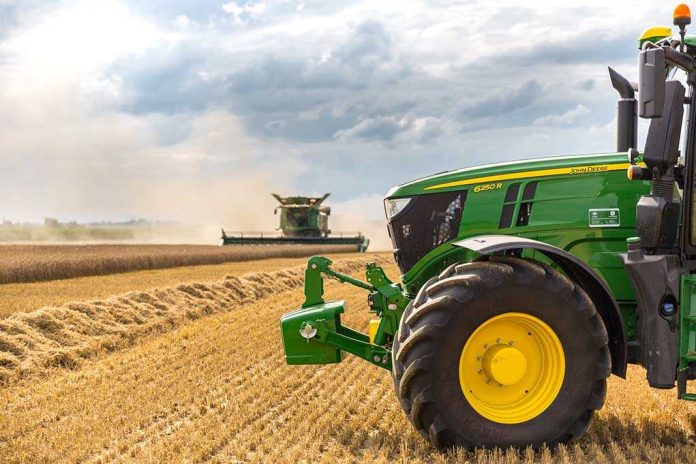
President Donald J. Trump used a speech in Clive, Iowa to spotlight John Deere’s plan: a $70 million excavator factory in Kernersville, North Carolina, plus a parts distribution center near Hebron, Indiana. The attention-grabber wasn’t the dollar figure; it was the positioning. Deere says the North Carolina facility will build future-generation excavators previously produced in Japan, and that the result will be an excavator entirely made in America.
That “only excavator” line matters because excavators sit at the front end of national capability: roads, bridges, home sites, storm cleanup, pipeline trenches, utility repairs. When your heavy iron comes from overseas, your schedules and budgets inherit overseas risk. When your heavy iron comes from home, you still have risk, but it’s risk you can argue with, regulate, and fix. That’s the practical, kitchen-table version of industrial policy.
Why Kernersville and Hebron Signal a Strategy, Not a Photo Op
Deere framed the projects as part of a long U.S. manufacturing commitment, with executives emphasizing innovation, job creation, and customer support. Kernersville becomes the focal point for excavator development and production, while Hebron becomes the logistics muscle for parts availability. People who don’t run equipment hear “distribution center” and think warehouse; equipment owners hear “less downtime,” because the right part at the right hour beats any marketing slogan.
The one-year opening window also hints at urgency. Manufacturers do not rush concrete and steel unless they see demand, risk, or both. Construction equipment demand cycles can be lumpy, but supply-chain unpredictability has become a permanent line item. Moving production from Japan to North Carolina isn’t a knock on Japan; it’s a bet that distance, shipping fragility, and geopolitical noise now cost more than they used to.
Jobs Are the Headline, but Control Is the Prize
Deere expects roughly 150 jobs at each facility, a number that will sound small to anyone remembering the employment scale of 20th-century factories. The modern reality is different: automation, robotics, and precision manufacturing mean fewer people can produce more output, if the skills are there. For Kernersville and Hebron, those jobs still matter because they seed a local ecosystem of suppliers, maintenance contractors, and skilled trades.
American conservative common sense says this plainly: work that produces tangible goods builds steadier communities than work that depends on financial gimmicks. A factory job is not “magic,” but it does tie prosperity to making something people need, not to moving paper around. If the facilities deliver the promised timelines and quality, the bigger win becomes competence: the country regains the habit of building complex machines domestically.
Deere’s Broader U.S. Footprint Makes This More Credible
One reason this announcement lands harder than a typical corporate press release is context. Deere points to a large, long-term U.S. manufacturing commitment, and it already runs a major parts operation in Milan, Illinois that has been active for decades and employs a large workforce. That existing footprint reduces the odds that Kernersville is merely a symbolic outpost; it looks more like an expansion of an established domestic network.
Markets also reacted with modest optimism around the time of the announcement, even while peers in the sector saw mixed moves. Investors can be fickle, but they usually reward clarity: a company identifies where it wants to win, invests, and explains the operational logic. Building excavators domestically and strengthening parts distribution reads like a coherent attempt to protect margins and customer loyalty during volatile demand cycles.
The Quiet Question: Can “Made Here” Stay Competitive?
The hard part begins after the ribbon cutting. A U.S.-made excavator has to compete on reliability, total cost of ownership, and delivery times, not just patriotic branding. Deere’s plan tries to address the whole chain: manufacturing in North Carolina and parts support from Indiana. If customers can get machines sooner and keep them running longer, “Made in America” becomes a performance feature, not just a bumper sticker.
Promises deserve scrutiny, especially when politicians amplify them. Deere’s statements read like standard corporate optimism, but they also match real-world incentives: reduce shipping exposure, shorten feedback loops between engineering and production, and serve customers faster. That aligns with conservative values of self-reliance and resilience, as long as the company doesn’t ask taxpayers to subsidize decisions it can justify on business fundamentals.
What to Watch Over the Next Year
The easiest numbers to track will be concrete: facility opening dates, hiring progress, and whether Kernersville actually takes on the “future-generation” excavator work previously done in Japan. The more telling signals will be operational: lead times, dealer satisfaction, and parts fill rates from the Hebron distribution center. If those indicators improve, the reshoring story gains weight beyond campaign applause lines.
If delays stack up or if production remains dependent on imported subassemblies, the “entirely made” claim will draw sharper questions. Most equipment has global components, so the phrase can be more aspirational than literal. The best-case outcome is still significant: an American campus that designs, develops, and builds a category-defining machine, and a domestic logistics backbone that keeps contractors working when schedules get tight.
(VIDEO) Trump Announces John Deere is Building $70 MILLION Factory in North Carolina – “This is Going to be the Only Excavator Entirely Made in the United States of America” https://t.co/saNwmIF6AR
— Gordon Carrico, Jr. (@GordonCarrico) January 28, 2026
The deeper takeaway is this: the country doesn’t just need more factories; it needs fewer fragile links between national priorities and foreign bottlenecks. Deere’s North Carolina and Indiana projects will either become a model of how to do that, or a reminder that reshoring is harder than announcing it on a stage.
Sources:
John Deere Announces Major Expansion With Two New U.S. Facilities
Trump says year-round E15 deal close, done; announces two new Deere facilities