

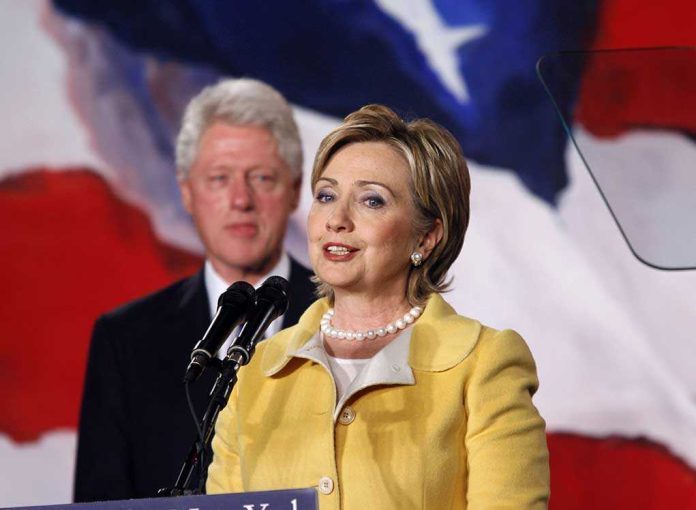
Former President Bill Clinton and former Secretary of State Hillary Clinton face an unprecedented contempt of Congress vote for refusing to testify under oath about their connections to convicted sex trafficker Jeffrey Epstein.
Story Snapshot
- House Oversight Committee advanced contempt resolutions against both Clintons after they refused bipartisan subpoenas for January 13-14, 2026 depositions in the Epstein investigation
- The Clintons are the only two individuals among ten subpoenaed witnesses facing contempt charges, despite the committee accepting written statements from former Attorneys General and FBI directors
- No former president has been compelled to testify before Congress since Gerald Ford voluntarily appeared in 1983, making this an historic enforcement effort
- Chairman James Comer rescheduled depositions multiple times over five months to accommodate the Clintons before recommending contempt proceedings
- If the full House votes for contempt, the matter moves to the Department of Justice for potential criminal prosecution
Five Months of Dodging and Delays
The House Oversight Committee approved subpoenas for both Clintons through a bipartisan voice vote in summer 2025 as part of an investigation into federal mishandling of the Epstein and Ghislaine Maxwell sex-trafficking cases. Chairman Comer originally scheduled Hillary Clinton’s deposition for October 9, 2025, and Bill Clinton’s for October 14. The Clintons never appeared. Instead, their attorneys submitted brief written statements that the committee deemed legally insufficient and non-compliant with the subpoena requirements. Federal courts have consistently ruled that witnesses cannot impose their own conditions on congressional inquiries.
Throughout late 2025, Comer’s committee offered repeated scheduling flexibility while the Clintons continued stalling. In early January 2026, depositions were rescheduled nearly a month later to January 13 for Bill and January 14 for Hillary at the Clintons’ own request. When those dates arrived, the Clintons again refused to appear, citing a funeral attendance as justification. After more than five months of negotiations that Comer described as reaching a “dead end,” the committee on January 21, 2026, marked up two reports recommending House-wide contempt votes for both former officials.
Why Only the Clintons Face Consequences
The differential treatment raises eyebrows when considering the committee’s acceptance of written statements from other high-profile figures. Former Attorneys General Eric Holder, Loretta Lynch, Jeff Sessions, and Merrick Garland all submitted written responses, as did former FBI Director James Comey. These individuals faced no contempt threats. The Clintons alone among ten subpoenaed witnesses now face potential criminal referral to the Justice Department. This distinction matters because it highlights either unique circumstances surrounding the Clintons’ Epstein connections or potential selective enforcement that undermines the committee’s stated commitment to equal justice.
Rep. Andy Biggs emphasized on the Wake Up America program that the evidence of willful disobedience appears crystal clear. Chairman Comer reinforced this position in official statements declaring that actions have consequences and no witness may willfully defy a congressional subpoena. The bipartisan origin of these subpoenas complicates partisan defenses. Democrats on the committee, including Ranking Member Garcia, previously characterized subpoena defiance as highly illegal and insisted no one stands above the law. Those prior statements now create an uncomfortable test of consistency as their party’s most prominent power couple faces the same accountability standard.
The Epstein Connection Nobody Wants to Discuss
The investigation explores federal agencies’ failures in prosecuting Epstein’s sex-trafficking operation, his suspicious 2019 death in federal custody, and the influence networks he cultivated among global elites. Recent DOJ disclosures mandated by the Epstein Files Transparency Act revealed new photographic evidence documenting Clinton-Epstein relationships. Flight logs previously showed Bill Clinton traveled on Epstein’s private aircraft multiple times, though Clinton’s representatives have long maintained he knew nothing of Epstein’s criminal activities. The committee seeks testimony rather than relying on carefully crafted written statements prepared by attorneys.
The stated legislative purpose focuses on reforming human trafficking prosecution, establishing ethics standards for officials who associated with known traffickers, and understanding how Epstein evaded serious consequences for decades. Republicans emphasize these policy goals justify compelling testimony from anyone with relevant knowledge, regardless of their former positions. Critics counter that the investigation represents partisan weaponization that ultimately harms Epstein’s victims by turning their suffering into political theater. The tension between these interpretations will likely intensify as the full House considers the contempt resolutions.
What Happens Next Could Make History
The contempt resolutions advanced from committee likely along party-line votes and await consideration by the full House of Representatives. If the House votes to hold the Clintons in contempt, the matter gets referred to the Department of Justice for potential criminal prosecution. This process mirrors the initial steps taken in previous contempt cases, but no former president has ever faced criminal charges for defying a congressional subpoena. Legal analysts note that while federal courts consistently reject witness-imposed conditions on congressional testimony, enforcement presents practical challenges when dealing with former presidents who retain significant legal resources and public support.
Syracuse Law Review analysis suggests a negotiation window technically remains open, though Comer appears committed to proceeding with consequences. The Indiana Lawyer described the contempt vote as the initial step toward a potential DOJ criminal case, acknowledging the unprecedented nature of prosecuting a former president for congressional contempt. Whether the Justice Department would actually prosecute remains uncertain, creating a situation where Congress might establish a contempt finding without meaningful enforcement. This outcome would either vindicate the Clintons’ calculated risk or further erode congressional authority to compel testimony from powerful witnesses who believe they can simply refuse to cooperate.
Sources:
Bill, Hillary Clinton risk contempt by House after missing Epstein depositions – Fox News
House Resolution Committee Amendment – U.S. House of Representatives