

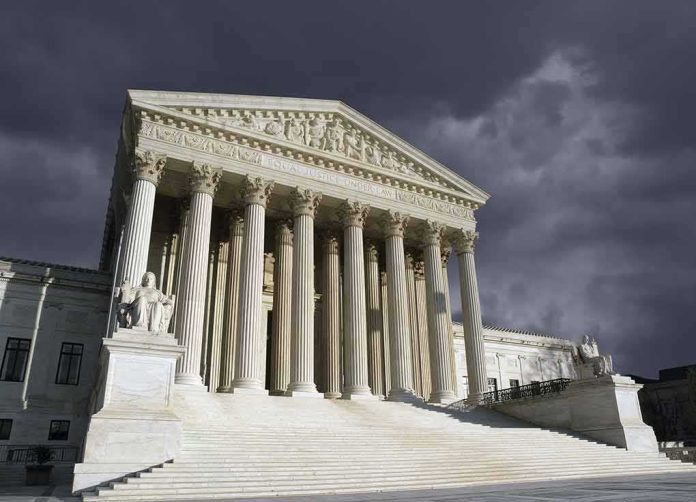
The Supreme Court will let President Trump’s Justice Department stand beside gun owners and argue that AR-15 bans break the Second Amendment, even as Cook County, Illinois, tries to get the case thrown out.
Story Highlights
- The Court granted the federal government 10 minutes to argue against AR-15 bans when it hears the case on Wednesday, December 2.
- The government says lawmakers may not ban guns that are in common use by law-abiding Americans.
- The case pairs Cook County’s gun ban with a similar ban in Connecticut.
- Cook County is asking the Court to drop its half of the case after the lead plaintiff asked to withdraw.
The Government Gets a Seat at the Table
On Monday, November 9, the Supreme Court granted a request from Solicitor General D. John Sauer to join the oral argument in Viramontes v. Cook County. The Solicitor General is the lawyer who argues for the United States before the Supreme Court. Sauer will speak as an amicus curiae, Latin for “friend of the court,” meaning an outside party that is not part of the lawsuit but offers its view. The government asked to take part because, in its words, “The United States has a substantial interest in the preservation of the right to keep and bear arms.”
Under the plan the government proposed, the gun owners get 20 minutes, the United States gets 10, and the governments defending the bans get 30. The gun owners’ lawyers agreed to share their side of the hour. The order is not a ruling on whether the bans are legal. It means the Justices will hear the federal government’s view in person.
What the Solicitor General Will Argue
The government laid out its case in a brief, a written argument, filed in September. Its core rule is simple: “Legislatures may not ban arms in common use among law-abiding citizens for lawful purposes.” The brief says the AR-15 is “the most popular rifle in the country.” It cites estimates that at least 16 million Americans own one and that at least 28 million AR-style rifles are in circulation. It also notes that the AR-15 is legal under federal law and in 40 states, while ten states and the District of Columbia ban it.
The brief argues that lower courts went wrong when they upheld the bans by calling the rifles “military-grade” or too dangerous. It says the Supreme Court’s past rulings, including the 2008 Heller decision that confirmed an individual right to keep a gun at home, rule out that reasoning. The government says both Cook County’s ban and Connecticut’s ban fail that test.
Why It Matters That Washington Joins
The federal government has argued as a friend of the court in the biggest gun cases of the modern era, including Heller in 2008 and Bruen in 2022. This time it is lining up with the gun owners against a county and a state. The case is consolidated, meaning the Court joined it with Grant v. Higgins, a challenge to Connecticut’s ban, so the government’s argument covers both laws at once.
Cook County’s Bid to End Its Case
The order came days after a surprise. On Thursday, October 29, the gun owners’ lawyers asked the Court to drop Cutberto Viramontes, the lead plaintiff, from the case. The filing gave no reason. “No other petitioner is seeking dismissal, so this case remains pending as to all other petitioners,” attorney David H. Thompson wrote.
On Thursday, November 5, Cook County filed what is called a suggestion of mootness, a request that the Court treat the case as having no live dispute left to decide. The county says the remaining plaintiff, Chicago resident Christopher Khaya, wants an IMI Galil rifle rather than an AR-15, so he lacks standing, the legal right to sue that comes from being personally harmed. The gun rights groups still in the case, the Firearms Policy Coalition and the Second Amendment Foundation, say the county’s ban covers the Galil too. According to reports, the county concedes the Court can still rule on Connecticut’s ban either way. The Court has not acted on the county’s request.
What the Bans’ Defenders Say
Cook County State’s Attorney Eileen O’Neill Burke, the county’s top prosecutor, argues that AR-15-style rifles are “offensive weapons of war designed for maximum lethality” and are not commonly used for self-defense. Illinois Attorney General Kwame Raoul and other state attorneys general say governments have long regulated unusually dangerous weapons. The City of Chicago leads a coalition backing the county’s ban.
What to Watch on December 2
When the Justices take the bench on Wednesday, December 2, the first fight may be over whether the Cook County half of the case is still alive. Then comes the big question: whether a government can outlaw a rifle that millions of Americans own. With the Solicitor General at the lectern, the gun owners will not stand alone. The challengers say the answer could reach far beyond one county, to every state that bans these rifles.
Sources:
supremecourt.gov, supremecourt.gov, justice.gov, justice.gov, cities929.com, cookcountystatesattorney.org, chicago.gov