
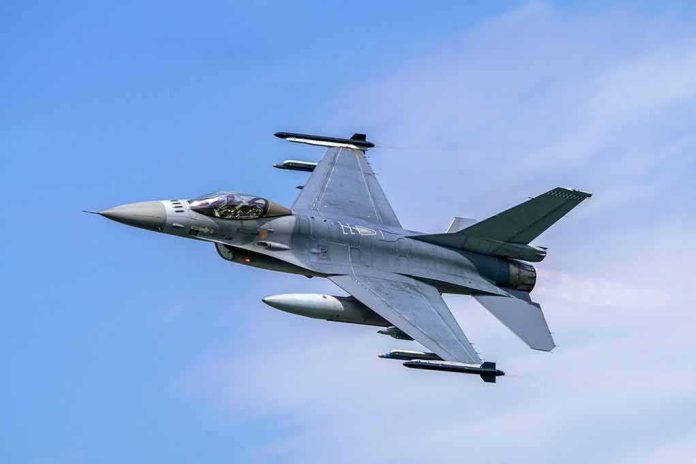
A civilian plane wandered into the restricted airspace over Camp David on Saturday morning while President Trump was there. A NORAD F-16 got to it first, and when the pilot did not respond, the fighter fired flares to get his attention. By Saturday evening the president had left the retreat, earlier than planned and without explanation.
As of Saturday, September 19, NORAD says the aircraft was escorted out of the zone with no injuries or damage. The pilot’s identity and reason for the incursion have not been released, and the White House has not said why the weekend was cut short.
Story Highlights
- NORAD said an F-16 intercepted a civilian aircraft near Camp David and used flares to get the pilot’s attention.
- The intercept happened around 7:50 a.m. Eastern on Saturday while President Trump was at the retreat.
- The jet escorted the plane out of restricted airspace; no injuries or damage were reported.
- Trump returned to the White House Saturday evening, ahead of schedule; no reason was given, and no link to the intercept has been stated.
Fighter Jet Intercepts Civilian Plane During Trump’s Camp David Stay
North American Aerospace Defense Command reported that a Continental U.S. Region F-16 intercepted a civilian aircraft after it entered restricted airspace over Camp David at about 7:50 a.m. Eastern on Saturday. President Trump was spending the weekend at the presidential retreat when the intercept occurred. The fighter deployed bright flares to catch the pilot’s attention and then escorted the plane out of the area, according to multiple outlets citing the command’s statement.
NORAD describes flares as a standard tool for communicating with pilots who do not respond to radio calls or visual signals. They burn out quickly and are designed not to harm people on the ground. Officials call the flares a controlled step meant to signal the pilot, not a warning shot or combat action, a point the command has made after similar events.
Then The Weekend Ended Early
Hours after the intercept, reports said the president departed Camp David and returned to the White House on Saturday evening, earlier than his published schedule. No explanation was offered. The same reports noted that Israeli Prime Minister Benjamin Netanyahu abruptly shortened his own U.S. visit the same day, canceling a Texas stop and flying home. Nothing official ties the two departures to each other or to the morning’s intercept; the timing is what has people asking.
Restricted Airspace And What Pilots Must Do
Camp David sits under a permanent no-fly zone that expands when the president is present. Pilots are expected to check notices and avoid the restricted ring around the retreat. When a plane strays in, interceptors follow a set script: pull alongside, rock the wings, and direct the pilot to turn away and contact controllers on the emergency frequencies 121.5 or 243.0 megahertz.
Federal Aviation Administration guidance says intercepted pilots must follow visual and radio instructions without delay. If the pilot fails to respond, the interceptor may use flares. The procedures are built to resolve airspace breaches fast and safely, without risking people on the ground or in the air.
What We Still Do Not Know
Officials did not release the pilot’s identity, route, or reason for the incursion, and there is no official indication that the aircraft posed a direct threat to the president or the facility. The White House has not explained the early return. Until either question is answered, the record is a routine intercept and an unexplained change of plans on the same day.
The message from the command is the same one it gives after every breach: treat it as serious, move fast to correct it, and use standard signals that protect lives and hold the security perimeter. That part, at least, went as designed.
Sources:
facebook.com, ntd.com, yahoo.com, wionews.com