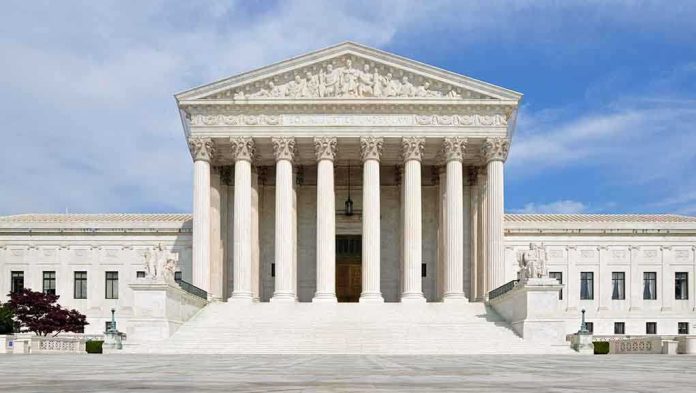
On Sunday, September 13, Pete Buttigieg used NBC’s Meet the Press to endorse expanding the Supreme Court to 15 justices — the first time a leading Democratic presidential prospect has put a number on court packing on national television this cycle. He framed it as a cure for partisanship. Republicans heard something else.
Story Snapshot
- September 13: Pete Buttigieg endorsed a 15-justice “balanced bench” model on Meet the Press.
- He said the goal is a less partisan Court, not adding seats “for its own sake.”
- Congress, not the Constitution, sets the Court’s size, which has changed before.
- The Court has been fixed at nine justices since Reconstruction, making changes rare.
Buttigieg’s On-Air Proposal and Rationale
Pete Buttigieg told NBC’s Meet the Press on September 13, 2026, that “the number is secondary,” but he supports a model with 15 justices to encourage more independent decisions. He described a “balanced bench” where five of the seats would require consensus among the others to fill. He said the aim is to reform the institution to make it less partisan, not to add seats for advantage. He framed expansion as one way to rebuild public faith in rulings.
Buttigieg tied his argument to concerns about how the Court handles high-impact cases. He said a larger, structured Court could cool the partisan heat that now surrounds nominations and decisions. His remarks place him among Democrats who have floated Court changes after rulings on abortion, guns, and agency powers. He did not present bill text or a timeline. He focused on the principle that the Court’s structure should push justices toward independence over party loyalty.
What The Law Allows and What History Shows
The Constitution does not set the number of Supreme Court justices. Congress sets the size by law, and presidents sign those laws. During the nation’s first century, Congress changed the Court’s size more than once for reasons tied to growth and circuit design. Since the late 1860s, however, the number has stayed at nine, and attempts to change it have sparked fierce backlash. Franklin Roosevelt’s 1937 plan to add up to six seats failed in Congress.
Legal summaries from the Congressional Research Service say scholars almost all agree Congress has the power to change the Court’s size, at least for practical reasons like caseload. Academic reviews note that while size changes did occur in the 1800s, modern proposals to expand the Court often raise fears about political capture and long-term damage to judicial independence. That is why expansion efforts today face steep political and public hurdles even when legally possible.
Where This Stands Right Now
Today’s fight follows a common pattern: one side sees the Court as out of step and seeks structural reform, while the other side calls that “court packing” and a threat to norms. Buttigieg’s 15-justice idea fits that mold. Supporters argue expansion could dilute partisanship and steady public trust. Critics warn any party that changes the size for power invites the other to answer in kind, risking a spiral of tit-for-tat that erodes the Court’s standing over time. No bill has been introduced, and Buttigieg offered no timeline.
Mayor Pete Buttigieg @PeteButtigieg referred to the United States Supreme Court as a nakedly partisan institution as he called for packing SCOTUS during his appearance on Meet the Press this morning.
Mayor Pete said:
“It has become a nakedly partisan institution… Although I… https://t.co/VlWU4nEMJZ pic.twitter.com/qJVeTiouwY
— Loomer Unleashed (@LoomerUnleashed) September 13, 2026
The stakes go beyond legal theory. The Supreme Court rules on speech, guns, elections, immigration, health care, and the reach of federal agencies. Families feel these calls in daily life. Voters on the right and left share a fear that powerful insiders keep bending rules to lock in wins. Proponents say a “balanced bench” could check that trend. Opponents say expansion would prove the point, showing politicians can rewrite guardrails whenever they have the votes.
Sources:
thegatewaypundit.com, legalinsurrection.com, transcripts.cnn.com, nbcnews.com, x22report.com, npr.org, jonathanturley.org