

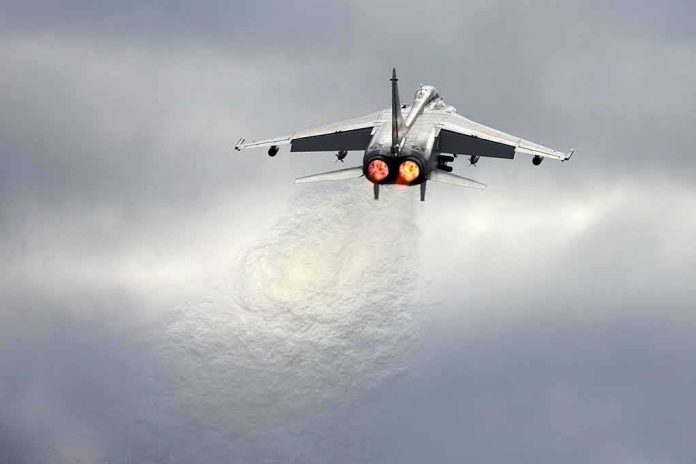
A senior U.S. official says American forces struck Iran’s Qeshm Island after Iran’s Revolutionary Guard fired at a U.S. aircraft.
Story Highlights
- Three U.S. officials confirmed limited, defensive strikes near the Strait of Hormuz on Monday, November 2.
- A senior U.S. official said the target was Qeshm Island, after Iran’s Revolutionary Guard fired at an American aircraft.
- The strikes came on the eve of the Tuesday, November 3, midterm elections, as U.S. and Qatari mediators work on a deal.
- President Trump said a deal “could happen,” but also said several Iranian sites still have to be dealt with.
- Trump said the target was an anti-aircraft site that took Iran about two months to build, and “as soon as it was completed — we hit it.”
U.S. Strike Description And Stated Trigger
On Monday, November 2, the U.S. military launched limited, defensive strikes on Iranian targets near the Strait of Hormuz, three U.S. officials said. A senior U.S. official said the strikes hit Qeshm Island after Iran’s Islamic Revolutionary Guard Corps fired at an American aircraft. The Revolutionary Guard is the branch of Iran’s military that answers directly to the country’s supreme leader. A U.S. official said the strikes were limited and were not a return to major combat.
Officials described a second incident the same day, according to reports: U.S. forces stopped an Iranian missile fired from Qeshm at commercial shipping. Iranian state media reported a series of blasts on the island. U.S. Central Command, which runs American forces in the Middle East, did not put out a statement on the strikes. Iranian officials have not formally confirmed a direct attack on the island, according to reports.
Why Qeshm And The Strait Of Hormuz Matter
Qeshm is the largest island in the Persian Gulf. It sits in the Strait of Hormuz, the narrow sea lane between Iran and Oman that carries about one in five barrels of the world’s oil. Iran uses the island to try to control ship traffic through the strait, according to reports.
For Americans, the strait is about prices. Rising costs tied to the closure of the Strait of Hormuz have cut into support for President Trump and the Republican Party, according to reports. The U.S. military’s own estimate, as of mid-October, puts the cost of the war at $47.1 billion or more. About $29 billion of that is for replacing spent munitions. The figure leaves out damage to U.S. bases that Iranian drones and missiles have targeted.
Administration Goals: Defend Without Escalating
The war is in its ninth month, and President Trump has gone back and forth between talk of a deal and threats of more sustained strikes. In a Truth Social post on Monday, November 2, he said a deal “could happen” and that Iran wants a settlement as soon as possible. U.S. and Qatari mediators are brokering the talks.
That same night, Trump said the U.S. still has to “take care of” several Iranian sites, including Pickaxe Mountain, which houses a suspected nuclear site. He called that job “not a big deal” and said it could be done in about an hour. Israeli Prime Minister Benjamin Netanyahu pushed Trump for more sustained strikes in a weekend phone call, according to reports. Trump confirmed the call and called it a “very good talk,” but did not say what they discussed.
What This Means For Readers At Home
On Tuesday, November 3, Trump called the Qeshm strike a “minor attack, it wasn’t a war.” He said the target was an anti-aircraft site that took Iran about two months to build, and “as soon as it was completed — we hit it.” The White House is running two tracks at once: answer fire at American aircraft, and keep a deal on the table. For families paying more at the pump, a calm and open strait is the prize on both tracks.
What To Watch Next
Iran’s parliament speaker, Mohammad Bagher Ghalibaf, warned on Tuesday, November 3, that any U.S. strategic mistake would open “a new battlefield in the war.” He said, “The ball is in America’s court to prevent war.” Trump has floated restarting hostilities after the midterms, but he has not announced a decision. Officials have not released which weapons were used or what damage the strikes did.
Sources:
cbsnews.com, stripes.com, usnews.com, cnbc.com, haaretz.com