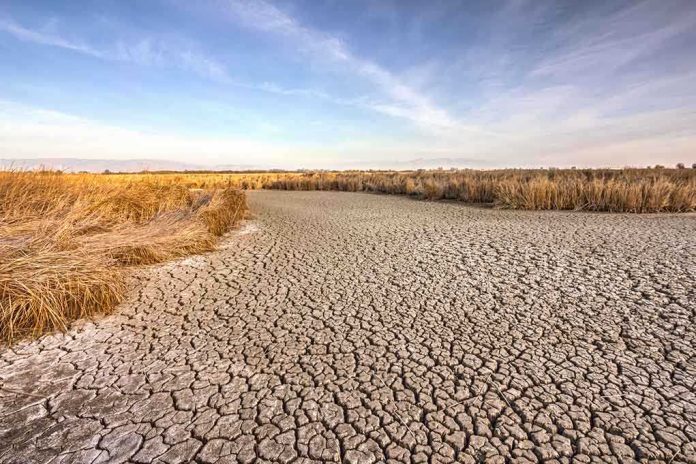
America’s largest reservoir has fallen to a new all-time low, tightening the screws on water, power, and trust in basic government planning.
Story Snapshot
- Lake Mead set a record low after years of drought, heat, and weak snowpack.
- NASA images show steep losses in a short time during the drought years.
- Experts link the drop to both arid conditions and long-standing overallocation.
- Lower water threatens Hoover Dam hydropower and raises rate and reliability risks.
Record Low Marks a New Phase in the Colorado River Crisis
Reporters and agencies say Lake Mead has hit its lowest level since the reservoir first filled, capping years of decline driven by heat, drought, and poor snowpack that feeds the Colorado River. The drop underscores a broader crisis across the basin that serves about 40 million people. The new low narrows the buffer for cities, farms, and tribes that depend on storage to ride out dry years. It also crowds Hoover Dam’s power operations, where falling water reduces output.
NASA records show how fast levels can fall when drought bites. One analysis found that in only three years, the lake’s surface dropped more than sixty feet during a sustained dry spell. Such steep declines stress every system tied to the reservoir, from boat ramps and marinas to intake pipes and turbines. The visual evidence is hard to miss. A bright “bathtub ring” marks the old shoreline. Exposed coves and stranded docks show how far the edge has retreated.
Causes: Drought, Heat, Weak Snow, and Human Demands
Scientists and water managers point to a mix of causes. Extended drought has cut the river’s flows. Hotter air boosts evaporation from open water and dry soils. Warmer winters mean less mountain snow and earlier melt, which reduces steady runoff into the lake. On top of that, the river was promised to more users than it can now supply. An Arizona State University expert called the reservoirs the region’s “savings account,” drawn down for decades amid a 25-year dry run.
Hydrologists add concrete numbers to the picture. One expert told reporters the lake can lose more than six feet of depth each year to evaporation alone, and recent hot springs and early summers likely speed that loss. The United States Bureau of Reclamation and the National Park Service have described a historic drought interacting with human use to keep levels low. Together, these forces push storage down and make each new heat wave or weak snow year hit harder.
What the New Low Means for Power, Prices, and Daily Life
Lower water weakens hydropower at Hoover Dam because there is less pressure to spin the turbines. When the lake falls, power output drops, and operators may need to buy more electricity elsewhere. That can raise costs for towns, farmers, and small businesses across the Southwest. If levels fall far enough, some turbines risk shutting down. That scenario would force a pivot to other sources that can be more expensive and less stable during peak heat.
LAKE MEAD SINKS INTO THE 1,030s AS WATER CRISIS DEEPENS
Lake Mead just crossed into territory we’ve never seen before.
The massive reservoir has now fallen below 1,040 feet, with the latest reading hovering around 1,039.8 feet.
That puts Lake Mead at its lowest level since it… pic.twitter.com/VZbxqwS3t1
— Michael Bradbury (@MrMBB333) August 13, 2026
Families and businesses are already seeing the ground truth. Boat ramps close. Water intakes need extensions. Local officials warn of tighter conservation rules and possible cutbacks. For many readers on the left and right, this feels like one more sign that leaders waited too long. Agencies argued and modeled while the water slipped away. People now want straight talk, usable plans, and clear accountability, not another round of studies while shorelines keep dropping.
Why This Hits a Nerve Across the Political Spectrum
Western water has long mixed natural limits with political deals. This crisis exposes both. Conservatives see strained power grids and higher bills as the cost of poor planning. Liberals see the burden falling hardest on working families and small towns. Both worry that distant elites will protect themselves first. The record low is not abstract. It touches water taps, electric rates, farm jobs, and city growth plans. It also tests whether government can act before the next heat wave lands.
What to Watch Next: Snowpack, Deals, and Hard Choices
Outcomes now hinge on a few levers. First, winter snow in the Rockies must improve and arrive on time. Second, states and tribes must update rules so use matches what the river can deliver today, not last century. Third, power planners need backup when hydropower dips. NASA’s record of rapid losses warns against delay. A run of dry winters or one more brutal summer can erase gains fast. Durable cuts and smarter use will matter more than one wet season.
Sources:
weather.com, newsweek.com, science.nasa.gov, cbsnews.com