

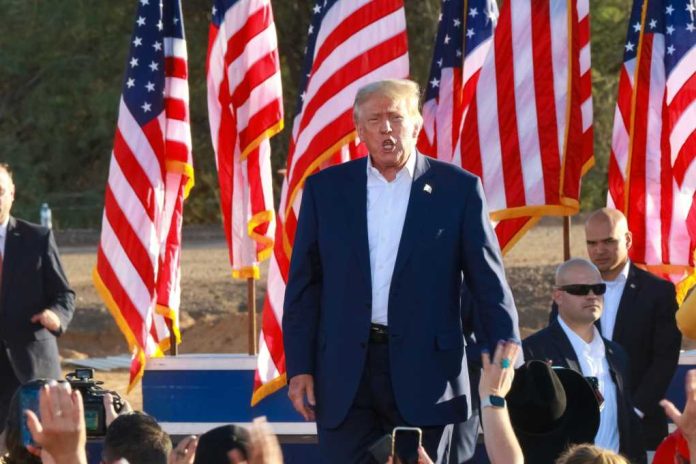
When a sitting president says the threat inside America is bigger than World War II or 9/11, it tells you just how frightened the people in charge say they are—while millions of Americans already fear the government itself is no longer on their side.
Story Snapshot
- President Trump says communism inside America is a “mortal threat” greater than World War II, Pearl Harbor, and 9/11.
- He links the danger to ideas he sees on the left, including democratic socialism and what he calls “Marxist lies.”
- News outlets and scholars say his claims are heavy on fear and light on hard evidence, framing the speech as partisan.
- Both conservatives and liberals who feel ignored by Washington hear the speech as another sign of deep division and elite power games.
Trump Raises Alarm About a “Mortal Threat” at Mount Rushmore
President Donald Trump used his America 250 speech at Mount Rushmore to warn that communism is a “mortal threat to American liberty” and the greatest danger the nation has ever faced. He told the crowd this threat is bigger than World War I, World War II, Pearl Harbor, or even the September 11 terrorist attacks, putting an internal ideological enemy above the wars and attacks that killed hundreds of thousands of Americans. For many listeners, that ranking sounded extreme but showed how seriously he wants people to take the issue.
Days before the Mount Rushmore event, Trump made similar comments at the White House when a reporter asked about the rise of socialist candidates backed by New York City Mayor Zohran Mamdani. Trump said what voters are told is “social democracy” is really communism and called it “the biggest threat to our nation since our founding.” He argued that soft language hides a hard ideology that would reshape America from the inside more than any foreign army could. Supporters heard a warning; critics heard a scare tactic aimed at the midterm elections.
What Trump Says Communism Looks Like Inside America
At Mount Rushmore, Trump went beyond foreign enemies and tied communism to ideas and people inside the United States. He said communism has been “totally normalized in the Democrat Party” and claimed the Communist Party is made up of “illegal immigrants, criminals, and everybody that doesn’t want to work.” He also attacked what he called “Marxist lies” such as “we live on stolen land” or that American heroes were oppressors, arguing these stories are meant to tear down the nation’s founding and open the door to a new, more radical system.
Trump framed communism as “the enemy of the Constitution and the enemy of July 4th,” painting it as the direct opposite of the country’s core values. He warned of “a resurgence of the communist menace in our land” and urged Americans to choose between being “a communist or a patriot, but not both,” turning a complex debate into a sharp either-or choice. He also spoke of a death toll of about 100 to 120 million people under communist regimes in the last century, using that number to show the human cost he believes the ideology brings, even though he did not cite a specific study or source for the figure.
Media and Expert Pushback: Rhetoric vs. Evidence
Major outlets, including National Public Radio (NPR), The Hill, and The New York Times, described Trump’s Mount Rushmore speech as “darkly political” and said it veered from traditional patriotic themes into culture war territory. Reporters noted that while Trump named Karl Marx and spoke about communists in U.S. cities, he did not identify specific Democratic politicians as communists or offer documents, court records, or membership lists to prove that communism is “normalized” in the Democratic Party. Critics argued that these claims sounded more like campaign lines than evidence-based warnings.
Commentary in USA Today and other outlets placed Trump’s language in a long pattern of “Red Scare” rhetoric in American history, where leaders use fear of internal enemies to rally their base. Scholars pointed to past eras, such as McCarthyism in the 1950s, when politicians blurred the line between real threats and political opponents, sometimes leading to blacklists, ruined careers, and civil rights violations. They said Trump’s focus on progressive Democrats, democratic socialists, and activists fits this pattern of treating left-of-center ideas as steps toward totalitarian rule rather than part of normal democratic debate.
Why This Speech Hits a Nerve in Today’s Distrustful America
Trump’s warning landed in a country where many people on both the right and the left already feel the system is rigged by powerful elites, often called the “deep state.” Decades of frustration over endless wars, Wall Street bailouts, rising housing costs, and political gridlock have convinced many citizens that Washington serves donors and bureaucrats first and regular people last. When a president says the greatest threat is an ideology he links to fellow Americans, it can sound to some like he is defending the people; to others, it feels like one more way to divide and distract from problems the government has failed to fix.
@BillClinton breaks down @POTUS's Mount Rushmore address on the eve of America's 250th anniversary—where Trump declared communism "the greatest threat" facing the nation, called @TheDemocrats "the Communist Party," pushed to eliminate the Senate…https://t.co/Lyi8OzWxES pic.twitter.com/FphbRTDVXs
— Carlyle Gordon/#NAFOfella (@lcby) July 9, 2026
Conservatives who resent woke agendas, globalist trade deals, high energy prices, and unchecked illegal immigration often hear Trump’s talk about communism as a label for policies they already dislike, a way to say those ideas would erase freedom and reward dependency. Liberals who worry about growing inequality, cuts to social programs, and discrimination against minorities often see the same speech as an attempt to silence critics by branding them enemies of the state. In both camps, there is a shared worry that leaders use big words like “communism” and “patriotism” less to solve problems and more to keep voters angry, loyal, and distracted while the deep state stays in charge.
Sources:
thegatewaypundit.com, instagram.com, youtube.com, facebook.com, whitehouse.gov, thehill.com, pbs.org, nbcnews.com, wsj.com, usatoday.com