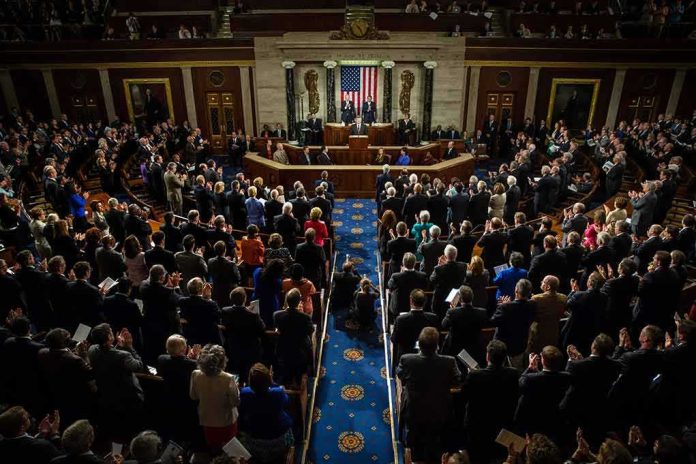
When both parties just killed a spy-power extension in the House, they accidentally exposed how little control Americans really have over who reads their emails and texts.
Story Snapshot
- The House rejected a bill to extend Section 702, the main law the government uses to tap foreign communications that also sweep in Americans’ messages.
- National security officials say losing 702 would blind the United States to terrorists, hackers, and hostile regimes that use American tech networks.
- Privacy advocates warn that 702 lets agencies search Americans’ calls, texts, and emails without a warrant through so‑called “backdoor searches.”
- The fight has scrambled party lines and deepened public anger that Washington protects secret powers better than it protects ordinary citizens’ rights.[2][6]
What Section 702 Is — And Why It Has So Much Power
Section 702 of the Foreign Intelligence Surveillance Act lets agencies like the National Security Agency collect emails, texts, and calls of non‑Americans overseas without getting a judge’s warrant first.[5] Officials say it was built after the September 11 attacks so they would not miss terrorists using U.S. email and phone systems again. Supporters now call it one of the country’s most critical tools for tracking foreign terrorists, hackers, drug cartels, and hostile governments.[7] Collected data is stored for years and searched in classified databases.[5][3]
The law is supposed to target only foreigners abroad, but when those people talk with Americans, the Americans’ side of the conversation is swept up too.[5] Intelligence officials openly describe this as “incidental collection” and admit it is built into how the program works. Oversight courts have approved rules for how agencies are supposed to minimize, or limit, how they keep and use that U.S. information.[3] But the same incidental design that makes 702 powerful also makes it dangerous in the eyes of many critics.
In their latest bout of Trump Derangement Syndrome, Democrats voted today to jeopardize our national security by blocking a clean extension of Section 702 of FISA—a vital tool for detecting foreign terrorist threats.
Make no mistake: Their recklessness endangers American lives.
— Tom Emmer (@GOPMajorityWhip) June 11, 2026
Why Both Security Hawks And Privacy Hawks Are Furious
National security leaders argue that letting 702 lapse, even for a short time, would create blind spots that enemies could quickly exploit.[7] Former officials say it helps track everything from Iranian and North Korean weapons work to Russian war planning, Chinese espionage, and international drug networks.[1][3] Some estimates claim more than a quarter of U.S. intelligence reporting has roots in data gathered under 702. For conservatives who focus on terrorism, border security, and foreign threats, losing that reach feels like Washington choosing political games over safety.
Privacy and civil liberties groups see almost the opposite problem. They point out that, in practice, 702 has enabled the government to gather “substantial quantities” of Americans’ private communications without warrants, then search them later. Analysts can run searches using Americans’ names, phone numbers, email addresses, or other personal identifiers to dig through this data. Critics call that a “backdoor search loophole” around the Fourth Amendment, which usually requires a warrant before the government reads a person’s messages. For many on both left and right, that looks less like targeted spying and more like a massive data sweep waiting to be abused.
Documented Abuses And Short‑Term Fixes That Did Not Restore Trust
Declassified court opinions and watchdog reports have found repeated violations of rules meant to protect Americans’ data collected under Section 702. Intelligence agencies and the Federal Bureau of Investigation have at times run queries that broke court orders or internal limits, including searches related to people inside the United States who were not clear foreign‑intelligence threats. Congress responded in 2024 by tightening querying rules, limiting Federal Bureau of Investigation searches, and ending some “abouts” collection that grabbed messages merely mentioning a target. Supporters claim those reforms fixed the worst abuses.[6]
Major civil liberties organizations argue the changes did not go nearly far enough.[4][5][6] They stress that the law still lets agencies retain and use large volumes of Americans’ communications for purposes that go far beyond terrorism, including some domestic crime and drug cases.[4][5] They warn that 702, sold as a foreign intelligence tool, has become a quiet channel for domestic surveillance without traditional warrants.[4] That feeds a broader belief, shared by many conservatives and liberals, that the security state always gets another chance, while ordinary citizens are told to simply trust secret courts and classified rules.
How The House Rejection Fits A Bigger Washington Pattern
Congress has handled Section 702 on repeated short deadlines, passing temporary extensions and punting tough choices about privacy and power.[1][5] The last big fight ended with the shortest renewal ever, a two‑year sunset that guaranteed the issue would explode again instead of being settled.[1] This latest House vote to block another extension fits that pattern: lawmakers waited until the last minute, split over basic protections like warrant requirements, and then failed to agree at all.[2] The result is more public confusion and less faith that anyone in Washington is acting for regular people.
The deeper worry for many Americans is not just one law, but a system that seems to serve itself. Intelligence officials, from both parties and both administrations, insist the country will be unsafe without sweeping digital powers.[7] Civil liberties experts warn that the same tools have been repeatedly misused against the very public they claim to defend. Meanwhile, lawmakers raise money, trade accusations on cable news, and then race from deadline to deadline without building a stable, constitutional framework for the digital age.[1][2][6] In that sense, the House’s failure to extend 702 without real reform is not just about spying; it is another sign of a government that many feel has stopped putting the American people first.
Sources:
[1] Web – US House rejects extension of key spy powers
[2] Web – The national security stakes could not be higher as the FISA Section …
[3] Web – It’s Time to Renew Section 702 of FISA Permanently – Lawfare
[4] Web – Judicial Oversight of Section 702 of the Foreign Intelligence …
[5] Web – FISA Section 702: Reform or Sunset
[6] Web – FISA Section 702’s Reauthorization Era
[7] YouTube – Section 702 of FISA: Privacy and Civil Liberties Reforms