
The most revealing part of the Columbia protest wasn’t the chanting—it was the moment 13 people chose chains over compliance and discovered New York City doesn’t negotiate with gridlock.
Story Snapshot
- NYPD arrested 13 anti-ICE demonstrators near Columbia University after they refused police orders to disperse.
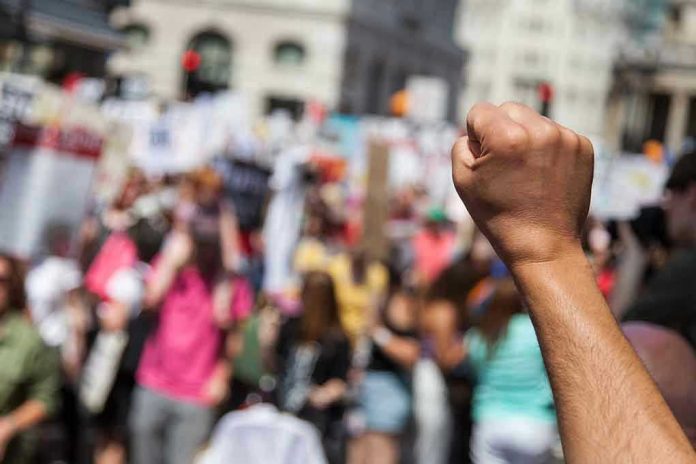
- Protesters wore matching “Sanctuary Campus Now” and “ICE Off Campus” shirts, signaling a coordinated campus-focused message.
- Video from the scene showed activists linking or chaining themselves as a tactic to slow removals and amplify attention.
- All 13 received criminal court summonses; reporting did not indicate injuries or additional charges at the time.
The location matters: this was Columbia, not Wall Street
Reports and video placed the arrests outside Columbia University in Manhattan, not at the New York Stock Exchange. That difference isn’t trivia; it changes the entire meaning of the protest. A Wall Street stunt targets markets and money. A Columbia action targets institutional culture and campus governance—pressuring administrators to adopt “sanctuary” policies and to publicly reject cooperation with federal immigration enforcement. That’s a different battlefield, with different leverage and consequences.
The NYPD response followed a familiar city script: officers gave orders, protesters refused, then custody followed. Police confirmed 13 people went into custody and received criminal court summonses. In practical terms, summonses often mean the system aims for quick processing and courtroom accountability rather than prolonged detention. The message still lands: civil disobedience may be “nonviolent,” but it’s not consequence-free when it blocks sidewalks, entrances, or police operations.
Chaining as theater: why activists use it and why police undo it fast
Chaining or linking bodies is less about physical strength and more about time. It forces officers to slow down, find tools, create space, and manage safety risks, all while cameras roll. The tactic also shifts the visual narrative: activists look determined; police look forceful even when they act carefully. That is the point. Activists gamble that the optics will build sympathy, recruit new supporters, and pressure Columbia to declare the campus off-limits to ICE.
NYPD has its own incentives to move quickly. New York’s public-order model treats obstruction as a spark that can spread, especially around high-profile institutions. When a small group successfully ties up a sidewalk or gate, copycats appear the next day with better prep and more bodies. A quick removal discourages escalation and keeps the city from signaling that chaining creates a “no-touch zone.” That approach aligns with a common-sense baseline: protest is protected; blocking lawful movement is not.
What “Sanctuary Campus” really means in practice
“Sanctuary campus” slogans sound simple until you translate them into policy. Universities can limit voluntary cooperation, require warrants for nonpublic areas, and provide legal resources to students. They can also direct staff on what information gets shared and when. What they cannot do is nullify federal law or physically block federal agents acting with proper authority. The tension sits right there: activists want categorical refusal; institutions tend to offer conditional compliance.
For readers who value order and clear lines of authority, the key question is accountability. A campus cannot promise absolute protection if it lacks legal power to deliver it. Selling an illusion of immunity can mislead the very people activists claim to defend. Common sense says universities should be honest about what they can and cannot do, and city authorities should enforce neutral rules consistently: the same standards for every cause, every crowd, every day.
Why this protest looked like 2024 all over again
Columbia has served as a magnet for headline-ready activism, and tactics travel. The city has seen waves of campus protest where barricades, linking arms, and chaining create dramatic removals and viral clips. Anti-ICE activism plugs into that playbook because it’s built for attention: clear villain, clear slogan, and a physical act that cameras understand instantly. The pattern matters because it suggests planning, not spontaneity, even when groups insist they’re just “responding.”
The open question is whether these arrests deter the next round or advertise it. Summonses can be treated by seasoned activists as a cost of doing business, especially if fundraising and social media reward the spectacle. That feedback loop is why communities get frustrated: residents and commuters pay the price in disruption while the organizers bank attention. Conservatives tend to call that what it is—performative politics—unless it pairs emotional claims with lawful, productive solutions.
What happens next: court dates, campus discipline, and the real pressure point
Criminal court summonses push the story into a slower, less glamorous arena: hearings, compliance requirements, possible fines, and a paper trail. Universities also have their own processes. Even when administrators avoid public statements, they often weigh student conduct rules, access restrictions, and safety planning behind closed doors. The most significant consequence may not be the courtroom—it may be whether Columbia tightens event rules, perimeter control, and coordination with city agencies.
NEW: Stunning video shows agitators being arrested after chaining their bodies to New York Stock Exchange in NYC amid nationwide May Day protests.
Group members were wearing black T-shirts that read, "NO WORK, NO SCHOOL, NO TRADING."
They could be heard shouting "billionaires… pic.twitter.com/VG1XVB06yN
— Fox News (@FoxNews) May 1, 2026
The unanswered issue—because the public reporting remains thin—is what, exactly, protesters demanded from Columbia in concrete terms and whether anyone in authority engaged them. One source and one viral-style video can show arrests, but they can’t fully explain the organizing network, funding, or decision-making. Readers should watch for court outcomes and for any formal university policy changes. That’s where the real story ends up: not in the chains, but in the paperwork.
Sources:
More than a dozen anti-ICE agitators hauled away by NYPD near Columbia University