
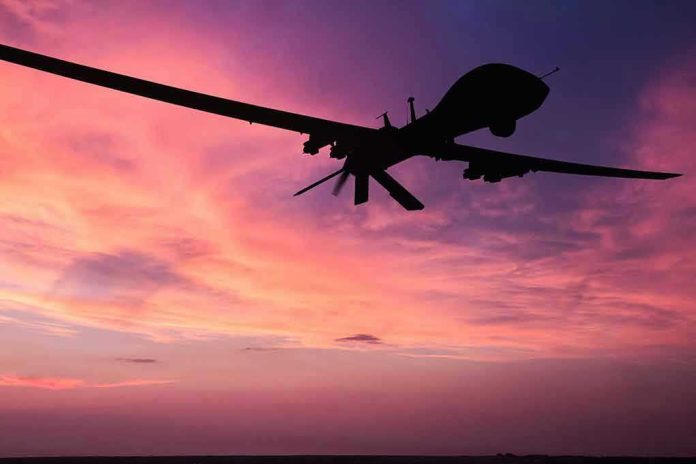
The Pentagon has done the unthinkable: it took Iran’s signature kamikaze drone, reverse‑engineered it, and turned it into a frontline weapon for U.S. forces in the Middle East.
Story Snapshot
- U.S. Central Command now fields LUCAS, a one‑way attack drone whose core design is based directly on Iran’s Shahed‑136 “kamikaze” drone.
- A U.S. official confirmed the military obtained an intact Shahed, reverse‑engineered it, and worked with American companies to field the LUCAS system.
- LUCAS costs about $35,000 per unit, giving CENTCOM a cheap, long‑range, autonomous strike option in a new drone/AI task force.
- The move signals to Iran that its asymmetric drone advantage is eroding and marks a shift toward attritable, massed drone warfare in U.S. doctrine.
How Iran’s Weapon Became America’s
The Shahed‑136 is a simple, propeller‑driven loitering munition Iran designed to saturate defenses with cheap, long‑range strikes. Russia adopted it as the Geran‑2 and used it in large numbers against Ukrainian infrastructure, proving that slow, inexpensive drones can impose heavy costs on high‑end air defenses. The U.S. took notice. Instead of just building a new system from scratch, CENTCOM obtained an intact Shahed‑136, reverse‑engineered it, and partnered with several U.S. companies to create LUCAS, a near‑clone now fielded as an operational weapon.
This is not a one‑off experiment. LUCAS is a low‑cost, scalable, long‑range one‑way attack drone deployed within CENTCOM’s area of responsibility, primarily the Middle East. It operates beyond line of sight, can be launched from mobile ground platforms and vehicles, and is designed for autonomous flight to pre‑programmed targets. CENTCOM describes it as a cutting‑edge capability at a fraction of the cost of traditional U.S. long‑range strike systems. A U.S. official put it bluntly: the LUCAS drone “pretty much follows the Shahed design.”
A New Kind of CENTCOM Task Force
LUCAS is not flying alone. CENTCOM has stood up a dedicated task force focused on one‑way attack drones, autonomy, and artificial intelligence, integrating LUCAS into a broader uncrewed ecosystem. This unit reflects a shift from relying solely on exquisite, expensive platforms to embracing attritable, massed systems that can be used flexibly across a vast, contested theater. The task force is designed to deploy and integrate these drones alongside other uncrewed assets and AI‑enabled targeting, creating a networked, scalable strike capability that can respond rapidly to threats from Iran and its partners.
The Shahed‑136’s success in Ukraine highlighted a fundamental cost‑imposition problem: cheap drones forcing defenders to burn expensive interceptors and high‑end air defenses. CENTCOM’s environment is even more demanding, with Iranian drones, missiles, and proxy groups operating across Iraq, Syria, Yemen, and the Red Sea. LUCAS gives U.S. forces a cheap, long‑range option for striking static or lightly defended targets, complementing missiles and manned aircraft. It also provides a tool for limited, deniable, or lower‑signature strikes, which may make retaliation and tit‑for‑tat exchanges more politically manageable.
What This Means for Iran and the Region
The deployment of LUCAS is as much a psychological and strategic signal as it is a tactical capability. By openly fielding a Shahed‑style drone, CENTCOM is telling Iran that its asymmetric advantage in cheap, massed drones is eroding. Iran can no longer count on its drone designs giving it a unique edge; the U.S. can now replicate and counter those systems at scale. This undermines Iran’s ability to use drones as a low‑cost, high‑impact tool against U.S. forces, allies, and commercial targets in the region.
For regional actors, the implications are clear. Iran and its partners may respond by producing more advanced, stealthier, or faster one‑way drones, or by investing more heavily in counter‑autonomy and electronic warfare. Gulf states, Israel, and others will face an environment where both U.S. and Iranian/proxy forces field increasingly sophisticated and numerous loitering munitions. Civilian populations and critical infrastructure remain vulnerable to strikes that are cheap, hard to stop, and often used against dual‑use targets, raising persistent concerns about collateral damage and psychological impact.
The Bigger Shift in U.S. Warfare
LUCAS is not just a new drone; it is a symbol of a deeper doctrinal shift. The U.S. is moving away from exclusive reliance on exquisite, expensive platforms toward a model of mass, attritable, networked systems. This shift is driven by the need to counter low‑cost threats at a sustainable cost and to maintain overmatch in an era where adversaries can field large numbers of simple, effective weapons. Once the U.S. openly copies an adversary’s design and fields it as a frontline weapon, it normalizes “drone cloning” and accelerates the diffusion of effective designs like the Shahed‑136.
The economic and political effects are significant. LUCAS costs about $35,000 per unit, a tiny fraction of the price of a missile or manned strike aircraft. That lower per‑shot cost may reduce immediate expenditures per strike but could increase the total volume of drone operations, reshaping defense budgets and industrial priorities. It also gives policymakers more flexible military options, which can be politically attractive but may lower the threshold for kinetic action. Critics argue this expands a model of mass drone strikes seen in Gaza and Ukraine, raising ethical questions about autonomy, proportionality, and accountability when systems are pre‑programmed and cheap.
Sources:
U.S. Deploys Shahed‑136 Clones To Middle East As A Warning To Iran – The War Zone (The Drive)
US clones Iranian one-way attack drone as it builds own kamikaze fleet – The Canary
U.S. Deploys Iranian Drone Copy In Middle East Unit – Aviation Week