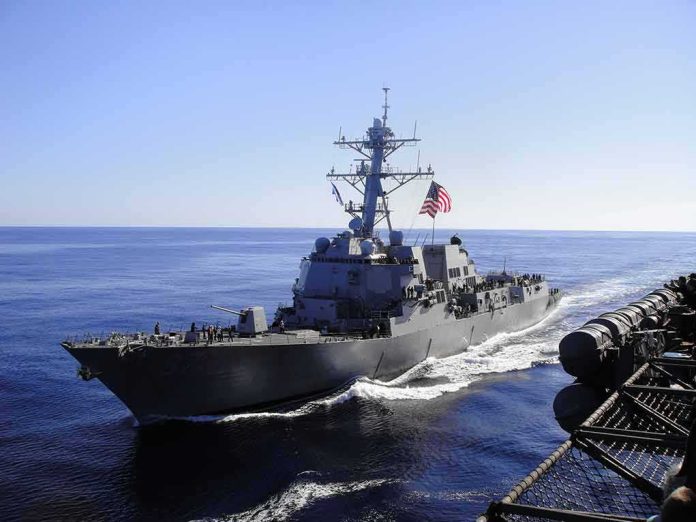
A front-line U.S. Navy destroyer went dark for four days in the South China Sea after a generator failure, leaving 300 sailors without power, air conditioning, or working toilets.
Story Snapshot
- The Navy says USS Benfold lost power on July 24 due to a generator-related casualty.
- The ship was towed to Subic Bay on July 28; power was restored July 30.
- Repairs finished Aug. 7; the destroyer departed Aug. 8 and returned to duty.
What Happened: A Total Power Loss At Sea
U.S. Seventh Fleet officials said the guided missile destroyer USS Benfold (DDG-65) reported an “engineering casualty” involving its generators on July 24, 2026, during routine operations with the George Washington Carrier Strike Group in the South China Sea. The failure caused a full loss of power. Navy spokesman Commander Matthew Comer said key services stopped, including galley operations, toilets, and air conditioning. The Navy reported no injuries to the crew during the outage.
The Navy arranged a tow on July 28 and took the ship to Subic Bay in the Philippines for repairs. Reports citing Navy officials said power returned on July 30. Repair teams from the Ship Repair Facility, Japan Regional Maintenance Center worked the issue. They completed repairs on August 7. Benfold departed Subic Bay on August 8 and later reached its forward base at Yokosuka, Japan, resuming operations after checks.
Conditions On Board And The Human Toll
Navy statements confirm that sailors went days without air conditioning, toilets, or normal meal service because power was out. Secondary outlets described extreme heat and tough living conditions, including reports relayed by family members. Those accounts add color but are not official records. The Navy’s on-record details still show significant hardship. Losing cooling, sanitation, and cooking at sea is taxing even for trained crews, especially in tropical heat.
Comer praised the crew’s response, citing “resilience” and “professionalism,” which matches standard Navy language after major casualties. That tone reflects a focus on seamanship under stress. It also underscores how fast a single engineering fault can ripple across daily life onboard. When ship service power fails, modern destroyers lose more than propulsion. They lose the basic systems that allow 300 people to live and work safely in a steel box at sea.
Timeline Of Recovery And Readiness Implications
Public reports align on a tight sequence: blackout on July 24, tow on July 28, power restored July 30, repairs done August 7, and departure August 8. The dates show a contained crisis with a measured response. Towing to a regional yard put the ship near parts, labor, and pier-side services. That choice likely sped repairs. The Navy has not yet released a deeper technical root cause. Officials have only described a generator-related casualty.
The incident also fits a wider readiness story. Independent reviews by the Congressional Budget Office and the Government Accountability Office have documented chronic maintenance delays for large conventional Navy ships, including destroyers. Analysts estimate Arleigh Burke-class destroyers may spend close to a quarter of their lives in maintenance, cutting into available days at sea. That pressure can strain crews and systems and can raise the odds that a single failure has large effects.
Why Both Parties Should Care About The Fix
Ship reliability is not a niche Navy problem. It is a national security and taxpayer issue. When a forward-deployed destroyer goes dark, the United States loses presence and deterrence for as long as the ship is offline. Congress has heard warnings for years that deferred work and high operational tempo shorten service life and reduce readiness. That trend hurts every community that depends on secure trade routes and stable fuel and food prices tied to open seas.
U.S. Destroyer USS Benfold Stranded in South China Sea for 4 Days Due to Power Outage — The U.S. Seventh Fleet confirmed the incident. pic.twitter.com/r49gaHOTSa
— Far East Post (@FarEastPos3t) August 18, 2026
The Benfold crew’s safe recovery is a credit to training and to partners in the Philippines. But lasting progress will come from fewer breakdowns, faster repairs, and clearer public reporting. Lawmakers and Pentagon leaders will likely revisit funding for maintenance, spare parts, and sailor-led upkeep programs flagged by recent watchdog reports. Voters across the spectrum want ships that work when needed. That starts with fixing what breaks and preventing the next blackout before it happens.
Sources:
zerohedge.com, opex360.com, reddit.com, gao.gov, rand.org, ideas.repec.org, stripes.com, govinfo.gov