

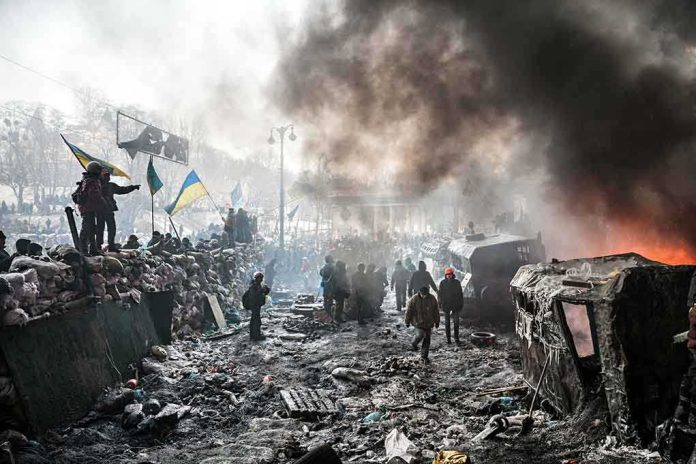
A Russian drone struck Ukraine’s main security headquarters in central Kyiv, hitting a core state target steps from a UNESCO site, officials said.
Story Highlights
- Ukrainian leaders said a Russian drone hit the Security Service of Ukraine headquarters in downtown Kyiv.
- Officials said the drone aimed at the acting security chief’s office; smoke and injuries were reported.
- Ukraine’s deputy foreign minister called it a serious escalation that demands a firm response.
- The strike fits a wider 2025–2026 air war trend targeting command and control sites.
Strike On Ukraine’s Security Service In Central Kyiv
Ukrainian officials said a Russian drone hit the Security Service of Ukraine headquarters on Volodymyrska Street in central Kyiv on September 4. President Volodymyr Zelenskiy said the drone aimed for the office of the agency’s acting head, Oleksandr Poklad. Reporters described heavy black smoke rising from the site. Kyiv’s mayor reported injuries from the broader attack window, though counts varied across outlets as events unfolded.
Local media and international wires placed the strike near St. Sophia Cathedral, a United Nations Educational, Scientific and Cultural Organization World Heritage site. Deputy Foreign Minister Andriy Sybiha called the attack a serious escalation and said it showed Moscow’s stance toward diplomacy. His warning stressed both the symbolic target and the cultural risk near a protected landmark in the city center.
Why This Target Matters For The War
Strikes on headquarters and command posts are not random. Militaries hit these sites to disrupt decision making, planning, and communications. Analysts and official reports have tracked this pattern on both sides since late 2025. The Institute for the Study of War noted a sharper tempo of mid and long range attacks on logistics and command nodes as the air war expanded in 2026. The Kyiv strike fits that pattern of going after the brain of the state’s security arm.
Hitting a core security building in daylight also sends a message. It tells citizens that no place is fully safe and pressures leaders to divert resources to defense and repairs. That is why Ukrainian officials framed the attack as an escalation that warrants a response. At the same time, early injury totals differed among newsrooms, which often happens in fast moving events. Those figures tend to settle after emergency services complete their counts.
Links To A Larger Campaign Of Long-Range Strikes
This event sits inside a larger, grinding air campaign. Independent conflict trackers recorded thousands of Russian air or drone strikes in 2026, while Ukraine increased its own medium range operations against Russian forces and infrastructure. That tit for tat has normalized the language of “decision making centers” and “command posts” across official statements and daily briefings, making days like this more common than rare.
A Russian drone struck the headquarters of the Security Service of Ukraine (SBU) in central Kyiv on the afternoon of Friday, September 4, 2026. The precision daytime strike, which sent thick plumes of black smoke over the historic heart of the capital near the UNESCO-listed #News
— GodfreyDubon (@GodfreyDubon) September 4, 2026
For Americans watching from afar, the lesson is simple and sobering. Modern war reaches deep into cities and national institutions, not just front lines. When a drone can hit a security headquarters beside a priceless church, it shows how fragile critical systems and heritage can be during conflict. Leaders face hard tradeoffs: shield civilians and culture, keep command functions running, and avoid steps that widen the war. Those choices carry costs that ordinary people often bear.
Sources:
kyivpost.com, meduza.io, sud.ua