

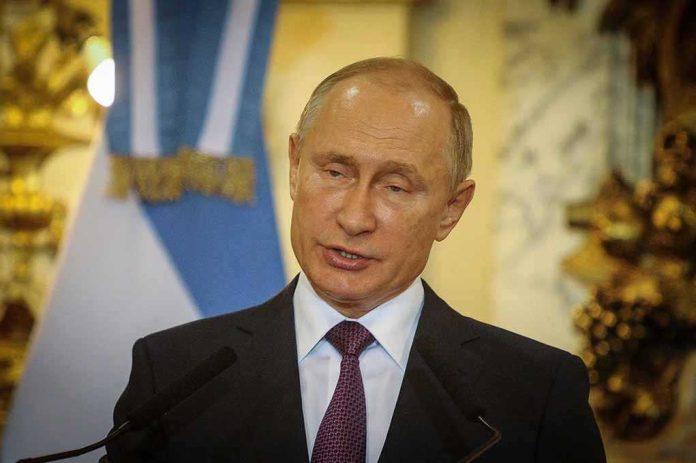
Trump says Russia will ship millions of tons of diesel to the U.S. and world markets to bring down fuel prices that are squeezing farmers and truckers.
Story Highlights
- Trump said Vladimir Putin agreed to send more than 300,000 tons of diesel right away, 500,000 tons in November and 1,000,000 tons after that.
- Diesel averaged about $6.26 a gallon last month, and the cost is landing hardest on farmers, ranchers and truckers.
- The Treasury Department issued a temporary license so Russian diesel can be sold on world markets without breaking U.S. sanctions.
- Russia’s government said it is ready to supply oil and fuel to the U.S. and other markets.
President Trump announced the deal on Truth Social, his social media site, after what he called a “highly successful discussion” by phone with Russian President Vladimir Putin on Friday, October 9. The goal is to pull down diesel prices, which have climbed amid the war with Iran and Ukrainian strikes on Russian oil refineries. Diesel runs the trucks, tractors and building equipment that grow and move nearly everything Americans buy, so its price shows up in grocery bills too.
What Trump Announced
Trump said Russia would “immediately supply over 300,000 Tons of Diesel Fuel to the American and Global Marketplace.” He said 500,000 tons would follow in November and 1,000,000 tons right after that. He also said Russia would deliver 3,000,000 more tons “within a short period of time,” depending on the condition of its diesel refineries.
“Lower prices for Americans, especially our Great Farmers, Ranchers, and Truckers, is my Greatest Priority,” Trump wrote. At the White House, he said diesel prices “will come tumbling.”
Who the High Prices Hurt
AAA, the motor club that tracks fuel costs, put the national diesel average at $6.28 a gallon, up from $3.68 a year ago. Diesel first topped $6 a gallon right before Labor Day weekend and hit a record on Sept. 22.
Farmers pay it to run tractors and harvest crops. Truckers pay it on every load they haul. Several trucking and freight businesses filed for bankruptcy in September as fuel costs rose. Because diesel moves food and goods across the country, a high price at the truck stop works its way into the price of nearly every product on store shelves.
How Treasury Cleared the Way
The Treasury Department issued a temporary license, a written permission that lets companies buy, ship and sell Russian diesel without breaking U.S. sanctions. Those sanctions are penalties the U.S. placed on Russia’s energy business after its 2022 invasion of Ukraine. Under the license, the sanctions will not apply until April 2027 to Russian diesel loaded onto tankers as of Friday.
It is the first license since the war in Ukraine began to ease diesel sanctions for longer than the usual 30 days. The White House has not said who will pay for the fuel or when it will reach American buyers.
What Russia and Critics Said
Putin confirmed the call, which ran about an hour and a half. He said Russia “confirmed its readiness to supply oil and oil products to the American and global markets.” Alexander Novak, Russia’s deputy prime minister, said Russia was “immediately starting to lift restrictions on diesel exports ahead of schedule” and that supplies to the U.S. could begin in October. Russia has barred diesel exports since July because Ukrainian attacks on its refineries cut its own supply.
Ukrainian President Volodymyr Zelenskyy called the move “a weak decision, unfortunately, a weak decision by strong partners.” Democratic Sens. Chuck Schumer, Jeanne Shaheen and Elizabeth Warren called it a betrayal of Ukraine and of U.S. allies in Europe. The deal also runs against a sanctions law Trump signed in September, which calls for tariffs, or import taxes, of up to 100% on the five biggest buyers of Russian oil and gas.
What Comes Next
The first 300,000 tons is the first test, followed by the November shipment. Some energy experts expect only a small change at the pump. Asked about the effect on prices, Clayton Seigle of the Center for Strategic and International Studies, a Washington research group, said, “I think probably not much.” Michael Lynch of the Energy Policy Research Foundation, an energy research group, said Russia’s current customers would likely have to find fuel elsewhere, which would keep prices about where they are.
Earlier that week, Trump signed a separate order that temporarily lets drivers use red-dyed diesel, a farm fuel that skips the 24.4-cent federal diesel tax, on highways. For farmers and truckers, the real measure of both moves will be the number on the pump in the weeks ahead.