

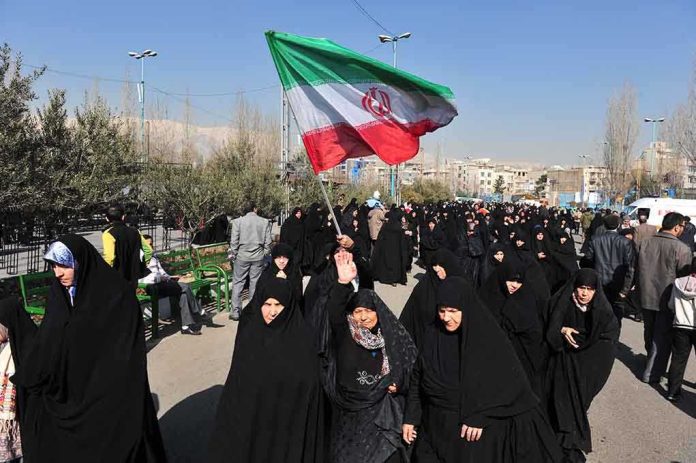
Iran’s regime is now putting children in front of American firepower—literally—by urging families to form “human chains” around power plants and bridges as President Trump’s deadline looms.
Quick Take
- Iranian state messaging has promoted “human chains” around critical infrastructure, with officials describing participation by youths as young as 12–13.
- The mobilization comes as President Donald Trump pressures Tehran to reopen the Strait of Hormuz by a Tuesday night deadline, with strikes threatened against power plants and bridges.
- U.S.-Israeli strikes continued Tuesday, and Iranian officials reported civilian casualties in Alborz Province, including children.
- Human-shield imagery appears designed to deter strikes and generate international backlash, even as Iran’s IRGC and Basij networks drive internal mobilization.
Tehran’s “Human Chains” Put Children on the Front Line of a Deadline Crisis
Iranian state-linked outlets and officials have promoted a nationwide effort to place civilians around key infrastructure—especially power plants and bridges—as a deterrent to threatened U.S. strikes tied to President Trump’s demand that Iran reopen the Strait of Hormuz. Reports describe volunteers numbering in the millions and public calls for parents to send youths to checkpoints and logistics roles. The most controversial claim is that children as young as 12–13 are being encouraged to participate.
Iran has framed the mobilization as a patriotic “people’s defense” and a symbolic barrier to foreign attack, but the tactical effect is straightforward: surround targets with noncombatants so any strike risks mass civilian deaths and a propaganda bonanza. Even when participation is described as “voluntary,” Iran’s internal security apparatus has long relied on social pressure and state-organized turnout. Independent verification of the youngest participants’ ages remains limited, and much of the messaging is sourced to Iran’s own outlets.
How the U.S.-Iran Escalation Reached This Point
The current standoff sits inside a wider U.S.-Israeli air campaign that began in late February 2026 and has expanded into sustained strikes against Iranian sites and transportation nodes. That broader conflict has already produced allegations of unlawful harm to civilians, including scrutiny over a February strike connected to a school in Minab that killed large numbers of children. Human-shield tactics in April fit a grim pattern: as military pressure rises, civilians—especially children—become tools in the information war.
Iran’s leadership appears to believe that concentrating civilians at politically sensitive sites can reshape Washington’s cost-benefit calculus, particularly around energy infrastructure that affects daily life and international markets. At the same time, the Trump administration’s approach—setting a clear deadline tied to Hormuz—signals a preference for leverage through explicit consequences. For American voters exhausted by endless wars, the key question is whether deterrence can be maintained without sliding into images of children caught between regimes and missiles.
What’s Known About Casualties and Claims—And What Isn’t
As the Tuesday deadline neared, strikes reportedly continued on railways, bridges, and energy-related hubs, and Iranian officials reported civilian deaths in Alborz Province, including children. Separately, human rights organizations have argued that earlier strikes failed to adequately protect civilians, while UN voices have demanded accountability regarding attacks on schools. Those claims add international pressure, but they also highlight the fog of war: casualty counts can vary, verification can be difficult, and both state and non-state actors shape narratives to influence foreign publics.
Why Human Shields Matter to Americans Watching From Home
Human-shield strategies are designed to exploit the West’s legal and moral restraints—restraints that distinguish a constitutional republic from a police state. Iran’s reported recruitment of minors is particularly inflammatory because it turns children into strategic assets. For conservatives who already distrust global institutions and elite narratives, the episode also underscores a hard truth: authoritarian regimes often gamble that U.S. leaders will be blamed no matter what they do. For liberals worried about civilian harm, the same episode raises the question of whether Tehran is deliberately manufacturing tragedies to constrain U.S. options.
In practical terms, the administration faces two competing imperatives: maintain credible deterrence around a strategic chokepoint, while minimizing civilian casualties and denying Tehran a propaganda victory. With Republicans controlling Congress, Trump has more room to sustain pressure, but that does not eliminate operational and diplomatic tradeoffs. What remains clear from available reporting is that Iran’s public messaging has elevated civilians—possibly including children—to the center of its defensive posture, making every next step riskier.
Sources:
Trump says “whole civilization will die tonight” as strikes on Iran continue and deadline nears
U.S. Responsible for Killing Over 100 Children in Iran School Attack
UN experts strongly condemn deadly missile strike on girls’ school in Iran, call for accountability