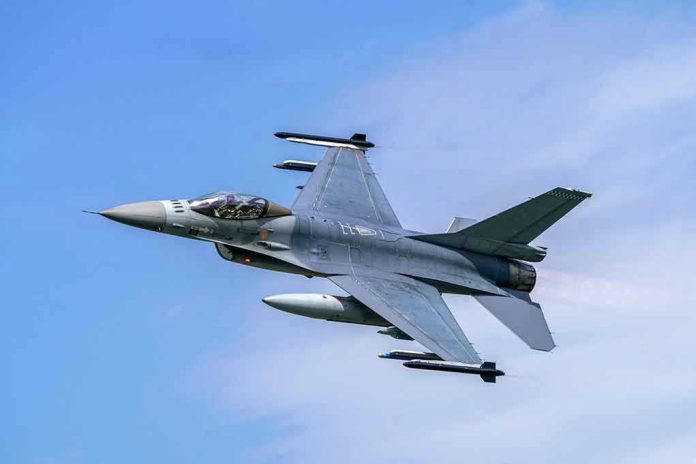
The Pentagon’s spending on F-35 jets reveals a staggering oversight in accountability that raises serious questions about military expenditure.
Story Overview
- The Pentagon paid $1.7 billion for underperforming F-35 jets.
- Lockheed Martin faced no financial penalties despite failing performance metrics.
- The F-35 program is the most expensive in U.S. military history.
- Operational capability of the jets fell significantly below expectations.
Pentagon’s Costly Gamble
The Department of Defense has long been under scrutiny for its substantial investments in military technology, but the latest revelations about the F-35 program highlight a new level of concern. Lockheed Martin, the defense contractor responsible for producing the F-35 jets, received $1.7 billion from the Pentagon for aircraft that failed to meet performance standards. This payment occurred despite the jets being operational only half the time, a significant shortfall from the Department of Defense’s minimum requirements.
The Pentagon’s Inspector General has pointed to a lack of accountability in the F-35 Joint Program Office, which did not enforce adequate performance metrics on Lockheed Martin. This oversight has led to a situation where taxpayers are funding a program with insufficient return on investment. The decision to proceed with a $1.6 billion contract in June 2024 for further work on all three variants of the F-35, despite these issues, adds another layer of controversy.
Unmet Expectations
The F-35 jets were expected to be a game-changer in military aviation, but their performance has fallen short of expectations. In 2024, these aircraft were operational only about 50% of the time, missing the Defense Department’s targeted operational capability by a striking 17 percentage points. This performance gap underscores the challenges of maintaining complex military technology while adhering to budgetary constraints and operational demands.
The absence of financial penalties for Lockheed Martin raises questions about the mechanisms in place to ensure defense contractors deliver on their promises. The lack of punitive measures could potentially set a precedent for future contracts, suggesting that performance metrics are negotiable rather than mandatory.
The Broader Implications
The F-35 program stands as the costliest military initiative in U.S. history, with projected expenses soaring above $2 trillion. This staggering figure reflects not only the high cost of developing cutting-edge technology but also the financial commitments required to sustain and maintain these aircraft over their operational lifetime. Critics argue that such an investment demands greater transparency and accountability, particularly when taxpayer money is at stake.
The current situation is a wake-up call for policymakers and defense officials alike, emphasizing the need for stringent oversight and clear performance benchmarks. As the F-35 program continues to evolve, the lessons learned from its shortcomings could inform future defense spending strategies, potentially leading to more efficient and effective allocation of resources.
Looking Forward
The Pentagon’s handling of the F-35 program offers an opportunity to recalibrate its approach to military procurement and contractor accountability. As discussions around defense spending intensify, it is essential to reconcile the need for advanced military capabilities with fiscal responsibility. Ensuring that defense contractors like Lockheed Martin are held to rigorous performance standards is crucial to maintaining the integrity of U.S. military investments.
While the F-35 program’s challenges are evident, they also present a chance to redefine the relationship between the Pentagon and its contractors. By prioritizing accountability and performance, the Department of Defense can better safeguard taxpayer dollars while advancing the nation’s defense objectives.