

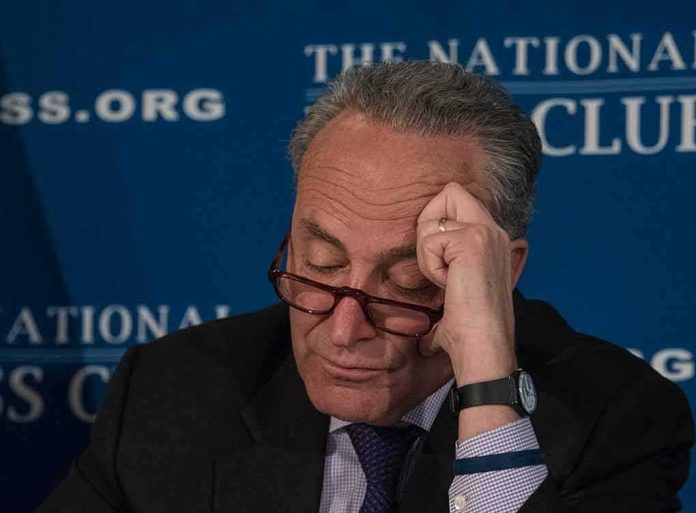
Chuck Schumer says he will run again to lead Senate Democrats, but some of his own party’s Senate candidates won’t promise him their votes.
Story Highlights
- Schumer, the Senate Minority Leader, says he is running for another term as Democratic leader whether his party wins or loses in November.
- Kansas Democrat Adam Hamilton says he won’t back Schumer for leader at all, calling for “fresh leadership.”
- Michigan’s Abdul El-Sayed and Minnesota’s Peggy Flanagan have declined to say whether they would support him.
- Michigan Sen. Elissa Slotkin says her party needs “significant new leadership.”
Schumer Says He Is Staying
Schumer, a New York Democrat who has led Senate Democrats since 2017, made his plans clear in an interview: “I am running for re-election for leader. Period.” He said he plans to stay in the top job after the November 3 midterm elections, win or lose, a vow he made on Wednesday, September 30.
The reason some Democrats want a change is plain. Candidates like Kansas nominee Adam Hamilton say the party needs new ideas and fresh leadership at the top. Democrats have grumbled in private about Schumer since Republicans won the Senate in 2024. Those complaints came back twice in 2025, first when Schumer refused to allow a government shutdown early in President Trump’s term, and again when he could not stop Democrats from breaking ranks to end what became the longest full shutdown in history.
The Candidates Who Won’t Commit
Adam Hamilton is the Democratic nominee running against Republican Sen. Roger Marshall in Kansas. He has said he won’t support Schumer as leader whether Democrats end up in the majority or the minority. “And no disrespect for him at all, it’s just that I think we need new ideas,” Hamilton said. “We need new ideas, we need fresh leadership.”
Abdul El-Sayed, who won Michigan’s Democratic Senate primary over the candidate Schumer backed, has stayed noncommittal on the leader’s race both before and after that win.
Peggy Flanagan, Minnesota’s lieutenant governor and the Democratic Senate nominee there, has also declined to say where she stands. Both El-Sayed and Flanagan have taken money from Senate Majority PAC, a political spending group closely tied to Schumer that works to elect Democratic senators.
Senators Keep Their Distance, Too
Some sitting Democratic senators are careful as well. Slotkin, a first-term senator from Michigan, said, “That’s why I believe we need significant new leadership,” and added, “The old models are no longer working, and that includes the Democratic Party.”
Sen. Chris Van Hollen of Maryland, who has backing from some progressives as a possible Schumer replacement, has declined to say whether he would run against him. In September he said the midterms were “all I am focused on.” Sen. Chris Murphy of Connecticut brushed off a question about whether winning the Senate back would make Schumer stronger: “I’m not doing those questions now.”
Why It Matters to You
If Democrats win the majority, their leader decides which bills get a vote and which nominees move forward, including judges who serve for life. Democrats choose that leader by a vote of their caucus, the group of all Democratic senators, after the election. Every new Democratic senator is one more vote in that room.
That is why these answers count. Schumer wants to stay. One candidate he needs for a majority says he wants someone new, and two others, both helped by a group close to Schumer, won’t say. These are their stated positions as of October 9, and they show a party arguing with itself about its own future just weeks before Election Day.
Sources:
washingtonexaminer.com, news4jax.com, apnews.com