

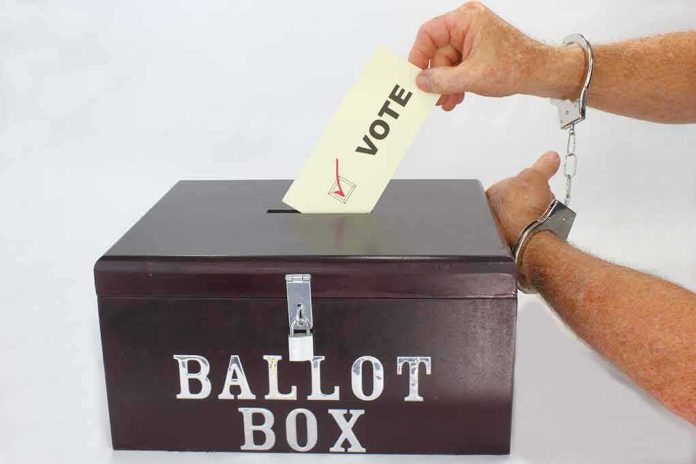
Texas Attorney General Ken Paxton’s office has arrested convicted felons accused of voting in Harris County while still on parole, which Texas law says bars them from casting a ballot.
Story Snapshot
- Paxton announced on Saturday, October 31, that his office arrested convicted felons for illegal voting.
- A citizen’s tip on October 27 said felons in prison, on parole or on probation had voted in Harris County.
- State prison officials confirmed several of them were on parole when they voted.
- Judges in Montgomery County issued the arrest warrants on Friday, October 30.
Arrests Announced After Focused State Investigation
On Saturday, October 31, Texas Attorney General Ken Paxton announced that officers from his office had arrested convicted felons accused of illegally casting ballots in the 2026 election. Paxton said his office “arrested convicted felons for voting illegally in Texas.” The reason for the arrests is simple: under Texas law, a person convicted of a felony cannot vote until every part of the sentence is done, and that includes parole.
The office has not released the names of those arrested, how many there are, or the exact charges each one faces. Judges in Montgomery County, north of Houston, issued the arrest warrants on Friday, October 30, and officers from the Attorney General’s Office carried them out. The work was led by the office’s Election Integrity Unit, a team that looks into possible election crimes. The office says the investigation is ongoing and more arrests or charges could follow.
Citizen Tip Triggered Targeted Review
The case began with one tip. On Tuesday, October 27, a citizen filed a complaint with the Election Integrity Unit. The person said that convicted felons who were in prison, on parole or on probation had registered and voted in Harris County, and sent along publicly available information to back it up.
State analysts then checked who the people were, looked at their voter registration records and reviewed whether they had voted in the 2026 election. They asked the Texas Department of Criminal Justice, the state agency that runs prisons and parole, to confirm each person’s status. “So far, TDCJ has confirmed that multiple individuals were on parole when they cast their ballots, rendering them ineligible to vote under Texas law,” the office said.
What Texas Law Says
Under the Texas Election Code, a person with a final felony conviction loses the right to vote for a time. That right comes back only after the whole sentence is finished, including any prison time, parole, probation or community supervision, or after a full pardon.
Voting when you know you are not eligible is a crime called illegal voting. In Texas it is a second-degree felony, a serious charge that carries 2 to 20 years in prison. Those arrested are accused, not convicted, and they keep the presumption of innocence while their cases move through court.
Why This Matters To Election Security
The timeline moved fast. A private citizen flagged possible illegal votes on a Tuesday. State analysts checked the claim against voter and prison records. Judges signed warrants that Friday, and Paxton announced the arrests the next day. Paxton tied the arrests to protecting honest voters. “We will continue working to protect the lawful votes of Texans,” he said.
The arrests came days before Election Day on Tuesday, November 3. Matching voter rolls against prison and parole records is one way the state says it catches those votes.
What Comes Next In The Legal Process
Prosecutors will decide which charges to bring against each person, and courts will judge the evidence. If more arrests follow, the state may release more details, such as names and the number of people charged.
Texans who finished a felony sentence and have their voting rights back can check their status with their county election office before they vote. Anyone who suspects voter fraud can report it to the county election administrator or to the Texas Attorney General’s Office.
Sources:
ksstradio.com, texasattorneygeneral.gov, ktrh.iheart.com, wbap.com, thecentersquare.com